



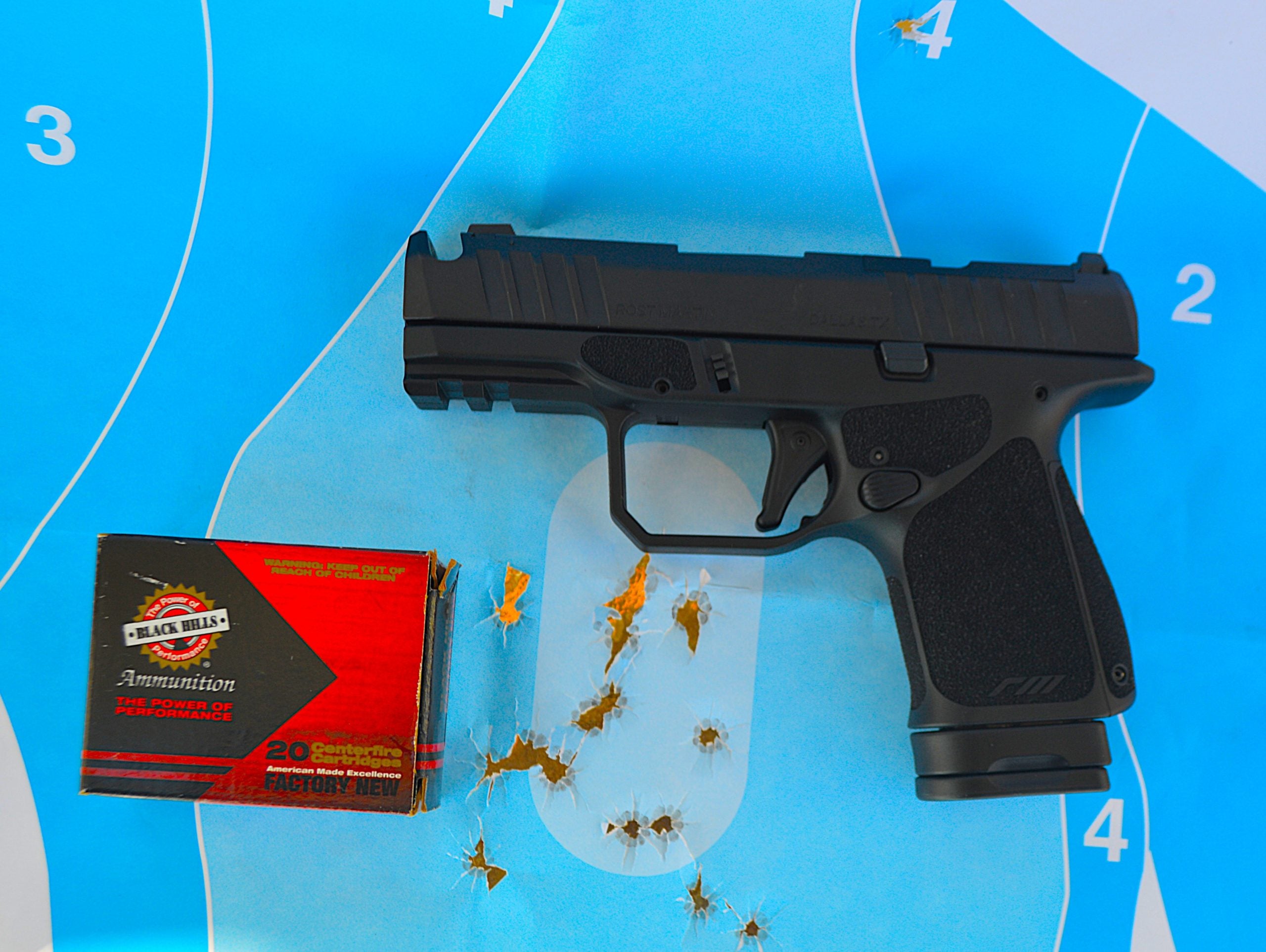

In today’s market of plug-and-play technology, five hundred dollars is a middle-of-the-road price for a polymer-frame, striker-fired handgun.
While some pistols cost more and some less, at this price, a shooter should expect a reliable handgun. Budget isn’t the only factor in choosing a pistol, but most of us have a finite budget. At just over $500 retail, the Rost Martin RM1S leaves room for ammunition, a holster, and training.
The original Rost Martin 9mm handguns are well established. The RM1S Comped is a version with an integrated compensator, making for an interesting combination.
Rost Martin RM1S Specifications
- Type: Recoil-operated, locked-breech, striker-fired, semiautomatic
- Cartridge: 9mm Luger
- Capacity: 12+1, 15+1
- Barrel: 3.6 in., forged steel, ported
- Length: 6.7 in.
- Height: 4.6 in. / 5.1 in.
- Width: 1.24 in.
- Slide: Steel
- Finish: Nitride
- Weight: 19.7 oz.
- Grip: Polymer, textured, black
- Trigger: 4.5 lbs.
- Safety: Trigger lever; internal striker drop safety
- Sights: Steel; white-dot front, U-notch rear; optic-ready with RMR plate
- Accessories: One 12-rd mag; one 15-rd mag; cable lock; three backstraps; RMR-pattern plate
- MSRP: $469
- Manufacturer: Rost Martin, 844-237-2890, rostmartin.com


Testing the RM1S Comp
The pistol was unboxed, examined, and found to be well-made of good material. I field-stripped the pistol and found no obvious tool marks or defects. The 9mm was lubricated along the bearing surfaces and barrel hood. Shooting tests are important. I may allow a break-in malfunction or two, but modern polymer-frame handguns seldom need break-in. Before discussing the firing tests, let’s look at the pistol’s background.
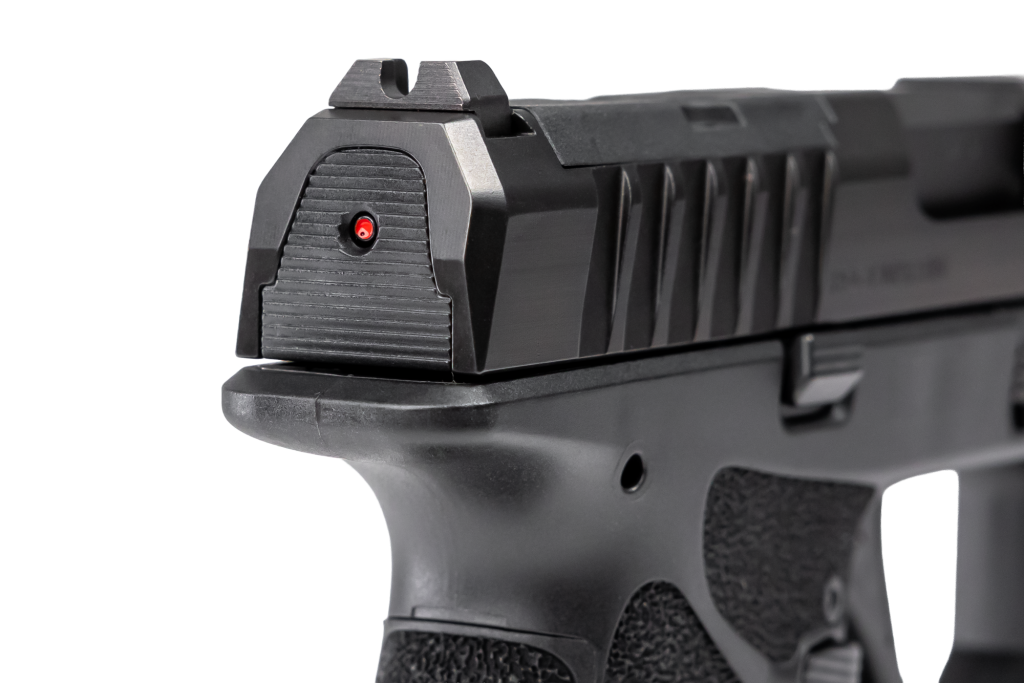
The company is based in Dallas, Texas, and all parts are made in the USA. The RM1C has earned a strong reputation as a well-sized, reliable concealed-carry handgun. The RM1S compact follows the same pattern of good manufacture. The slide finish is evenly applied. Front and rear cocking serrations are standard. The sights are not high-profile but appropriate for concealed carry, with three white outline dots. The slide is cut for optics and supplied with a single RMR-pattern plate that also accommodates similar optics, such as the TruGlo Nexus. A nicely cut serrated rib runs between the sights. The striker protrudes at the rear when the pistol is cocked.
The grip frame is well textured with a balance of traction and comfort. The accessory rail allows mounting a combat light. The slide rides low in the hand compared to similar handguns. There is a modest beavertail tang extension. An ambidextrous slide lock is a welcome feature. The magazine release is also ambidextrous and operates positively.
Takedown is simple. The levers operate similarly to a Glock, but the slide lifts straight up rather than running off the rails. This is similar to the Canik striker-fired design. Internally, there are no surprises. The pistol is built on proven principles. A safety lever in the trigger face prevents discharge unless fully pressed. Take-up is short with a rapid reset. Trigger compression is a smooth 4.5 pounds. This is a very good striker-fired action. A trigger of this weight with a strong reset is ideal for rapid defensive fire.
The RM1S ships with two high-quality steel magazines: one 12-round and one 15-round. The 15-round magazine increases height by half an inch.
Firing
For most of the evaluation, I used Black Hills Ammunition 115-grain FMJ, a clean-burning and accurate load I rely on when testing new firearms. The pistol was drawn from a Galco belt slide for most firing drills. This holster fits a wide range of square-sided slides and works well in training.
I drew and fired at man-sized targets at 5, 7, and 10 yards, engaging multiple targets quickly. The RM1S performed well. The pistol settles nicely in the hand and offers good handling qualities. The sights are well designed for personal defense, and the barrel porting keeps the muzzle on target during firing strings. The pistol proves formidable for personal defense.
I fired 120 rounds of 115-grain FMJ with no failures to feed, chamber, fire, or eject. I then moved to jacketed hollow points. These loads, with stronger recoil impulse, are a good test of reliability. Recoil remained subdued—no more noticeable than with FMJ—due to the ported barrel. Control is excellent.
Loads fired with good reliability included:
- Black Hills 124-grain JHP
- Black Hills 115-grain JHP +P
- Federal 115-grain JHP
- Hornady 124-grain XTP
- Choice Ammunition 124-grain XTP
- Speer 147-grain Gold Dot
- Winchester 147-grain SXT
While recoil varied slightly among loads, it was never unpleasant. There were no failures of any type.
The size of the Rost Martin falls between the Glock 43X and Glock 19, but it handles most like the Glock 19. Once proofed with a range of ammunition, I fired the pistol for accuracy at 15 yards from a benchrest using an MTM Case-Gard rest. I used three proven loads and fired two five-shot groups each.
Accuracy results (five-shot groups, 15 yards):
- Black Hills 124-grain JHP: 2.0 in.
- Federal 147-grain HST: 1.75 in.
- Hornady 115-grain Critical Defense: 1.9 in.
The Rost Martin 9mm is a good shooter—reliable, light enough for concealed carry, and accurate enough for any foreseeable defensive need. It earns a clean bill of health.
Carrying the RM1S Compensated
I am carrying the pistol in a Galco Concealable. This improved pancake-style holster hugs the body for concealment, and Galco’s forward molding improves retention and provides a superior draw angle.

I like this holster and own several versions. While I don’t want to mismatch pistols and holsters, the RM1S fits perfectly in a Concealable molded for the Glock 19.
Read the full article here
