




Yes, Ballistol is a genuinely good gun cleaner.
It’s reliable, versatile, and has earned its place in gun rooms for over a century. Whether you’re cleaning pistols, rifles, black powder guns, or even tools and knives, Ballistol handles the job well — and it does more than just clean. It has real limitations worth knowing too, which we’ll cover honestly below.
A Brief Look at Ballistol’s History
Ballistol’s story starts in 1904, when German chemist Dr. Helmut Klever developed a multi-purpose oil for the German Imperial Army. He combined the words ballistic and oleum (Latin for oil) to arrive at the name Ballistol, or ballistic oil.
By 1905, the German military had officially adopted it. It remained in service through both World Wars and is still manufactured today by Ballistol GmbH in Aham, Germany. That kind of staying power doesn’t happen by accident.
My Experience Using Ballistol
Over the years, I’ve run Hoppe’s No. 9, BreakFree CLP, Shooter Lube, and a shelf’s worth of other products. Ballistol has earned a permanent spot in my cleaning kit for a few practical reasons:
- Convenient aerosol can: Tosses in the range bag without leaking.
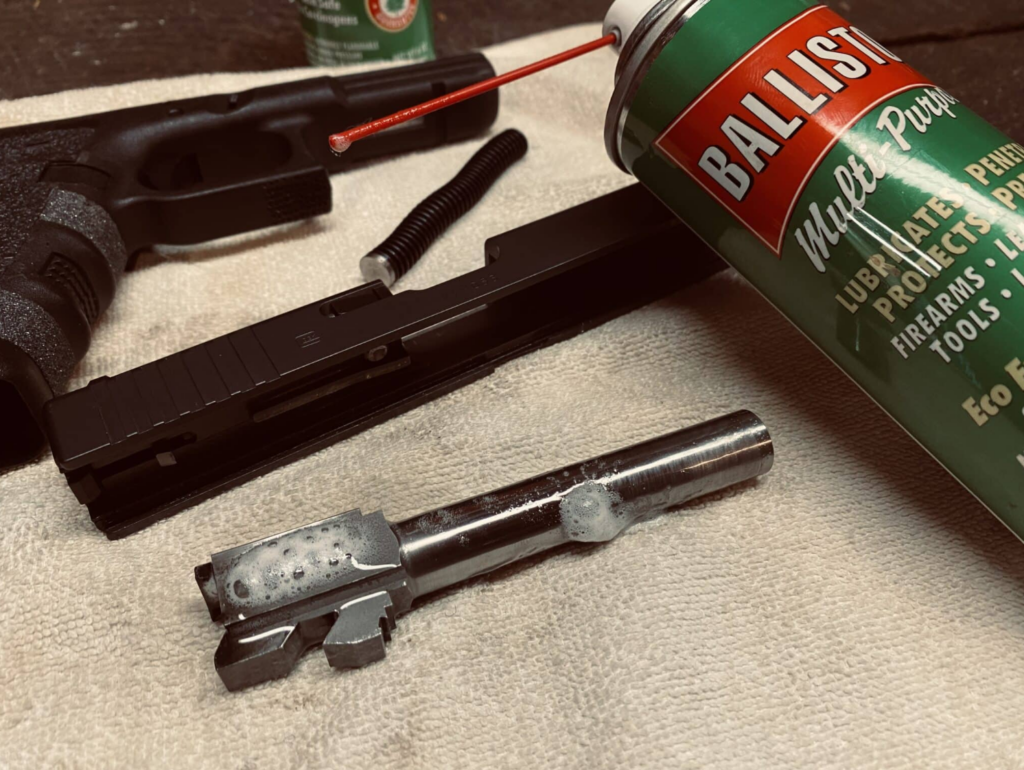
- Cleans fast: Coated the bore of my Glock, waited a minute, wiped it clean. Carbon came off easily.
- Light protective coat: A pass with a Ballistol-soaked patch or rag leaves just enough oil on the slide and frame.
- Fast turnaround: Routine field strip and clean in under five minutes.
One honest note on smell: it’s distinctive. Some people describe it as anise or mild licorice. It’s not harsh, but it’s noticeable. I clean in the garage with the door open — totally manageable.
What Makes Ballistol Different
Cleans, Lubricates, and Protects in One Step
Ballistol functions as a cleaner, lubricant, and rust inhibitor from a single can. That’s genuinely useful at the range or in the field where you don’t want to haul separate products.
Safe on Wood, Leather, and More
One of its original design requirements — dating back to when the German cavalry still existed — was compatibility with wood stocks, leather slings, and horse tack. It’s still one of the few gun products you can use confidently on a wood stock or leather holster without worrying about damage.
Neutralizes Acidic Residues
Ballistol has a slightly alkaline pH (8.0-8.5), which means it actively neutralizes acidic residues left by powder combustion, corrosive primers, and fingerprint oils. If you’ve ever left fingerprints on raw steel and watched them etch in, Ballistol prevents that. It’s also useful for cleaning corrosive-primed surplus ammunition out of a bore — it emulsifies in water, which makes a water-Ballistol mix (sometimes called “Moose Milk”) a time-tested method for corrosive primer cleanup.
Non-Toxic Formula
Mineral oil is petroleum-derived, which is accurate — but Ballistol’s formulation is non-toxic in the sense that it’s safe for incidental skin contact and won’t create the absorption or inhalation hazards that solvent-heavy cleaners like some Hoppe’s products can. That’s meaningful for shooters who clean frequently without gloves.
Water Resistance
Ballistol doesn’t rinse off easily when exposed to moisture. That makes it a practical choice for humid environments, wet-weather shooting, or storing gear in damp spaces.
Ideal for Black Powder and Airguns
Two applications the original article overlooked: Ballistol mixed with water is one of the most effective cleaners for black powder and percussion firearms — it neutralizes the sulfur-based fouling that BP residue leaves behind. Additionally, because Ballistol cannot “diesel” (combust under compression), it’s the go-to cleaning and lubrication product for high-power PCP and springer airguns, where petroleum-based oils are genuinely dangerous to use.
What Ballistol Will NOT Do
To be straight with TTAG readers: Ballistol does not remove copper or lead fouling. If you’re a precision rifle shooter who needs to strip copper jacket deposits from the bore, you need a dedicated copper solvent — Hoppe’s No. 9, Bore Tech Eliminator, Montana Extreme, or similar. Ballistol handles carbon fouling and surface rust; it’s not a bore scrubber for jacketed bullet deposits. Use the right tool for that job.
As a lubricant for high-friction semi-auto surfaces, Ballistol works fine for standard-use firearms. Shooters running round counts in the thousands or operating in extreme conditions may prefer dedicated high-film-strength lubricants, but for most gun owners, it’s more than adequate.
Ballistol vs WD-40: What’s the Difference?
People frequently compare these two, and it’s worth clarifying: WD-40 is a water displacer and light-penetrating solvent—not a lubricant or a gun product.
It evaporates quickly, leaves no lasting protective film, and isn’t formulated for firearm maintenance. It can be useful in an emergency to displace water from a soaked gun, but once you’re back to the bench, clean it off and apply a proper CLP.
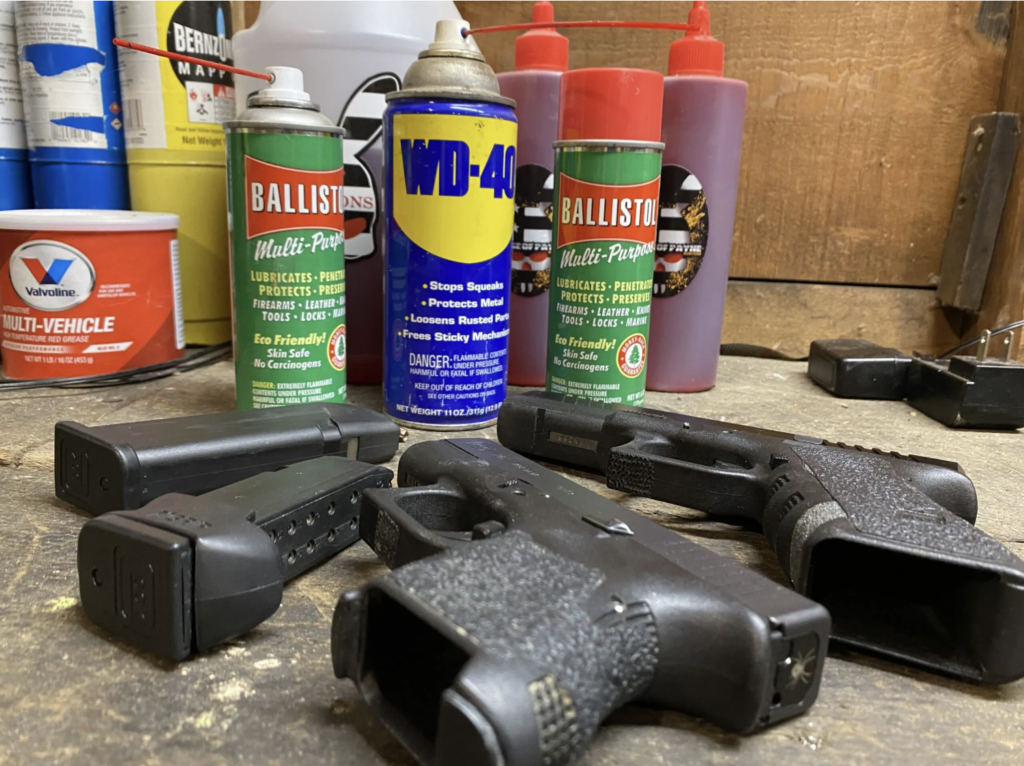
Ballistol stays where you put it, offers real rust inhibition, and is formulated specifically for firearms and related gear. They’re not in the same category.
What Is Ballistol Made Of?
- White mineral oil — lubrication and rust prevention (petroleum-derived but non-toxic)
- Vegetable-derived oils — conditions wood and leather
- Alkaline salts of oleic acid — neutralizes acidic residues from powder and primers
- Alcohols and benzyl acetate — cleaning and penetration
- Propane/isohexane (aerosol only) — propellant
The alkaline chemistry makes it particularly useful for corrosive primer cleanup and fingerprint neutralization — something most CLPs don’t address.
Frequently Asked Questions
The German military used it from 1905 through 1945. It’s currently used by some U.S. Coast Guard units and various military and law enforcement units in Europe. It’s not a standard U.S. military issue product, so claims about “Navy SEAL teams” should be taken as anecdotal rather than institutional.
No. It’s manufactured in Germany by Ballistol GmbH in the town of Aham, Bavaria.
Yes — that’s one of its original design purposes. It’s safe on leather slings, wooden stocks, and holsters.
No. For copper jacket fouling, use a dedicated copper solvent. Ballistol handles carbon and corrosion; copper removal is outside its capability.
Yes — and it’s specifically recommended for high-power PCPs and springers because it cannot combust under compression, unlike petroleum-based oils.
Final Verdict: Is Ballistol Worth It?
For what it is — a one-product solution for cleaning, light lubrication, rust prevention, and material compatibility across wood, leather, and metal — Ballistol earns its shelf space. The alkaline chemistry is genuinely useful and not something most CLPs offer. The non-toxic formula and the black powder / corrosive primer applications are real advantages that competitors don’t match.
Know its limits: it won’t strip copper fouling, and for precision bore work you’ll still want a dedicated solvent. But as an everyday CLP for most shooters, it’s a product that’s been proving itself for 120 years for good reason.
Where To Buy
Read the full article here
