




The suppressor market is booming. With the $200 NFA tax stamp now a thing of the past, more shooters than ever are adding cans to their collections. It’s an exciting time to be in the market. But before you fork over money for a quality suppressor, there’s a question worth asking: Is your firearm actually ready for one?
Not every gun is suppressor-ready out of the box. Some need minor modifications. Others need significant work. And a few just aren’t good candidates at all. Knowing where your firearm falls on that spectrum saves you money, frustration, and the kind of hard lessons that come from mounting a suppressor on a gun that wasn’t prepared for it.
Start With the Muzzle Threads
The most obvious starting point is the muzzle. If your barrel doesn’t have threads, you can’t attach a suppressor without additional work. Simple as that. The good news is that the majority of firearms manufactured today are “suppressor-ready” and factory-threaded. On AR-platform rifles, the standard is 1/2×28 for .223/5.56 and 5/8×24 for larger calibers like .308. Pistols vary widely by caliber and manufacturer.
If your barrel isn’t threaded, a qualified gunsmith can thread it. This is a common and relatively affordable modification on most firearms. The key is to make sure the threading is concentric, meaning it runs true to the bore. Off-center threads are the enemy of both accuracy and suppressor longevity. Don’t cut corners here.
Check the Thread Pitch and Suppressor Compatibility
Assuming your barrel is threaded, you still need to confirm that the thread pitch matches the one on the suppressor you’re buying. Mismatched threads are more common than you’d think, especially with imported firearms or older guns that were threaded for specific regional standards. Always verify before assuming.
European firearms are a particular area to watch. Many guns manufactured in Germany, Austria, and other European countries use metric thread pitches that don’t match American standards. A common example is the M13.5×1 LH (left-hand thread) pitch found on some HK pistols, or the M14x1 LH pitch you’ll encounter on certain CZ and other European-made barrels. If you own a European pistol or rifle and plan to run a suppressor, don’t assume the threads will match those of a domestically spec’d can. The same goes for European-made suppressors, which are increasingly popular in the American market. A quality suppressor imported from a company like Ase Utra or B&T will often arrive threaded to European spec, which means you’ll need an adapter to run it on most American host firearms. Adapters solve the problem cleanly, but you have to know the problem exists before you can solve it.
Most suppressor manufacturers publish a compatibility list or specify which thread adapters work with their cans, and suppressors often ship with a set of adapters to cover common pitches. If yours doesn’t, adapters are inexpensive and widely available. It’s a five-minute fix once you have the right hardware.
Quick-Attach Mounting Systems
Not all suppressors thread directly onto the muzzle and call it a day. A growing number of cans use quick-attach mounting systems, and if you’re shopping for your first suppressor, it’s worth understanding how they work before you commit.
Quick-attach systems use a dedicated muzzle device, typically a flash hider or muzzle brake, that stays permanently mounted on the host firearm. The suppressor then locks onto that device in a single motion, usually with a rotation or a push-and-twist mechanism. The appeal is obvious. You can move one suppressor between multiple host firearms quickly, without tools, and without the tedious process of threading and unthreading a direct-attach can every time you switch guns. At the range with three suppressor-ready rifles, this matters more than you might think.
The tradeoff is that all of your host firearms now require that specific muzzle device to run the suppressor at all. You’re locked into that manufacturer’s ecosystem. Buying those muzzle devices for multiple guns is not an inexpensive investment. Also, if the company discontinues the product line or changes its mounting interface down the road, you may find yourself with compatibility headaches. Some shooters see that as a minor concern. Others, particularly those who like to mix and match gear, find it frustrating.
Point-of-impact shift is another consideration. Direct-thread suppressors, when properly torqued, are generally very consistent in how they affect your zero. Quick-attach systems introduce another mechanical interface into the equation. Most quality systems are engineered to index reliably and hold zero well, but it pays to verify this on your specific setup before relying on it for anything that matters. Zero your rifle suppressed, confirm it holds across multiple attachment cycles, and trust your data rather than the marketing sheet.
Popular quick-attach systems from companies like SilencerCo, Dead Air, and Surefire have proven track records and broad host compatibility. If you’re buying into one of these established platforms, you’re unlikely to run into problems. Just know what you’re signing up for, and factor the cost of dedicated muzzle devices into your overall budget if you plan to run the suppressor on more than one gun.
Piston vs. Direct Impingement
For semi-automatic rifles, particularly AR-platform guns, running a suppressor changes the gas system dynamics. Suppressors increase backpressure, which can cause over-gassing. Symptoms include bolt carrier group battering, increased felt recoil, more carbon fouling, and reliability issues.
This doesn’t mean your AR can’t run a suppressor. Many do just fine. But it does mean you should understand what’s happening mechanically and be prepared to address it. An adjustable gas block is typically the most practical solution, letting you tune the gas flow whether you’re running suppressed or unsuppressed. Piston-driven systems are inherently better suited for suppressed use because they reduce the amount of hot gas cycling back into the receiver. If you shoot your AR regularly with a can, an adjustable gas block is a worthwhile investment. Your bolt carrier group and buffer will thank you.
Pistol Suppressors
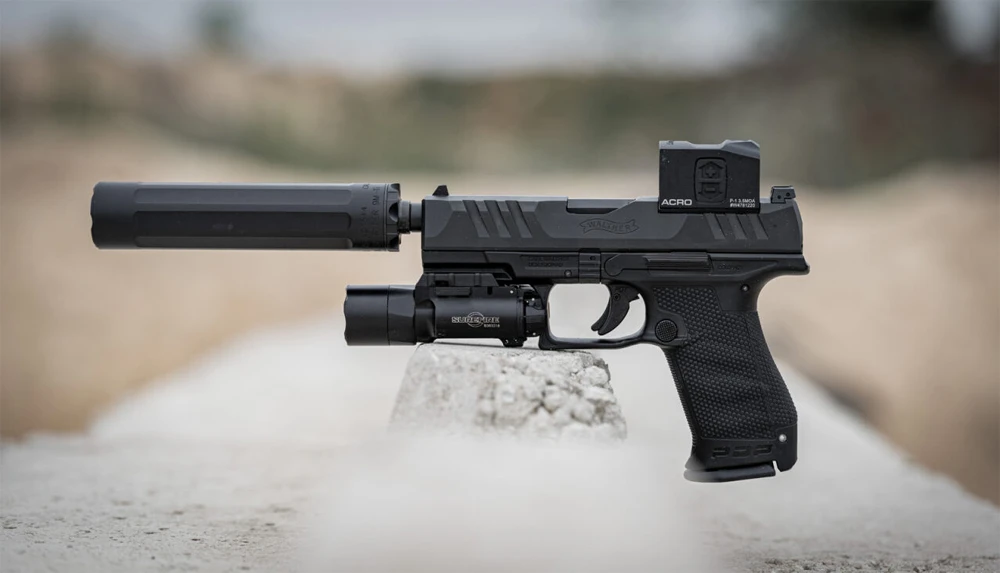
Suppressors add mass to the muzzle. On a pistol, this changes the slide cycling dynamics. Some pistols handle it without modification. Others need a heavier recoil spring or a booster assembly, which is a Nielsen device that allows the suppressor to cycle the slide reliably. Most pistol suppressors designed for tilting-barrel guns ship with a booster included, and some 3D-printed designs are light enough to cycle without one.
Fixed-barrel pistols, like the Ruger MK series, don’t need a booster because the barrel doesn’t move. But on your standard polymer-framed carry gun, make sure your suppressor setup includes one. Running a direct-thread suppressor without a booster on a tilting-barrel pistol leads to cycling failures and potential damage.
Don’t Overlook the Ammunition Factor
Supersonic ammunition is louder through a suppressor than subsonic ammunition. You’re still cutting the report significantly, but the crack of a supersonic projectile breaking the sound barrier is physics, not a suppressor design flaw. If your primary goal is maximum noise reduction, subsonic ammunition in the right caliber makes a meaningful difference.
Not every caliber has quality subsonic options. It’s worth researching your specific cartridge before setting your expectations. For .22 LR, subsonic loads are plentiful and affordable. For larger centerfire calibers, options exist but vary in quality and availability. 300 Blackout is one of the most popular options for shooting both subsonic and supersonic ammo.
Run a Function Check Before You Hit the Range
Once everything is assembled and properly torqued, do a function check before loading a single round. Make sure the suppressor is fully seated and locked. Verify there’s no wobble or play. If your suppressor uses a mounting system with a locking mechanism, confirm it’s engaged. A suppressor that comes loose mid-string is a problem nobody needs to experience firsthand.
Getting into a rhythm of inspecting your suppressor mount before each range session becomes second nature quickly. It takes thirty seconds and eliminates a class of problems entirely. Also, develop the habit of checking your suppressor during shooting sessions to make sure it hasn’t worked loose, and wear a glove or use a suppressor cover to avoid burning your hand.
The Bottom Line
Suppressors are one of the more satisfying upgrades you can make to a firearm. They protect your hearing, reduce recoil, and make extended shooting sessions significantly more enjoyable. But they only work reliably on a host firearm that’s actually ready for them. Do the homework upfront, address any issues before mounting a can, and you’ll enjoy everything a quality suppressor has to offer.
Read the full article here
