



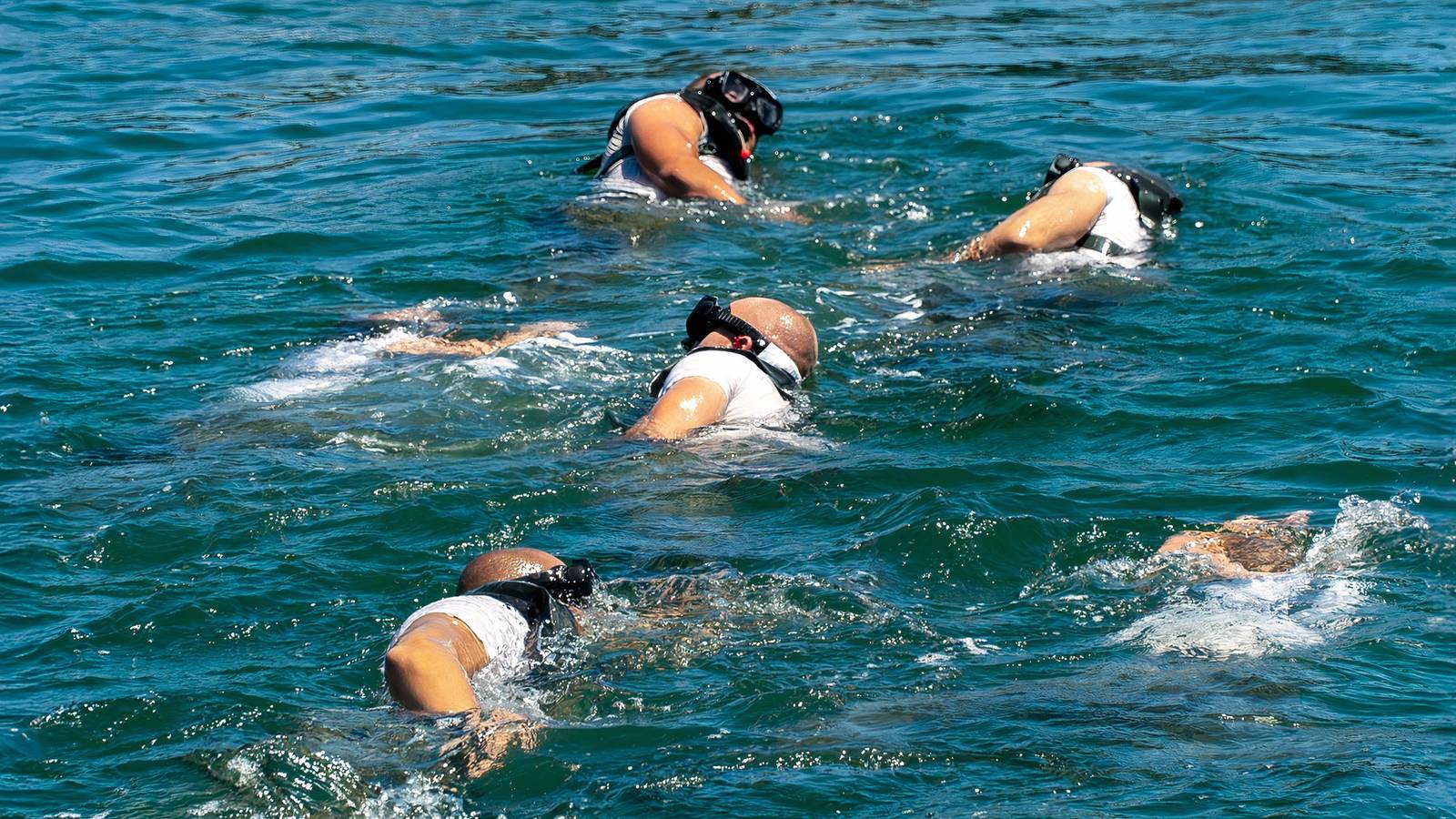

Did you know certain military fitness tests still require you to do situps? Not all programs shifted to the plank pose. If you are preparing for jobs in the Navy such as Navy SEAL, special warfare combatant-craft crew, explosive ordnance disposal/diver, rescue swimmer and special operations independent duty corpsman, your entrance exam is the Navy Physical Screening Test. Like many other fitness tests in the military, it includes a series of calisthenics exercises, such as pushups, situps and pullups, as well as a 1.5-mile run. The great equalizer, though, is the 500-yard swim performed in the combat side stroke (CSS), breaststroke or elementary sidestroke. (Note: Rescue swimmers are allowed to use the freestyle stroke for this test.)
To develop strategies for pacing, fueling and improving performance, focus on high-volume calisthenics workouts, running conditioning, swimming efficiency and practicing the test two to three times a month to develop strategies for pacing, fueling and improving performance. In my groups, we warm up with a 500-yard swim before every swim workout just so one day you can say, “Oh, the 500-yard swim, this is just my warm-up.” We also swim five to six times a week, covering 1,500 to 2,000 meters per day.
Common Efficiency Issues of the CSS
You need both swimming conditioning and technical efficiency to succeed in the swim portion. Technique is more important. Candidates who treat the swim portion like a sprint fail by adding more strokes per length, while those who treat it like an efficient glide succeed and perform the 500-yard swim in as many as 50%-60% fewer strokes. Here is how.
Strong Kick and Glide Phase
If you skip this phase, you will just get tired faster. Increasing your stroke count per length is one of the top mistakes that waste energy before the pushups even starts. The scissor or breaststroke kick can be used, but nothing will make you faster than a powerful combined kick and a super-streamlined glide. To build power in your kicks, consider adding fins and doing scissor kicks for part of your workout. To get a better, more streamlined body position, you need shoulder mobility. Notice the glide time that this perfectly streamlined position/kick can get you.
Full Top Arm Pull (Freestyle Catch)
Start with a freestyle catch (top arm pull) to gain momentum. The top arm pull of the CSS is identical to the freestyle “pull and turn” to breathe. In fact, I often have people learn freestyle (crawl stroke) first so we can teach the turn and pull, along with body position in the water, then teach the CSS.
Bottom Arm Pull and Breathe
Inhale during the bottom arm pull (like a breaststroke scull). This is a shorter stroke than the full top arm pull. Notice the bottom arm/breathe process in this video.
Tight Arm Recovery into Glide Position
After both arms have pulled and you have inhaled, it is time to recover the arms to the overhead glide position and kick. Hold this glide for 2-3 seconds each stroke. This is the key to efficiency. Skip the glide and start the next stroke too soon, and you have wasted energy and momentum that could have gotten you another body length in the pool by just holding the glide for 2-3 seconds. See the tight recovery into the glide position immediately after the kick.
Put It All Together
It goes like this:
- Top arm pull
- Bottom arm pull/breathe
- Kick and arm recovery
- Glide
- Repeat.
The best way to learn this stroke is to either be taught by an instructor or have someone film you swimming 50 meters and compare it to any of the CSS videos you see linked in this article. Some of the best non-swimming athletes usually finish the 500-yard test in sub-8 minutes, done efficiently with plenty of energy left over for the rest of the PST (pushups, situps, pullups run). (https://www.youtube.com/shorts/Az8w4TwcKsQ.)
Once you learn the technique and can efficiently get your swim down to a 50-second 50-yard pace, you are ready to start getting into swimming shape. Now, conditioning is the most important part of the process to improve your swimming time. We do this with the 50-50 Swim Workout.
Read More about the Navy PST, calisthenics workouts and running to maximize your total Navy PST scores. There are more articles where these came from at the Military.com Fitness Section, including:
Read the full article here
