



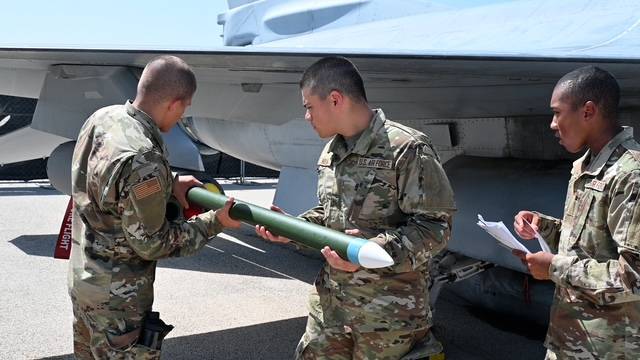

The young airmen had successfully armed and moved a training weapon toward an F-16 when their team leader realized something was wrong. It hadn’t been loaded correctly.
With military training instructors watching, the Texas heat bearing down and the clock running, the trainees faced a decision: Keep going, try to fix the problem beside the aircraft, or go back and start again. Then their leader did something that caught Col. Kellie Courtland’s attention.
“I’m not the right leader for this right now,” Courtland recalled the trainee saying. He asked another member of the team to lead while he read the instructions and helped walk the group through the problem.
“I love that,” Courtland told Military.com. “And they got there. They were successful.”
In an interview with Military.com during the Air & Space Forces Association’s Air, Space & Cyber Conference outside Washington, D.C., Courtland said the moment illustrates what the Air Force is increasingly trying to accomplish during the 7½ weeks it has to transform civilians into airmen.
Basic military training still includes marching, discipline, physical fitness and the other hallmarks generations of airmen remember. But trainees are also increasingly being put into small groups, placed under stress and forced to solve problems without an instructor or designated leader immediately telling them what to do.
The goal isn’t simply to produce airmen who can follow orders. It’s to prepare them to keep a mission going when the original plan falls apart.
We want trainees that can go in there and win, Courtland said. We want trainees that can go in there and rise to the occasion, not sink to their latest level of training.
Preparing Airmen for Plan B
Courtland has a perspective on BMT few commanders can match.
She first went through basic training at Lackland nearly 37 years ago. She later returned as a military training instructor, served as an operations officer and wing executive, and ultimately came back to command the wing responsible for training the Air Force’s newest enlisted members.
The basic emotions of arriving at Lackland haven’t changed much, she said. “Trainees will always be trainees,” Courtland said. “They will get here, they will be nervous, they will be scared, they will be upset.”
But what the Air Force expects those trainees to be capable of doing before they leave is changing. Courtland said BMT increasingly puts trainees into smaller teams because that more closely resembles how airmen actually operate once they reach the force.
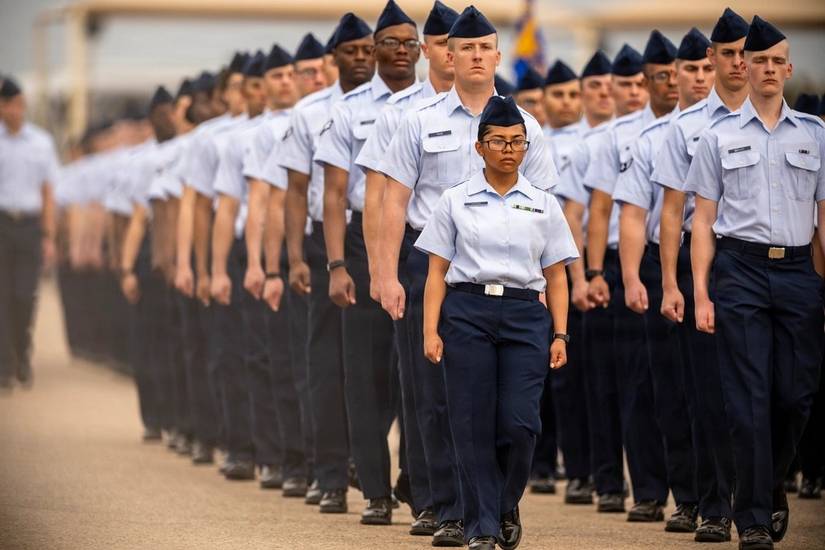
“I know darn well that never once have I marched out to the flight line in a flight of 60 people to do my job,” she said.
During some exercises, instructors deliberately remove the trainee leader and MTI from the equation, leaving the remaining airmen to solve the problem themselves.
If Plan A doesn’t work, I want to see you do a Plan B, Courtland said. I want to see you do a Plan C because reality is the mission can’t fail.
The F-16 exercise is already the “number one rated thing” on the BMT survey, Courtland said. Trainees must work together under time constraints while instructors observe them, forcing them to deal with the pressure of making decisions while tired, hot and stressed.
“We want them to feel that stress now,” Courtland said. “And then we want to teach them how to deal with stress.”
The Exact Right Generation That We Need’
The changes also run against a familiar criticism from some veterans: that changing basic training means making it easier. Courtland doesn’t see the current generation of recruits that way.
“This generation of airmen is just so incredibly smart,” she said. “They are tech-savvy, but they’re also very solution-oriented.”
In some cases, she said, today’s trainees come up with solutions that she and the airmen alongside her 37 years ago likely wouldn’t have considered.
The generation we have right now is coming in, Courtland said. They are the exact right generation that we need right now. They know how to think differently.
The Air Force is trying to take advantage of that ability while preparing new airmen for a fundamentally different operational environment.
That includes teaching them how to react to threats they could encounter well outside their traditional specialty. “What we don’t want is kids standing at their point and saying, ‘Oh my, there’s a drone,'” Courtland said.
Instead, she wants an airman who can identify the threat, report it and know what to do next.
“Everybody’s a sensor, no matter who you are,” she said. That represents a significant shift in what BMT is trying to instill before an airman ever reaches technical training.
From Marching to Airpower
Courtland remembers graduating from BMT having barely encountered the thing at the center of the Air Force’s mission: aircraft.
“When I graduated BMT, I had never seen an aircraft besides the one that I flew on a plane to get to BMT,” she said. “I had never seen an aircraft, and when I left, I still hadn’t seen one.”
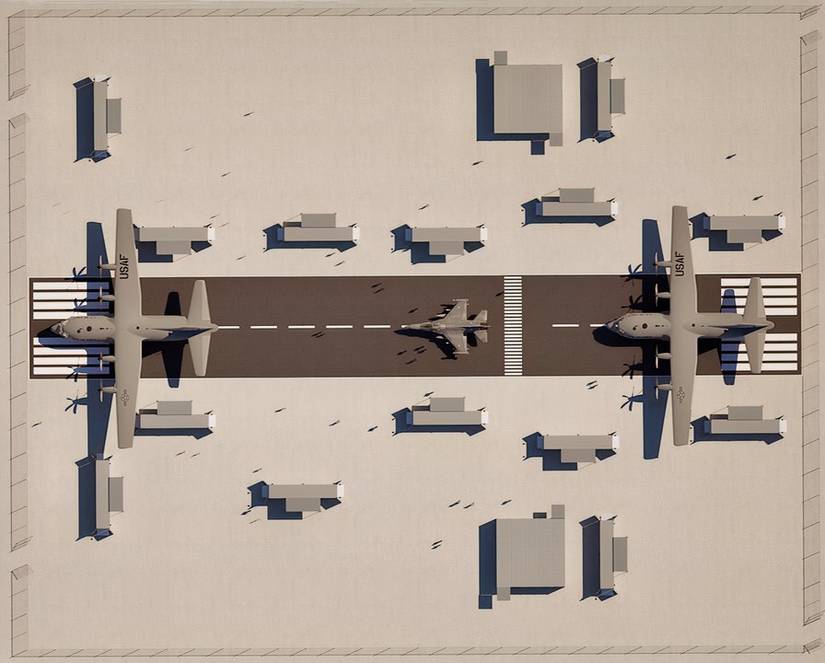
Today, trainees learn about aircraft positioned around Lackland’s parade grounds and spend time familiarizing themselves with aircraft such as the C-130.
The larger objective is to build an Air Force identity earlier.
We want, ‘I’m an airman. I’m an air-minded warrior, and our job is to generate airpower,’ Courtland said.
Every airman, regardless of specialty, should understand how their job contributes to defending, operating, generating or sustaining airpower, she said.
The changes are also altering the job of the MTIs responsible for delivering BMT. The more operational focus is even changing who is interested in becoming an instructor.
Maintainers who might not have previously envisioned themselves leaving the flight line to become educators now see trainees working around aircraft and performing more operationally focused training, Courtland said.
“Now they’ve got a spot down here too,” she said. “And we love that.”
BMT Only Gets 7½ Weeks
For all the changes underway at Lackland, Courtland said there is a limit to what BMT can accomplish.
We get a trainee for seven and a half weeks, she said. Everybody else gets them for the rest of their career.
That means the larger challenge may come after graduation. BMT can send an enthusiastic, operationally minded young airman to technical training, but Courtland said technical schools and operational units must continue developing what Lackland started.
“We can train you as an air-minded, world-class warrior,” she said. “Send them off to tech training, and then it’s on tech training to continue that.”
The question for commanders across the Air Force, she said, is what happens when those young airmen arrive at their units.
“What do you do when they get to your doorstep?” Courtland said. “How are you going to keep that fire burning, that motivation going?”
Nearly four decades after she first arrived at Lackland as a trainee herself, Courtland now watches another generation make that same transition. She hasn’t forgotten what it feels like.
“When I see those empty eyes, and I see that look, and they’re dripping with sweat, I remember,” Courtland said. “I remember how miserable that is, and how hard that can be.”
The difference is what the Air Force now expects those exhausted trainees to be capable of doing when they leave.
If Plan A doesn’t work, they need to be ready for Plan B. And, increasingly, Plan C.
Read the full article here
