




For decades, American airpower operated with an assumption that increasingly no longer holds: U.S. aircraft could generally launch from bases protected from direct enemy attack. The Air Force’s top civilian and uniformed leaders say that era is ending.
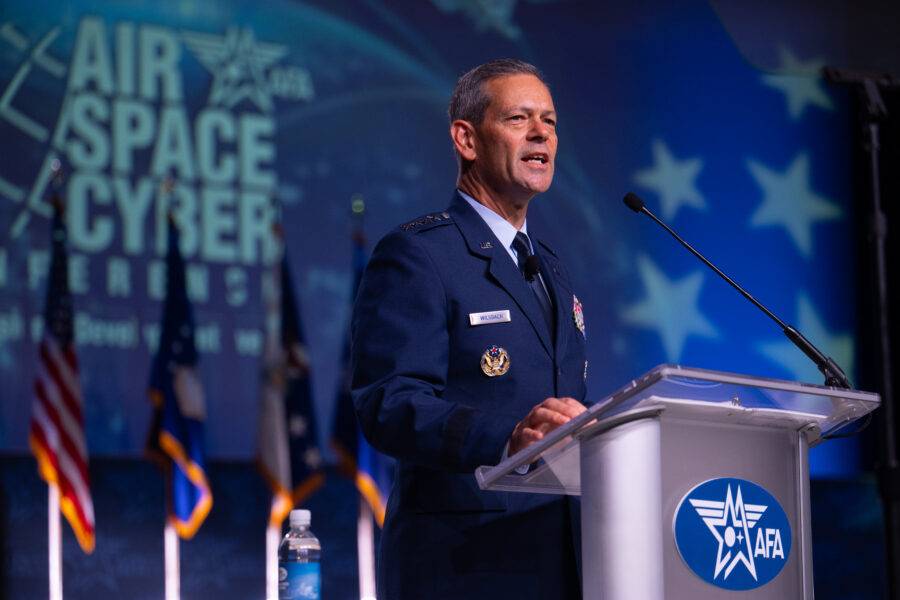
Speaking Monday at the Air & Space Forces Association’s Air, Space & Cyber Conference, Secretary of the Air Force Troy Meink and Air Force Chief of Staff Gen. Ken Wilsbach outlined a service confronting vulnerable bases, rapidly advancing autonomous weapons and a need to generate far more combat power without simply buying more expensive aircraft.
Their message was sharpened by Operation Epic Fury, a 38-day campaign in which 500 aircraft flew roughly 10,000 sorties as the joint force struck more than 13,000 military objectives.
For decades, American air and space power has often operated from a position of sanctuary. Those days are over, Wilsbach said. We can no longer treat point defense as a side hustle. We must make it a core function of air and space power.
Taken together, the two speeches offered a picture of an Air Force that could look significantly different within six years: hundreds of new autonomous aircraft, tens of thousands of lower-cost weapons, new defenses for American bases and Airmen increasingly expected to sustain combat operations while under attack.
“Because of the steps we’re taking today, we’ll have a radically different looking Air Force by 2032,” Meink said.
A Battlefield Changing Faster Than Expected
“The threat is changing actually faster than I thought possible when I took this job 18 months ago,” Meink said.
One-way attack drones, artificial intelligence and autonomous systems are changing both the economics and tactics of warfare, allowing militaries to produce effects that once required far more expensive weapons.
“In the European Theater, one-way attack drones have replaced artillery as the primary killer, while armor often sits idle,” Meink said.
For the United States, that presents a challenge for a military accustomed to developing extraordinarily capable, and extraordinarily expensive, weapons and aircraft.
“We must increase our combat power and innovate faster than anyone else, affordably,” Meink said. “We need cost-effective combat power.”
The Air Force plans to have at least 500 Collaborative Combat Aircraft, or CCAs, in service by 2032. Meink also announced the names of the service’s first two CCAs: the FQ-42 Vengeance and FQ-44 Fury.
Another class of uncrewed aircraft, called Mass Modular Aircraft, or MMA, is intended to provide even cheaper, long-range combat power.
With congressional funding, the Air Force plans to field 100 MMAs by 2029 at roughly half the cost of a CCA and one-tenth the cost of a fifth-generation fighter, Meink said. Another 500 could be operational by 2032.
“When we pair manned aircraft with low-cost autonomous systems, we will be able to unlock combat power at scale,” Meink said.
The service also expects tens of thousands of weapons from its Family of Affordable Mass Munitions by 2030.
38 Days of Combat Put the Air Force to the Test
Wilsbach used recent combat to illustrate why that transformation is needed.
During 38 days of Operation Epic Fury, 500 aircraft flew approximately 10,000 sorties, more than 250 per day. Airmen operated through roughly 1,200 “Alarm Reds,” repaired damaged airfields 48 times and conducted more than 420 reportable explosive ordnance disposal operations.
Airmen launched aircraft while bases were under attack, intercepted enemy drones, assembled thousands of weapons and continued operations after their living quarters were destroyed.
There were moments when they were afraid, and most people would be, Wilsbach said. But courage is not the absence of fear. Courage is overcoming it.
Those experiences reinforced a reality Air Force leaders increasingly expect in future conflicts: American bases themselves will be targets.
Wilsbach announced the establishment of a Point Defense Weapon System combining kinetic and non-kinetic capabilities to protect Air Force installations. The service is also creating a dedicated career field for Airmen specializing in point defense that he said will be operational within two years. The implications extend well beyond base security.
Aircraft may have to launch while missiles and drones are arriving. Maintainers may have to repair runways while attacks continue. Weapons crews may have to keep generating munitions even after their own facilities are damaged.
“We must be ready to fight, built to endure, and integrated to win,” Wilsbach said.
The Transformation Extends Into Space
The changes aren’t limited to the atmosphere. Meink publicly acknowledged that the United States has what he described as “space control weapons” in orbit.
“We are increasing readiness against existing threats, and the United States has on-orbit space control weapons capable of defending the Joint Force against hostile adversary action,” Meink said.
He provided few additional details. But the disclosure illustrated how the same challenge confronting the Air Force on the ground is extending into space: U.S. forces can no longer assume critical systems will remain beyond an adversary’s reach.
Meink also pointed to proliferated satellite constellations and the Space-Based Interceptor program as examples of efforts to distribute capabilities and move new systems into the field faster.
Technology Alone Won’t Determine the Next Fight
For all the emphasis on autonomous aircraft and new weapons, Wilsbach repeatedly returned to the Airmen operating them.
He pointed to the more than 50-hour effort to rescue the crew of an F-15E Strike Eagle shot down during Operation Epic Fury. The operation ultimately involved 176 aircraft and required fighters, bombers, tankers, intelligence platforms, special operations forces and other capabilities to operate together.
“Operation Epic Fury was not the story of one airplane, one weapon or one career field,” Wilsbach said. That may also capture the broader state of the Air Force described by its leaders this week.
The service is pursuing some of the most advanced aircraft and weapons in its history, including the B-21 Raider and F-47. But leaders are simultaneously arguing that technology alone will not determine success.
Bases have to survive attack. Supply chains have to keep aircraft flying. Weapons have to be available in sufficient numbers. Autonomous systems have to provide mass alongside more expensive crewed aircraft. And Airmen have to be prepared to keep fighting while the enemy is actively trying to stop them.
That shift is already reaching the beginning of an Airman’s career. Meink said Basic Military Training has been retooled to expose new Airmen to flight lines, ranges and operational environments earlier.
Transforming the force will also require money, and Meink warned that the cost of increasingly sophisticated systems is becoming unsustainable.
“Many of the weapons, components, or systems we have to buy have outrun the cost curve,” he said. “They perform extremely well, but the costs are growing faster than the rate of inflation.”
For Wilsbach, recent combat provided evidence that the Air Force’s transformation is about more than what it buys.
“Our Airmen carry that legacy forward,” he said. “They turn airplanes into combat power, information into decisions, logistics into endurance and technology into advantage.”
Read the full article here
