



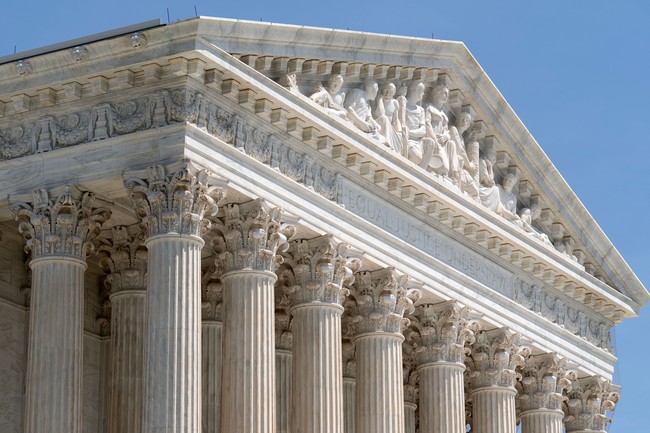

The Supreme Court’s first conference of the fall term is scheduled for September 28, and among the cases that will be discussed by the justices behind closed doors is Daniel Defense v. Lowy. On Wednesday, the Court requested that the respondents in the lawsuit file a formal response, which is a pretty good signal that at least one of the nine justices is interested in granting cert to the case.
Daniel Defense and 11 other members of the firearms industry were sued by Karen Lowy and Antonio Harris, who were both shot in Washington, D.C. in April, 2022 by a deranged individual who opened fire from an apartment located across the street from a school. Lowy was shot multiple times as she was waiting to pick up her daughter, and Harris, who was working as a security guard at the school, was shot in the abdomen.
Thankfully, both individuals recovered from their injuries, while the shooter ended up taking his own life. Lowy and Harris filed separate suits about 18 months after the shooting incident, naming more than a dozen gun industry members as defendants. Basically, any company that made a gun or a related product that the shooter purchased were sued.
As the cert petition filed by the defendants argues:
Plaintiffs do not allege that any of the manufacturers they sued knew or should have known anything about Spencer or his plans. They do not allege that any of the firearms or related products Spencer purchased were prohibited (except insofar as he illegally modified them). They do not allege that Spencer illegally acquired any of those products from any of the defendants (or anyone else); to the contrary, they allege that he legally purchased several from vendors that they did not name as defendants. Nor do they allege that Spencer used all the various products he purchased in his shooting spree. They instead allege only that Spencer owned at least one product manufactured by each defendant. Nevertheless, plaintiffs claim that each of these dozen-plus manufacturers (plus a bevy of other John Doe defendants comprising the “gun industry atlarge”) is responsible for Spencer’s horrific actions—on the theory that each “deceptively and unfairly” marketed their products to appear useful in tactical situations.
The plaintiffs don’t even argue that the shooter ever saw any of this supposedly deceptive and unfair marketing material. The only connection alleged is that each defendant manufactured at least one product that the shooter purchased.
A federal district court threw out the lawsuit after agreeing with the defendants that the plaintiffs had not plausibly alleged that the manufacturers’ speech “had a determinative or coercive effect upon” the shooter’s actions.
Amazingly, a divided panel of the Fourth Circuit Court of Appeals disagreed and reversed the district court opinion, allowing the lawsuit to proceed. The majority concluded that the plaintiffs “sufficiently alleged that the defendants’ conduct had a ‘predictable effect’ on the actions of the Shooter, such that the defendants are at least in part responsible for causing the plaintiffs’ injuries.
Why? Because:
The complaints specify that:
1. “the defendants deliberately designed their advertisements to appeal to impulsive, risk-seeking young men”;
2. “the defendants’ advertisements promote the use of … AR-15s to civilians”;
3. “the defendants ‘knew or should have known’ that young men such as the Shooter regularly commit mass shootings using weapons like the ones they advertise”; and
4. “the defendants knew or should have known that marketing their products in such a manner would have an impact on the Shooter’s decision to amass and use the defendants’ weapons and accessories to heinously injure the plaintiffs.”
The panel went on to argue that those marketing materials had a “determinative or coercive effect” because the defendants had published information “which leads a third party to conclude that it should proceed in a manner that injures a plaintiff,” even though mass shootings like this are incredibly rare and the 99.9 percent of people who have seen this marketing material never came to the conclusion that they should try to shoot up a school.
The defendants are now asking SCOTUS to address “Whether plaintiffs can satisfy the traceability requirement of Article III by alleging that the criminal acts of a third party are traceable to social media posts and other speech that they do not allege the third party ever saw.”
The non-lawyerly way of asking that question is “can you hold a gun maker responsible for a shooting based on their marketing material, even if the shooter never saw the material that supposedly led to the shooting?”
It’s a good thing that at least one justice has indicated an interest in the case and is now asking the attorneys for Lowy and Harris to formally reply to the cert petition. That may not guarantee that the Court will accept the case, but given the number of states that are adopting laws that empower these kinds of lawsuits, it’s a timely issue and one the justices should address, and sooner rather than later.
Editor’s Note: The radical Left will stop at nothing to enact their extreme gun control agenda and strip us of our Second Amendment rights.
Help us continue to report on and expose the Democrats’ gun-grabbing schemes. Join Bearing Arms VIP and use promo code FIGHT to receive 60% off your membership.
Read the full article here
