



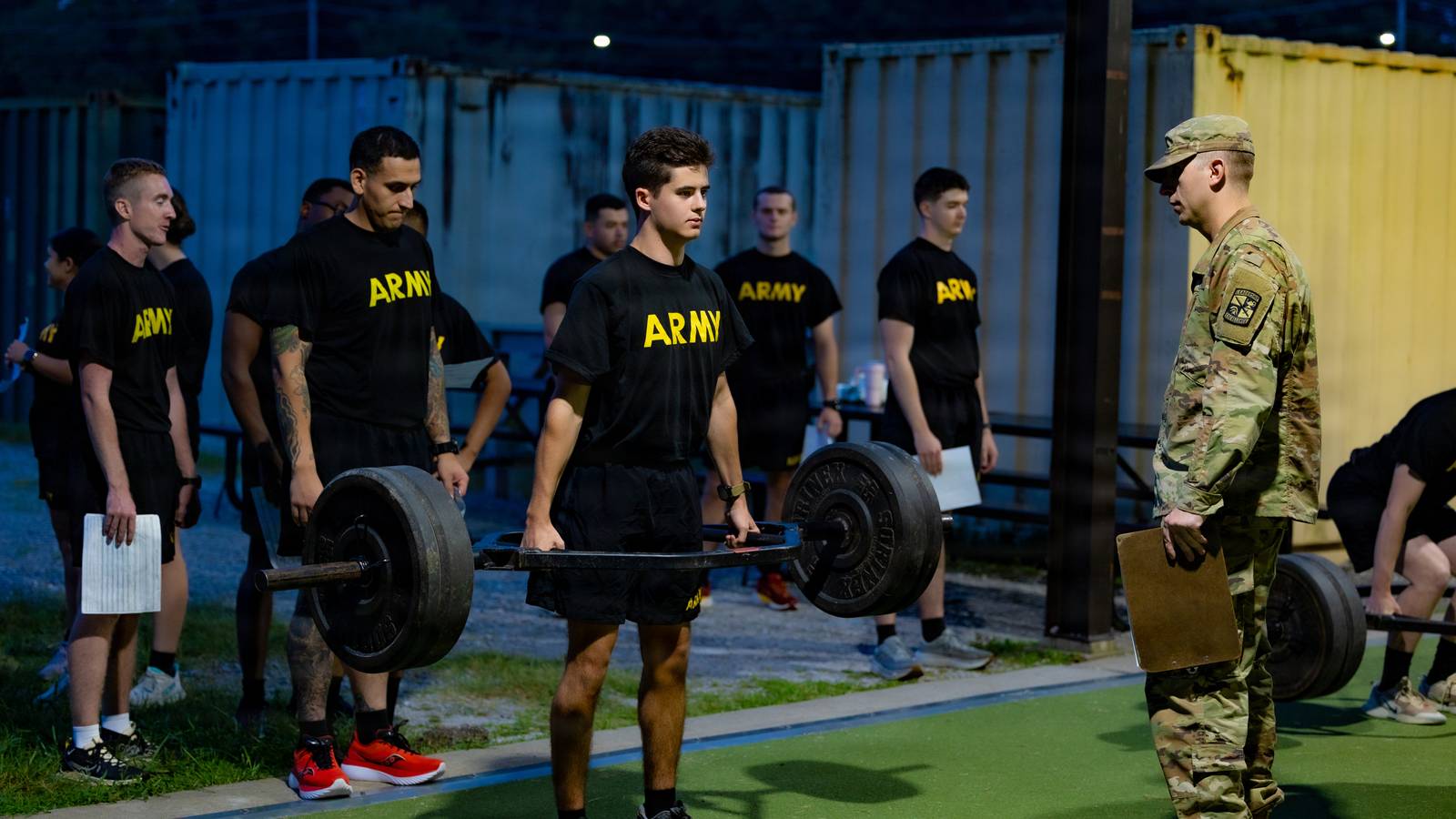

While it is important to have muscle stamina and endurance, being stronger improves overall durability when carrying heavy gear and equipment, which is part of a soldier’s life, depending on the job.
Whether you are preparing for Basic Combat Training or a combat-related MOS, you need a combination of strength, power, speed, agility, muscular stamina, endurance and to ace the new Army Fitness Test and the Army Combat Field Test as well as the training itself. We all come into the military journey bringing a variety of strengths and weaknesses.
Read More: How to Ace the Military’s New Waist-to-Height Ratio Test
Athletic History Matters
Usually, the incoming military recruit has an athletic history that helps with understanding where you should focus your pre-training. If you are a former cross-country running athlete, even if your running times dropped by a minute per mile, you will still be faster than most people in the Army. Lifting will be more important for someone who comes from an endurance background for durability gains.
If you are a strength/power/speed athlete, you may be plenty durable but need more muscle stamina and endurance training and less lifting.
If you have no athletic history, you need to work on both but may find you are predisposed to performing well in one or the other.
To gain strength and durability, you need to lift and ruck as part of a progressive routine. You can still run after you lift, but if you need to put on mass, you will need to eat even more food to gain weight. Putting on some weight may be necessary to maintain the endurance required to handle the loads required in combat infantry units in the Army.
The strength/power athlete may need to lose some mass and focus more on calisthenics and cardio events. Endurance athletes tend to have issues with the deadlift event in the biannual Army Fitness Test, while strength athletes have issues with max pushups and running 2 miles.
Typically, recruits coming from a lifting/power background cannot run fast. They are forced to lose weight for a few cycles and focus on the calisthenics and cardio events in the Army’s testing and training programs for their futures. In essence, they must lose some peak strength to gain endurance, but they’ll still be stronger than most. The endurance athlete might lose some of their peak endurance to gain strength and still be faster than most. This is what becoming a tactical athlete looks like: getting good at everything but not being bad at anything.
If you’re a strong runner but have little background lifting, the AFT deadlift can feel intimidating. The mistake most runners make is assuming that more lifting automatically means less running quality. The problem is usually too much fatigue, too much volume, or too much change at once when adding lifting to your current training. If your goal is to improve the deadlift for the AFT, the training should make you more efficient, not just more tired. The answer is to run less but still fast and lift more for the endurance athlete. Strength athletes have the opposite issue. They need to lift less and focus more on calisthenics and cardio, with nonimpact cardio perhaps helping them get more cardio with less impact at first.
Read More: The Space Force Wants to Grow: Here Are Its Recruiting, Fitness Standards
Start With the Movement, Not the Weight
For runners new to lifting, the priority is learning the hex bar lift movement and working on your grip. The hex bar deadlift is not just a test of strength; it is a test of position, timing and force. If you have spent years moving in one plane as a runner, your body may need time to learn how to squat, load the hips, brace the trunk, and drive through the floor with power to lift the weight. The hex bar deadlift is more of a squat from the floor than a traditional deadlift, which is more of a hip hinge movement.
That means beginning with simpler variations before chasing heavy numbers. Romanian deadlifts, kettlebell deadlifts, trap-bar deadlifts and single-leg deadlifts are all useful because they teach the same movement qualities with less intimidation and less technical breakdown. The athlete should feel stable, controlled and powerful before the load increases.
Protect the Run
The biggest concern for a runner adding strength work is interference. That is why the lifter, who is great already, can do much less and focus on running and reps. If the lifting is too hard, too frequent, or placed too close to quality run sessions, the legs will feel flat, and the aerobic work will suffer. That is why smart scheduling is just as important as the exercises themselves.
A good rule is to keep the hardest lifting and the hardest running separate when possible. Easy runs can usually coexist with strength work, but interval days, hill sessions, and heavy deadlift work should not all pile into the same 24-hour window. The goal is to arrive at both sessions with enough freshness to train well.
If you are a runner trying to improve the AFT deadlift, the answer is not to abandon running or become a gym specialist overnight. The answer is to build stronger legs, glutes, and back, train power in small doses, and organize the week so your run stays intact.
The opposite is true for the lifter. Build a strong cardio base (heart/lungs) primarily, lift 1-2 times a week, and run immediately afterward to simulate the Army Fitness Testing sequence and maintain some strength. Strength should support your running, not compete with it. You need to progress with patience, good coaching, and enough recovery time for the work to progress. Check out the Military.com Fitness Section for more training ideas and workouts for any military fitness test.
Read the full article here
