



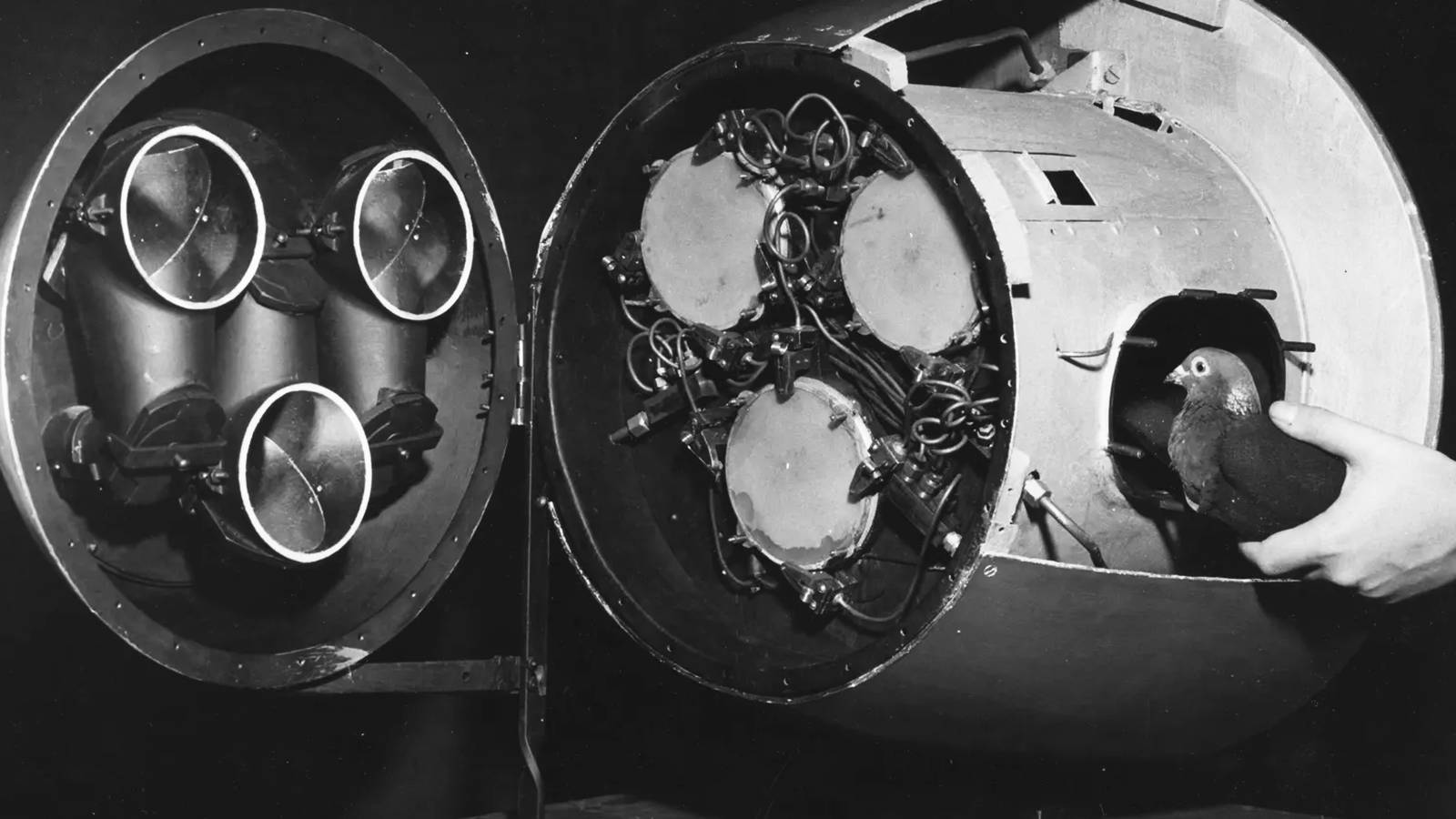

The United States once planned to drop more than 1,000 bomb-carrying bats over Japanese cities. A psychologist taught pigeons to guide missiles. Cold War troops were issued a recoilless weapon capable of launching a nuclear warhead. British engineers built a giant pair of rocket-powered wheels stuffed with explosives and expected the contraption to drive itself up a beach.
These weren’t concepts that lived only on paper. Every weapon on this list reached at least the prototype or testing stage. Several entered military service, and some were used in combat.
Here are 15 of the strangest weapons military engineers actually built.
1. The Bat Bomb: Bombs Strapped to Actual Bats
Status: Built and tested
The name leaves very little to the imagination.
During World War II, the United States developed a weapon that would release more than 1,000 hibernating Mexican free-tailed bats from a bomb-shaped container. Each bat carried a small timed incendiary device.
The plan was to drop the container over Japan before dawn. A parachute slowed its descent while the bats warmed and awakened. The container would open at roughly 1,000 feet, allowing the animals to scatter and roost beneath roofs and inside other hard-to-reach parts of Japan’s largely wood-and-paper buildings. Their incendiaries would then ignite.
The Navy eventually took control of the project under the wonderfully appropriate codename Project X-Ray. Despite extensive testing, the bats never made it into combat.
2. The Davy Crockett: A Nuclear Recoilless Rifle
Status: Fielded
Imagine giving an infantry unit its own nuclear weapon. The Army essentially did.
The Davy Crockett consisted of the M28 and M29 recoilless weapon systems and could launch the M388 nuclear projectile. It was intended to give infantry and armored formations a tactical nuclear capability against Soviet forces during the Cold War.
The Army kept the system in its inventory from 1961 to 1971. Soldiers trained with nonnuclear practice projectiles while the nuclear warheads remained under tighter control. Davy Crockett units were deployed with U.S. forces overseas, including in Europe.
The strange little weapon embodied an era when American planners were seriously preparing for nuclear weapons to be used on an ordinary battlefield.
3. Project Pigeon: A Bomb Guided by Pigeons
Status: Prototype built and tested
Before GPS, computerized guidance and sophisticated onboard sensors, psychologist B.F. Skinner offered the military another solution for steering a weapon toward its target. Pigeons.
During World War II, Skinner developed a guidance system in which trained pigeons sat inside compartments in a missile’s nose cone. The birds were taught to peck an image of the target through a window. Their movements could then provide guidance corrections.
A surviving prototype at the Smithsonian’s National Museum of American History has three pigeon compartments. The proposed design required agreement among the birds before the weapon would be released.
The military never fielded it. The pigeon nose cone, however, was very real.
4. Atomic Annie: A Cannon That Fired a Nuclear Bomb
Status: Fielded and nuclear-tested
The Army’s M65 280mm cannon was enormous even before someone decided to load an atomic shell into it.
Nicknamed Atomic Annie, the roughly 47-ton artillery piece was designed during the early Cold War to give ground forces a way to deliver nuclear weapons without relying on aircraft or missiles. Then the Army actually fired one.
During the Upshot-Knothole nuclear test series on May 25, 1953, an M65 fired an atomic artillery projectile during the Grable test at the Nevada Proving Ground. The weapon detonated about eight miles away.
It was the only nuclear artillery shell ever fired from an M65. Twenty of the cannons were produced and deployed to Europe and Asia, although none fired an atomic round in combat.
5. AIR-2 Genie: An Unguided Nuclear Air-to-Air Rocket
Status: Fielded
The Air Force once looked at formations of incoming Soviet bombers and decided accuracy was optional if the explosion was large enough.
The AIR-2 Genie was an air-to-air rocket carrying a nuclear warhead. It had no guidance system. An interceptor pilot would fire the rocket toward a bomber formation, and a timed detonation would allow the nuclear blast to do what a direct hit normally would.
On July 19, 1957, an F-89J fired a live nuclear Genie at 18,000 feet over Nevada during Operation Plumbbob. It remains the only U.S. test detonation of a nuclear-tipped air-to-air rocket.
Thousands of Genies were built, and the weapon remained in the Air Force inventory for decades.
6. The Great Panjandrum: A Rocket-Powered Exploding Wheel
Status: Built and tested
British engineers preparing for the invasion of Europe needed something capable of blasting through German beach defenses.
Their answer looked like a weapon invented for a cartoon.
The Great Panjandrum consisted of two steel wheels about 10 feet in diameter connected by a central cylinder that was intended to carry explosives. Rockets attached to the wheels would propel the entire device off a landing craft, across a beach and into German fortifications.
That was the plan, but during tests in 1943 and 1944, rockets detached and flew loose. The Panjandrum frequently refused to travel in a straight line. Trial footage preserved by the Imperial War Museums shows the weapon veering across a beach, falling over and shedding rockets as engineers attempted to control it.
It never saw combat.
7. Krummlauf: The Rifle That Shot Around Corners
Status: Built
Nazi Germany’s Krummlauf attempted to solve one of infantry combat’s oldest problems: How do you shoot someone without sticking your own head out first?
The device was a curved barrel attachment fitted to the StG 44 assault rifle. Versions could allow a soldier to fire from behind cover or permit troops inside armored vehicles to engage enemies approaching from blind spots. There was a problem with bullets turning corners.
The tremendous pressure quickly damaged the curved attachment, and bullets could shatter while traveling through it. An original 30-degree example survives in the Imperial War Museums collection.
8. Windkanone: Germany’s Anti-Aircraft Wind Cannon
Status: Built and tested
Late-war German weapons research produced plenty of machines that look strange in retrospect. The Windkanone, or Wind Cannon, earns its place near the top.
The device used the ignition of hydrogen and oxygen to produce an explosive blast of compressed air through a large upward-curving barrel. The intended target: aircraft.
Tests indicated the air blast could damage structures on the ground, but hitting a small, fast-moving aircraft was another matter. A Wind Cannon was installed on a bridge over the Elbe River in 1945.
It achieved no known success against Allied aircraft.
9. Goliath: A Remote-Controlled Exploding Mini-Tank
Status: Used in combat
The German Goliath looked like someone had scaled a tank down until a soldier could almost carry it.
It was really an expendable remote-controlled demolition vehicle.
Operators guided the small tracked machine toward bunkers, buildings, vehicles or other targets using a control cable trailing behind it. Battery-powered versions carried about 60 kilograms of explosives, while a larger gasoline-powered model could carry 100 kilograms.
Thousands were built during World War II.
The concept had obvious appeal, but battlefield conditions were not kind to it. Goliaths were slow, had poor ground clearance and depended on control wires that could be severed. Unlike many of Germany’s stranger experiments, though, the Goliath actually went to war.
10. The Sticky Bomb: A Glass Grenade Glued to Tanks
Status: Fielded
Britain needed anti-tank weapons quickly after losing enormous amounts of equipment during the evacuation from Dunkirk.
One result was the No. 74 anti-tank grenade, better known as the Sticky Bomb.
Early versions contained their explosive inside a glass flask wrapped in material coated with powerful adhesive. A protective metal casing kept the grenade from sticking to everything around it before use.
A soldier was expected to expose the adhesive surface and attach the bomb to enemy armor. Yes, wartime Britain really issued troops an explosive designed to be physically stuck onto a tank.
Millions of Sticky Bombs were eventually produced, though later versions replaced the fragile glass flask with plastic.
11. The Pedersen Device: The Gadget That Turned a Springfield Into a Semiautomatic
Status: Built for military service
A World War I infantryman carrying a bolt-action M1903 Springfield could theoretically transform his rifle into a semiautomatic weapon by removing the bolt and inserting a secret device carried on his belt. That was the Pedersen Device.
Designed by John Pedersen, the system fit into a specially modified M1903 and fired smaller .30-caliber pistol-type ammunition from a 40-round magazine. The modified rifle had an additional ejection port cut into its receiver.
Development was so secret that the military referred to the device as an “automatic pistol.” The war ended before it could be used as intended, and most of the devices were later destroyed. Surviving examples remain among the more peculiar artifacts of World War I small-arms development.
12. M50 Ontos: The Tiny Tank With Six Recoilless Rifles
Status: Used in combat
The Marine Corps’ M50 Ontos appears to have been designed under the principle that if one recoilless rifle is useful, six should settle the matter.
Ontos was a small, lightly armored tracked vehicle carrying six 106mm recoilless rifles mounted across its sides.
It was originally designed as an anti-tank weapon, but Marines found another use for it in Vietnam. Ontos crews fired the weapons against bunkers, fortified positions and enemy troops while supporting infantry operations.
Two Ontos platoons, for example, helped defend the combat base during the Battle of Khe Sanh.
It looked ungainly, but unlike several entries on this list, the Ontos proved useful enough once someone stopped insisting it fight the war it had originally been designed for.
13. Little David: America’s 36-Inch Mortar
Status: Built and tested
Calling this weapon Little David required a sense of humor. The American mortar had a bore 36 inches across and fired a projectile weighing roughly 3,650 pounds. Its barrel alone weighed about 40 tons.
The system grew out of equipment used to test large aerial bombs during World War II. As U.S. planners contemplated an invasion of Japan and the massive fortifications troops might encounter there, the enormous mortar was considered as a siege weapon.
The war ended before Little David could make the trip.
It never fired in combat, leaving behind one of history’s more imposing answers to the question of how large a mortar can reasonably become.
14. Vespa 150 TAP: The Anti-Tank Scooter
Status: Produced for French airborne forces
The French military managed to combine two objects rarely associated with each other: a Vespa and a 75mm recoilless cannon.
In the 1950s, the French Defense Ministry commissioned ACMA, Piaggio’s French licensee, to build a military version of the scooter for airborne forces.
The resulting Vespa 150 TAP could be dropped by parachute and carried a 75mm recoilless weapon, ammunition, fuel cans and a small trailer.
About 600 were produced between 1956 and 1959 for French paratroopers and the Foreign Legion. Despite weighing about 115 kilograms when configured for military use, Piaggio says the scooter could still reach roughly 60 kilometers per hour.
Few vehicles have ever looked more prepared to fight an armored vehicle and deliver someone’s lunch during the same trip.
15. Atomic Demolition Munitions: Nuclear Charges Carried by Army Engineers
Status: Fielded capability
Cold War nuclear planning eventually reached the point where even Army combat engineers had a nuclear mission.
Atomic Demolition Munitions, or ADMs, were relatively small nuclear explosive devices intended to destroy major infrastructure or create obstacles that enemy forces could not easily cross.
Army engineers trained to transport and emplace them. Historical Army material describes the ADM as giving combat engineers immense destructive power for creating barriers, while veterans of the program have recalled tactical nuclear devices roughly comparable in size to a beer keg.
The idea was chillingly straightforward. Rather than launch a nuclear weapon from an aircraft, missile or artillery piece, troops could place one where its blast would destroy a bridge, block a route or reshape terrain.
None was detonated in combat.
They nevertheless remained part of a Cold War in which nuclear weapons ranged from intercontinental missiles down to devices intended for soldiers working directly on the battlefield.
Military engineers have always been asked to solve problems that sounded impossible. Every so often, the solution was even stranger than the problem.
Read the full article here
