



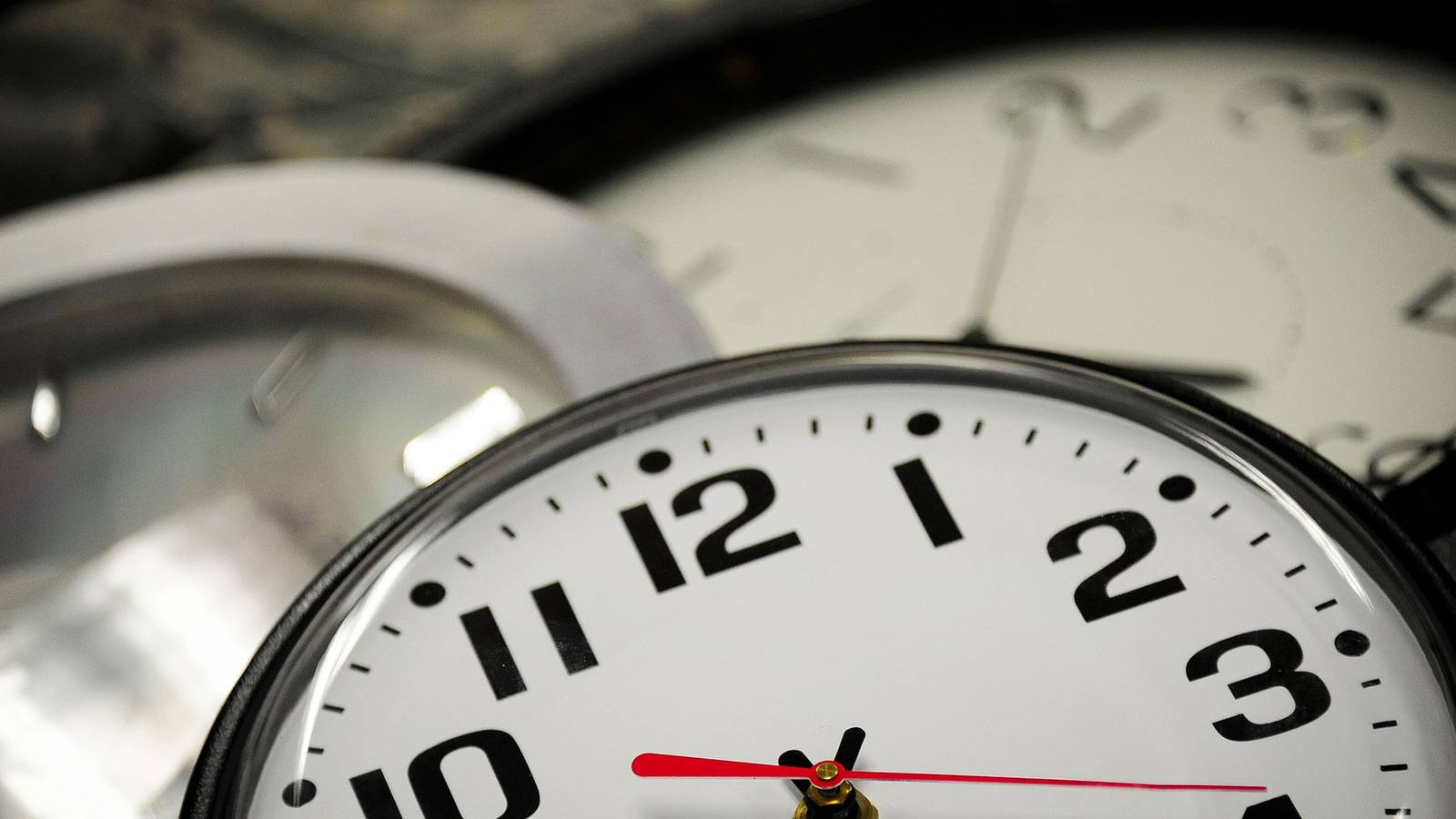

Military time, also known as the 24-hour clock, is a system the military uses to eliminate confusion between morning and afternoon hours, since the armed forces are in operation around the clock.
In military time, the day is divided into 24 hours, beginning at midnight (00:00) and ending at 23:59. Each hour is represented using four digits, with the first two digits indicating the hour and the last two digits representing the minutes. For example, 1:00 AM is written as 0100 hours, while 1:00 PM is written as 1300 hours.
Also called the “24-clock,” the format is commonly used in industries and professions worldwide in which 24-hour operations are routine, including law enforcement, fire departments, hospitals, aviation, railroads and other fields where precise timekeeping is crucial.
How to Read Military Time
There is no a.m. or p.m. in military time, as numbers are not reused, but instead, each hour has its own number.
Any given time of day is expressed in four digits. The day in military time begins at midnight with 0000, pronounced “zero hundred hours” or simply “zero hundred.”
You then add one hundred for each hour, so 1 a.m. is 0100 (zero one hundred) hours, 2 a.m. is 0200 (zero two hundred) hours and so forth.
In the four-digit expression of time, no colon separates the hours and minutes. For example, 6:30 a.m. in civilian time is written simply as 0630 in military time.
The morning hours are simple enough to understand. This ease continues through midday, which is 1200 (twelve hundred) hours.
Read More: Making Sense of Military Time
The military references to the afternoon and evening hours often take new enlistees in basic training longer to learn by heart.
After noon, instead of starting over with 1, military time continues chronologically, so that 1 p.m. is 1300 hours, 2 p.m. is 1400 hours and so forth.
The day ends just before midnight at what civilians would call 11:59 p.m., but which in military time is 23:59, or twenty-three fifty-nine hours.
For those still learning the 24-clock system, a simple way to translate afternoon and evening hours into civilian time is to subtract 12. For example, for 2000 hours, subtract 12 from 20 to get 8 p.m.
Read More: Military Lingo for New Military Spouses
Military Time Conversion Chart
12-Hour Clock
|
24-Hour Military Time
|
How to Say Military Time
|
|
12 midnight |
0000 |
Zero hundred (hours) |
|
1 a.m. |
0100 |
Zero one hundred (hours) |
|
2 a.m. |
0200 |
Zero two hundred (hours) |
|
3 a.m. |
0300 |
Zero three hundred (hours) |
|
4 a.m. |
0400 |
Zero four hundred (hours) |
|
5 a.m. |
0500 |
Zero five hundred (hours) |
|
6 a.m. |
0600 |
Zero six hundred (hours) |
|
7 a.m. |
0700 |
Zero seven hundred (hours) |
|
8 a.m. |
0800 |
Zero eight hundred (hours) |
|
9 a.m. |
0900 |
Zero nine hundred (hours) |
|
10 a.m. |
1000 |
Ten hundred (hours) |
|
11 a.m. |
1100 |
Eleven hundred (hours) |
|
12 noon |
1200 |
Twelve hundred (hours) |
|
1 p.m. |
1300 |
Thirteen hundred (hours) |
|
2 p.m. |
1400 |
Fourteen hundred (hours) |
|
3 p.m. |
1500 |
Fifteen hundred (hours) |
|
4 p.m. |
1600 |
Sixteen hundred (hours) |
|
5 p.m. |
1700 |
Seventeen hundred (hours) |
|
6 p.m. |
1800 |
Eighteen hundred (hours) |
|
7 p.m. |
1900 |
Nineteen hundred (hours) |
|
8 p.m. |
2000 |
Twenty hundred (hours) |
|
9 p.m. |
2100 |
Twenty-one hundred (hours) |
|
10 p.m. |
2200 |
Twenty-two hundred (hours) |
|
11 p.m. |
2300 |
Twenty-three hundred (hours) |
Why Does the Military Use 24-Hour Time?
One of the main advantages of using military time is eliminating ambiguity. Military routines and operations demand precision, and the use of the 24-clock system prevents any confusion over a.m. versus p.m.
“Precise time is crucial to navigation, geographical positioning for locating forces and targets, and secure communications,” according to the Encyclopedia of Military Science. “Military time, therefore, is more than a method for counting the hours. It’s also an authoritative source of time and a set of methods to disseminate synchronized time worldwide.”
Although the phrase “military time” is commonly used, this time system was not invented by the military. The 24-hour clock had already been employed throughout Europe for years before the U.S. military adopted it.
The U.S. Navy began using the 24-hour clock in 1920, after becoming familiar with it during World War I.
The U.S. Army didn’t officially adopt military time until 1942.
Read More: The Military Alphabet
Want to Know More About the Military?
Be sure to get the latest news about the U.S. military, as well as critical info about how to join and all the benefits of service. Subscribe to Military.com and receive customized updates delivered straight to your inbox.
Read the full article here
