



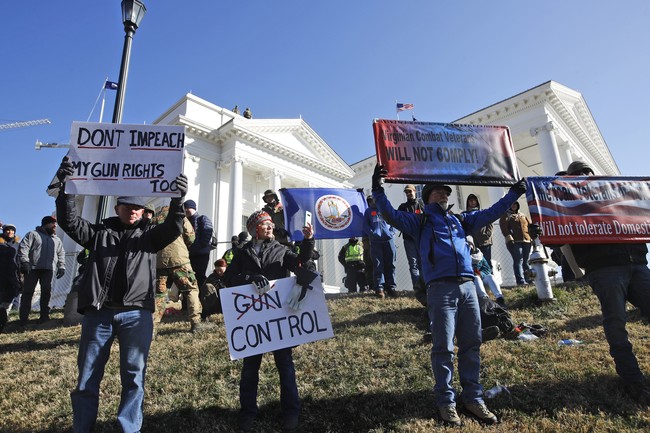

As a domestic violence survivor who understands the importance of self-reliance, firearms training, and advocacy for women’s empowerment, I’ve seen firsthand how critical the right to self-defense is when the system fails. Virginia’s 2026 legislative session recently delivered more than 20 new gun-related laws signed by Governor Abigail Spanberger, framed as “gun safety” measures. These include an “assault weapons” ban, “ghost gun” restrictions, expanded prohibitions tied to misdemeanor domestic violence convictions (closing the so-called “intimate partner loophole”), stricter firearm relinquishment rules under protective orders, and broader extreme risk protection orders (ERPOs, aka “red flag” laws).
While proponents claim these protect survivors, the reality is far different. These laws often disarm law-abiding victims and their households more effectively than they stop determined abusers. They create bureaucratic hurdles, due process concerns, and practical disarmament that leave women vulnerable precisely when danger peaks, during separation or when leaving an abusive relationship. Statistics oftencited show heightened risk in those moments, yet these policies prioritize restriction over self-defense.
Expansions to Substantial Risk Orders (ERPOs) broaden who can petition and grounds for removal, often on lower evidentiary standards. While intended to address threats, they risk abuse in domestic disputes. Ex parte orders can strip rights quickly based on accusations alone, with hearings later. False or retaliatory claims by abusers are common. For survivors, this creates legitimate fear: owning a gun for protection could lead to temporary (or effectively longer) disarmament via court order, leaving them defenseless. Due process concerns, including notices, hearings, evidence standards, remain inadequate in rushed legislative packages.
The new laws even further expand prohibitions. Misdemeanors that strip rights broadly, like HB19/SB160 expand firearm prohibitions to include convictions for assault and battery against “intimate partners,” not just spouses or household members. The intent of this legislation is to close what advocates call the “boyfriend loophole” but it raises serious issues for survivors. Misdemeanor convictions, often resulting from mutual altercations, false allegations in contentious divorces, or one-time incidents without severe injury, now trigger multi-year bans on possessing, purchasing, or transporting firearms.
For survivors, this is problematic. Abusers manipulate the system: they file countercharges, exploit vague statutes, or pressure victims into plea deals. A survivor who defends herself or has a minor charge from a chaotic relationship could lose her ability to carry for protection. Rural areas, like much of Virginia, have slow police response times; a three-year prohibition leaves an abuse victim vulnerable and exposed. Gun rights groups like the Virginia Citizens Defense League (VCDL) rightly argue that misdemeanors should not permanently or semi-permanently strip a fundamental civil right without robust due process.
What’s worse, these expansions feed into background check systems and private transfers, which also negatively affect domestic abuse victims. Survivors rebuilding lives may hesitate to own firearms for fear of legal entanglements, even if never convicted. Data on defensive gun uses shows firearms significantly deter or stop assaults, often without even pulling the trigger. Disarming potential victims through broad net policies undermines this.
Despite the potential for harm, Virginia legislators wasted no time updating firearm relinquishment rules, often not focusing on an individual, but the entire household. HB93/SB38 establishes clearer processes for transferring or surrendering firearms when someone is subject to a protective order or convicted of qualifying misdemeanors. The law requires transfer within tight timelines (e.g., 24 hours in some interpretations) to a person 21+ who does not live in the home. Courts can authorize searches if non-compliance is suspected.
On paper, this targets abusers and seems like a promising idea; however, in practice, it disarms cohabitants, especially victims, leaving them vulnerable to likely escalated violence from their abusers. Consider a married couple where the husband faces a protective order (sometimes granted ex parte with minimal evidence). The wife, a survivor, loses immediate access to jointly owned or home-defense firearms. Adult children or roommates in the household face the same problem. VCDL highlights cases where a wife’s shotgun for home defense becomes inaccessible, heightening vulnerability.
Survivors often stay in or return to shared homes initially due to finances, children, or other logistical issues. Removing guns from the household punishes the innocent. Abusers, by contrast, often ignore orders, hide firearms, or obtain them illegally, obtaining them through straw purchases, or black-market sources. The laws focus on compliant owners and burdens victims who rely on those guns for safety. Studies and real-world accounts show many domestic homicides involve abusers who were already prohibited but non-compliant.
To make the attack on individual liberty even worse, Virginia Democrats are focused on the latest political buzz: “Assault Weapons” Ban and magazine limits. We all know of SCOTUS rulings and the use of “in common use” as a protection for common modern firearms, but constitutionality is irrelevant when the goal is limiting self-defense tools. Virginia’s new ban on the sale, manufacture, and transfer of certain semi-automatic firearms (often labeled “assault weapons”) and high-capacity magazines (over 15 rounds in some proposals) takes effect July 1, 2026, with grandfathering for existing owners but restrictions on transfers.
For domestic violence survivors, especially single mothers or those in isolated areas, semi-automatic rifles, pistol caliber carbines (PCC’s) and standard-capacity magazines are often the most effective tools for home defense against multiple threats or stronger attackers. Handguns have limitations in capacity and recoil management under stress; long guns provide better accuracy and stopping power for many women. Banning future access or complicating transfers limits options as families grow or situations evolve.
Yet again, more failed policies ahead given criminals don’t obey bans. Survivors training at ranges or inheriting family firearms now must navigate a giant hill of formidable restrictions that discourage ownership. As a firearms instructor, I’ve trained countless women who gained confidence through accessible, effective tools. These laws erode that. Beyond core DV measures, the package includes ghost gun bans, safe storage mandates, industry accountability (potentially enabling lawsuits), and more. Cumulatively, they signal distrust of law-abiding citizens. For domestic violence victims, delayed access/waiting periods or allowing hurdles (when they are expanded) endanger those fleeing abuse who need immediate protection.
Additionally, victims face bureaucratic burdens: Relinquishment, reporting, and compliance drain time, money, and emotional energy from survivors already navigating courts, housing, and safety planning. Theserestrictions also have a negative effect on training. Fear of mis-stepping under complex rules discourages range time, carry permits, and skill-building for responsible, law-abiding abuse survivors that are essential for self-defense, all the while ignoring root causes: the laws target tools while abusers exploit failures in enforcement, prosecution, and cultural accountability.
Many survivors credit firearms with survival, with an estimated (yet rarely statistically tracked) millions of defensive uses annually, and sadly, these laws completely dismiss these statistics. As someone who values my life more than an abuser or predator’s andtrained to be my own protector amid slow rural response, I know guns in the hands of good people save lives. Despite reality, Virginia’s laws now assume: DISARMAMENT EQUALS SAFETY.
These gun control policies compound trauma for survivors by eroding autonomy. True protection empowers women with training, situational awareness, and constitutional rights; not more paperwork and prohibitions that hit the innocent hardest. Abusers will always find ways to obtain guns if they want them. Survivors deserve every tool to defend themselves and their families. Virginia lawmakers should revisit these with input from actual survivors who carry, train, and advocate, not just those pushing blanket restrictions.
Self-defense is a human right, especially for those the system has already failed.
If Virginia lawmakers genuinely want to keep people safe, they should prioritize empowerment for victims over giving the false sense of security that comes with gun control.
Editor’s Note: The radical Left will stop at nothing to enact their radical gun control agenda and strip us of our Second Amendment rights.
Help us continue to report on and expose the Democrats’ gun control policies and schemes. Join Bearing Arms VIP and use promo code FIGHT to receive 60% off your membership.
Read the full article here
