



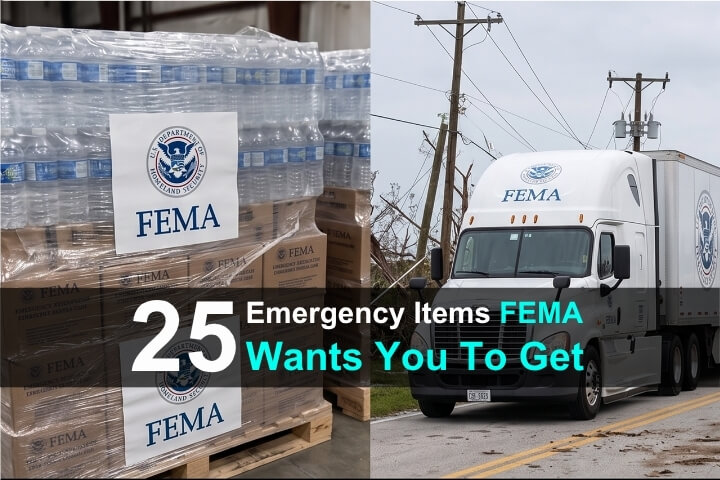


FEMA is a somewhat controversial government agency. Some people love FEMA because they bring food and supplies after a disaster. Other people hate them because they don’t bring enough food and supplies after a disaster (or not quickly enough).
Some people say FEMA is inefficient and a waste of tax money. Other people argue that they wouldn’t be so inefficient if they were properly funded. But whatever you think of FEMA, the people working there want you to be prepared.
Why? Because the more prepared you are, the less you’ll rely on them for help when disaster strikes (and they can only help so many people).
Want to save this post for later? Click Here to Pin It On Pinterest!
On their website, FEMA lists 11 items you should have in your basic emergency supply kit:
- Water – Store at least one gallon per person per day, with a minimum three-day supply for evacuation or a two-week supply for sheltering in place. In a disaster, municipal water systems can fail or become contaminated, making stored water one of the most critical supplies you can have.
- Food – Stock non-perishable items like canned goods, peanut butter, crackers, and energy bars that require little to no cooking. Aim for at least a three-day supply, and choose foods your family actually eats to avoid waste.
- Radio – A battery-powered or hand-crank NOAA weather radio lets you receive emergency alerts even when the power grid and cell networks are down. Look for one with multiple charging options — hand crank, solar, and battery — for maximum reliability.
- Flashlight – A reliable flashlight is essential for navigating in the dark during power outages and signaling for help. LED flashlights are preferred for their long battery life; keep extra batteries stored alongside it.
- First aid kit – A well-stocked first aid kit lets you treat cuts, burns, sprains, and other injuries when professional medical help is unavailable or delayed. At minimum it should include bandages, antiseptic wipes, gauze, medical tape, pain relievers, and disposable gloves.
- Whistle – A whistle can signal rescuers far more effectively than shouting, requiring far less energy and carrying much farther. Choose a pealess whistle (no moving ball inside) so it won’t jam or freeze in wet or cold conditions.
- Dust mask – In the aftermath of earthquakes, building collapses, or wildfires, the air can be filled with dangerous particulates, smoke, and ash. An N95 respirator offers significantly better protection than a basic dust mask and is worth the small extra cost.
- Sanitation supplies – When sewage systems fail and clean water is scarce, basic hygiene becomes critical for preventing the spread of disease. Stock moist towelettes, hand sanitizer, garbage bags, plastic ties, and toilet paper to maintain sanitation during an extended emergency.
- Wrench or pliers – After a disaster, you may need to shut off your home’s gas or water lines quickly to prevent fires, flooding, or further damage. Keep an adjustable wrench near your main shutoffs and make sure all household members know how to use it.
- Can opener – A manual can opener is a simple but often-overlooked item that becomes critical when you’re relying on canned food and have no power. Keep a sturdy, non-electric model in your kit — not the cheap kind that breaks after a few uses.
- Local maps – If cell towers go down or your phone battery dies, GPS navigation becomes useless. Printed maps of your local area and region let you navigate evacuation routes and find emergency shelters without relying on any technology.
In the video below, Survival Know How examines their list and explains what he likes and what he would add to it.
On their website, FEMA also lists 15 items you should have in addition to your basic supplies.
- Prescription drugs/glasses – Keep at least a week’s supply of critical prescription medications in your emergency kit, and ask your doctor or pharmacist about getting an emergency supply. If you wear glasses or contacts, include a backup pair.
- Infant formula/diapers – Families with babies need to stock enough formula, diapers, and wipes to last at least several days, since these items disappear quickly from store shelves during emergencies. Don’t forget a manual bottle brush and sterilization tablets if clean water for washing is uncertain.
- Pet food/extra water – Pets are family, and they need their own emergency provisions so plan for at least three days of food and water for each animal. Also include a copy of vaccination records, any medications, and a carrier or leash, since many emergency shelters require proof of vaccination.
- Important documents – Keep copies of critical documents like IDs, passports, insurance policies, bank account information, property records, and medical records in a waterproof, portable container. A digital backup stored on an encrypted USB drive or a secure cloud service adds another layer of protection.
- Cash or traveler’s checks – During a widespread disaster, ATMs and card payment systems often go offline, making cash the only way to purchase supplies. Keep small bills on hand, as making change may be difficult when systems are strained.
- Emergency preparedness book – When power is out and you can’t search the internet for instructions, a printed reference guide on first aid, water purification, and survival skills is invaluable. The American Red Cross First Aid & Survival Manual is one popular option worth keeping in your kit.
- Sleeping bag/blanket – If you’re forced to evacuate or lose home heating, a sleeping bag rated for cold temperatures or a compact emergency Mylar blanket can prevent hypothermia. Mylar blankets are especially practical. They fold down to the size of a deck of cards and reflect up to 90% of body heat.
- Change of clothing – Pack at least one complete change of clothing and sturdy, closed-toe shoes for each family member. Include weather-appropriate layers — a disaster in summer and one in winter require very different gear.
- Chlorine bleach – Unscented liquid chlorine bleach (6–8.25% sodium hypochlorite) can be used to disinfect water in a pinch: roughly 8 drops per gallon of clear water. It also doubles as a disinfectant for surfaces and sanitation tools, making it one of the most versatile items in your kit.
- Fire extinguisher – During a disaster, fire departments may be overwhelmed and unable to respond quickly to small fires. Keep a multi-purpose ABC dry-chemical extinguisher in your home and make sure everyone in the household knows how to operate it.
- Firestarters – The ability to start a fire provides warmth, a way to cook food, a means to purify water, and a morale boost in a prolonged emergency. Keep multiple methods (waterproof matches, a lighter, and a ferrocerium fire starter) since any one method can fail.
- Feminine supplies – Feminine hygiene products are essential for roughly half the population and should be stocked in adequate quantities for any extended emergency. They also have secondary uses: menstrual pads make excellent wound dressings in a pinch due to their high absorbency.
- Mess kits – Lightweight camping-style mess kits (plate, bowl, cup, and utensils) make it much easier to prepare and eat food in a field or shelter setting. Opt for durable, BPA-free plastic or stainless steel sets that can be cleaned with minimal water.
- Paper and pencil – When phones and electronics fail, a notepad and pencil become your primary communication tools for leaving messages, recording important information, and keeping notes. Paper degrades over time, so replace your supply every year or two.
- Books, games, etc. – Extended emergencies, especially those requiring shelter-in-place for days or weeks, take a significant psychological toll, particularly on children. Low-tech entertainment like card games, board games, and books helps maintain morale and provide a sense of normalcy.
Survival Know How examines this list as well in the video below.
You can check out the list for yourself by visiting Ready.gov.
Like this post? Don’t Forget to Pin It On Pinterest!
You May Also Like:

Read the full article here
