



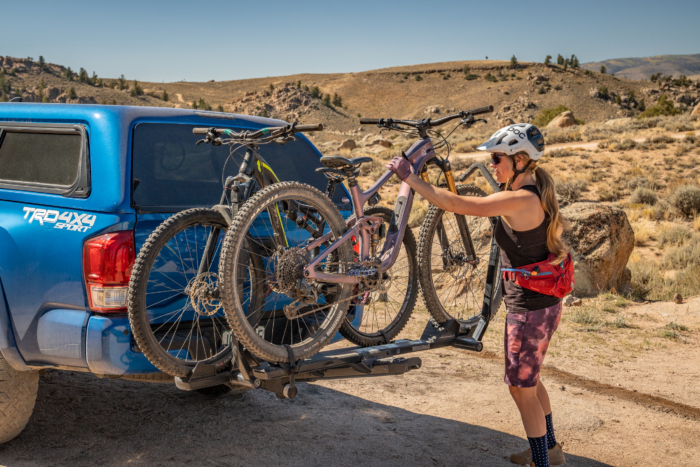

Hitch bike racks are arguably the easiest, safest way to transport bikes to a trailhead or campout. Based in Colorado, lead tester Eric Phillips has spent hundreds of hours testing five hitch racks with a variety of mountain bikes and electric bikes over the past six months including local circuits and a road trip to Utah.
After thousands of hours of testing on racks since 2022, it’s clear that the 2-bike Küat Piston Pro X sets the bar among plush designs, with hydraulically actuated wheel clamps, LED lights, and robust security features. Meanwhile, the 2-bike Küat Piston Ion offers a 100-pound rating suitable for e-bikes, RVs, and off-road use.
Factors like bike compatibility, weight limits, bike attachment style, and number of bikes all play a role in finding the right rack. All of these tester-approved racks are easy to use, stable, and carry a range of bike sizes and styles.
Editor’s Note: We updated our Hitch Bike Racks buyer’s guide on May 15, 2026, with a Bottom Line take at the top of each review, plus copy that is more educational, clear, and scannable.
The Best Hitch Bike Racks of 2026
Best Overall Hitch Bike Rack
9.1/10 RATING
Best Budget Hitch Bike Rack
7.5/10 RATING
Best Premium Hitch Bike Rack
8.2/10 RATING
Best Hitch Bike Rack for E-Bikes & RVs
8.4/10 RATING
Best 4-Bike Hitch Rack
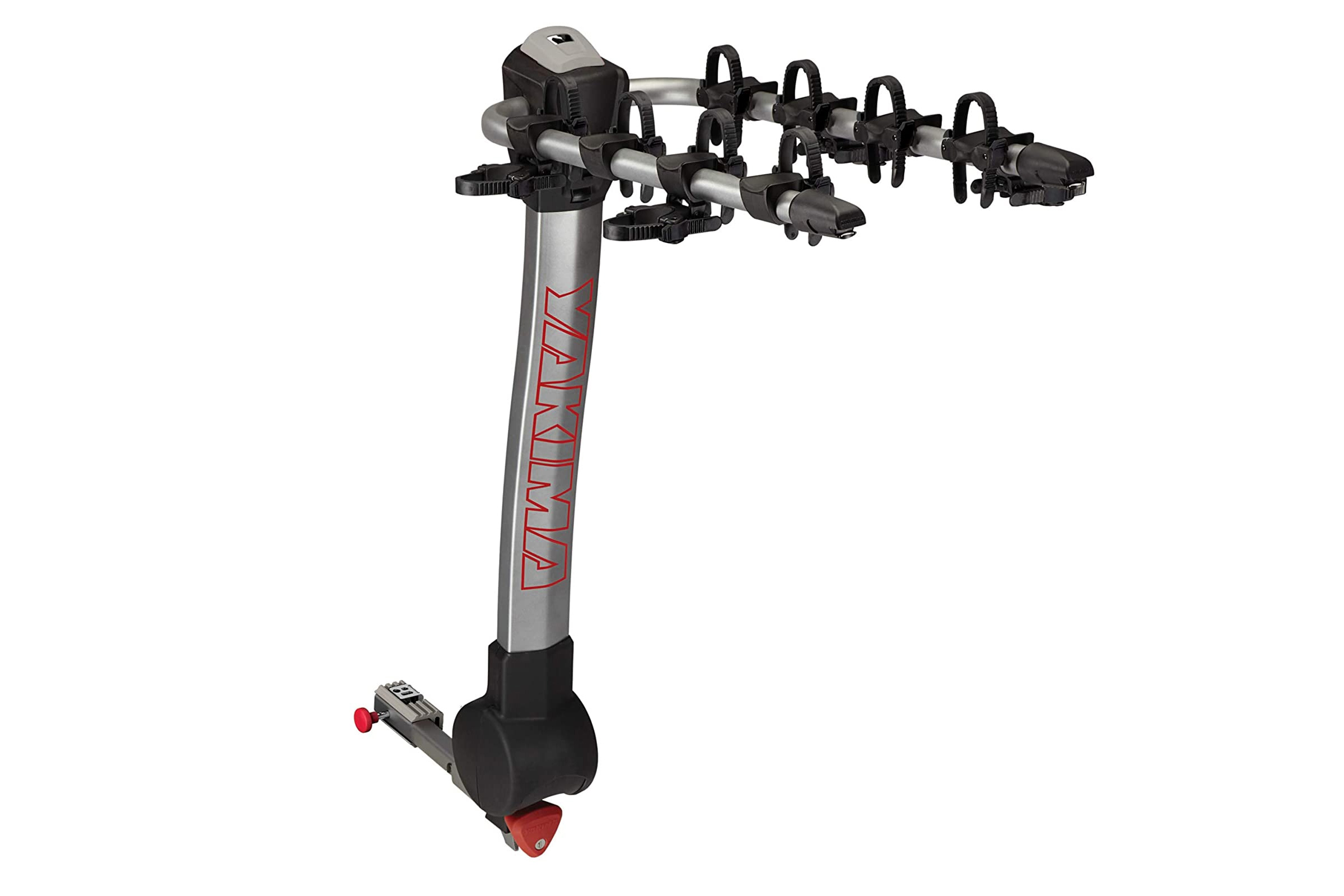
8/10 RATING
Best Swing-Away Hitch Rack
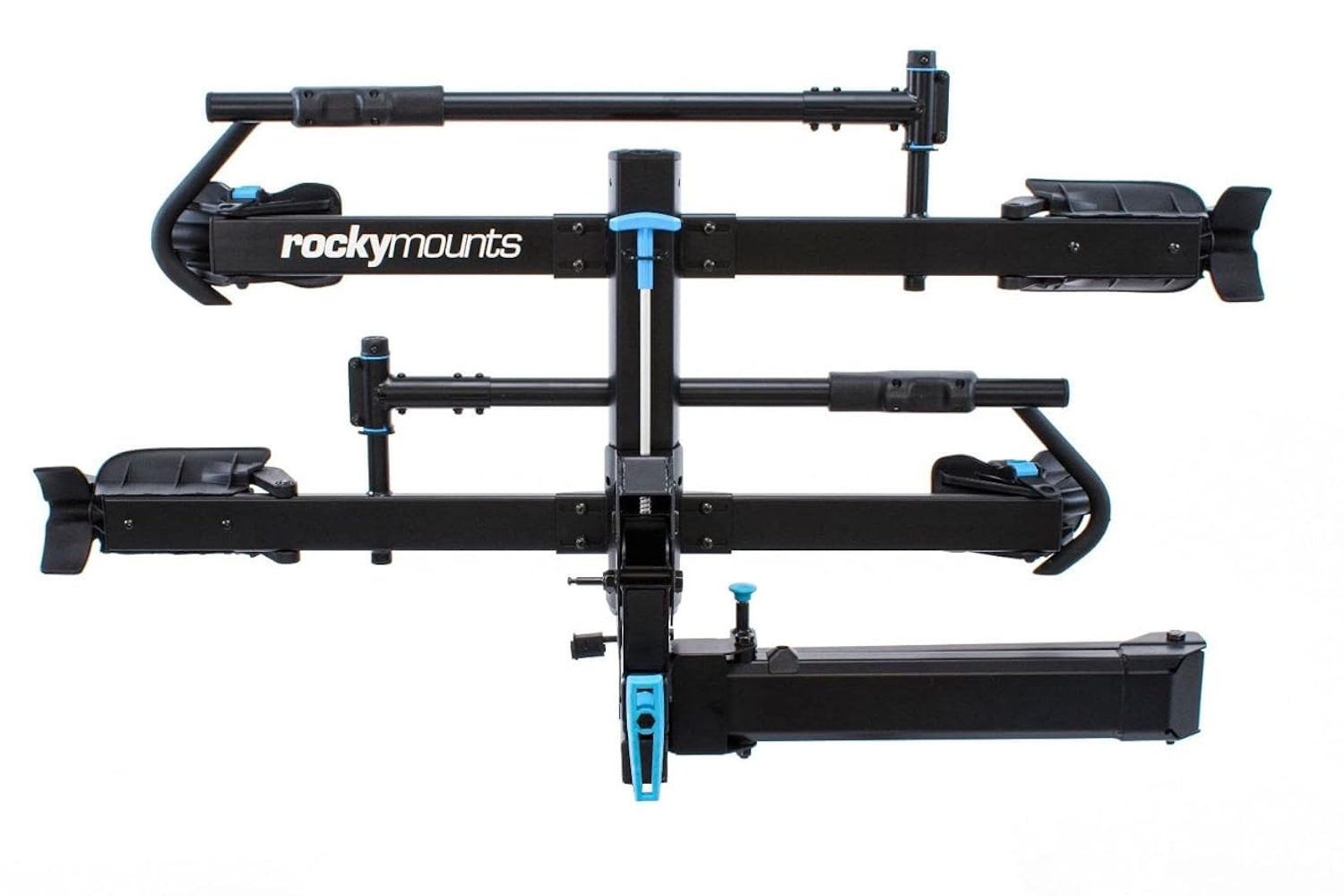
8.3/10 RATING
Best Heavy-Duty Platform Rack
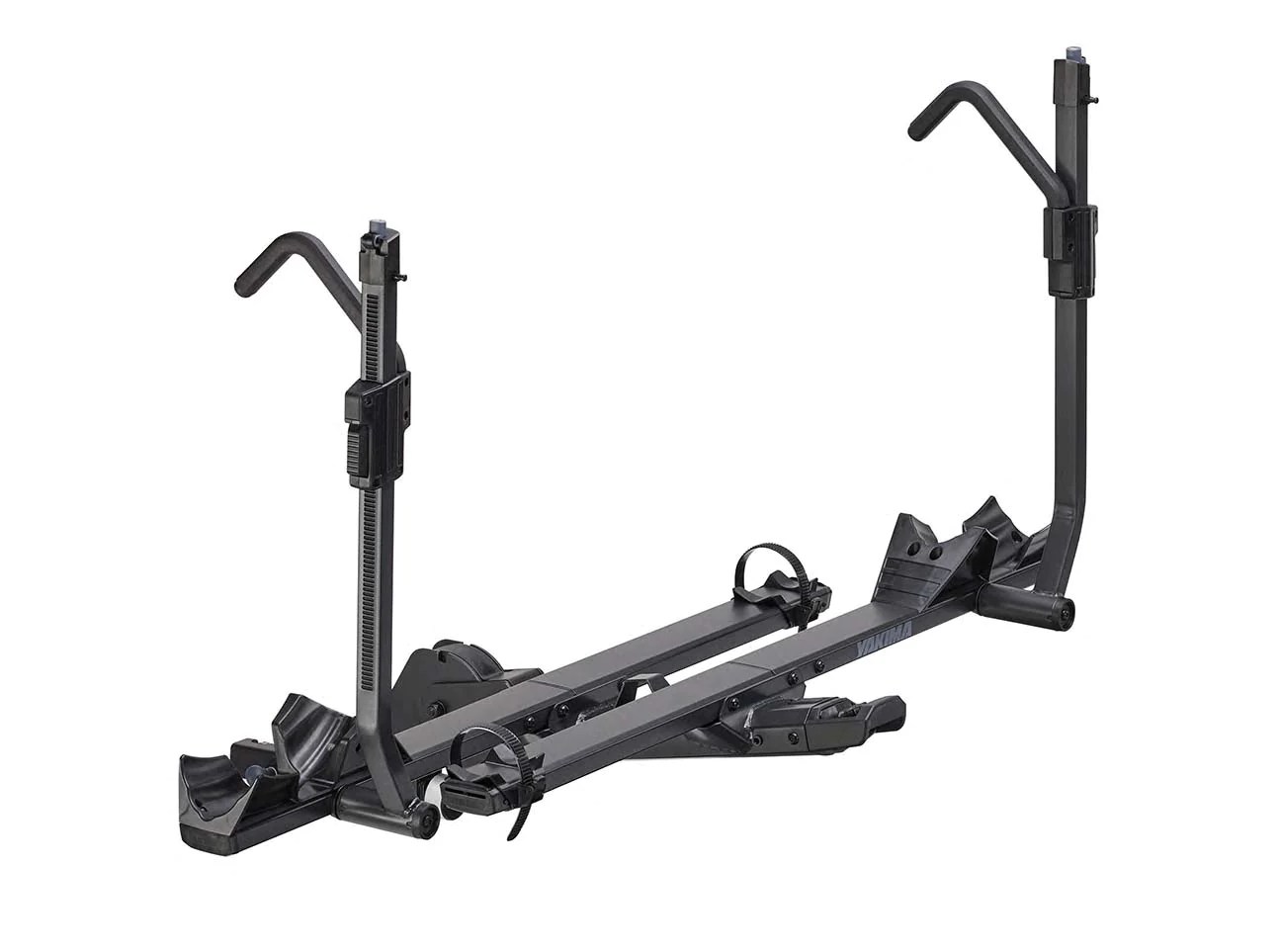
8.4/10 RATING
See more picks
Number of bikes
2 (up to 4 with add-on)
Carry capacity
60 lbs. per bike (2″), 55 lbs. (1.25″)
Hitch receiver options
1.25″, 2″
Locks
Integrated receiver lock, included cable lock
Pros
- Easy to load and unload
- Wide range of bike fit
- Hold bikes securely and with no frame contact
- Stable in transit
- Cable lock for bikes included
Cons
- Lots of plastic parts
- 60-pound weight limit is no longer class-leading
- Expensive
Bottom Line: The Thule Verse is a premium, flagship platform rack that sets a standard for ergonomics and ease of use. It’s the best versatile, heavy-duty carrier that handles everything from fat bikes to e-MTBs with zero frame contact and a best-in-class locking system.
The Thule Verse ($1,000) slots into the brand’s lineup as the premier flagship model, building upon the legacy of the T2 Pro XTR. It introduces significant upgrades in ergonomics and compatibility, making it one of the most user-friendly racks on the market. Today, it remains the gold standard for those who prioritize a no-compromise loading experience and need a rack that can transition between paved highways and rugged forest service roads. From highway to gravel roads, former editor Jeremy Benson put the Verse to the grindstone for a couple of months on daily outings for gravel and mountain bike rides.
The Tech: The Verse is a platform-style rack that secures bikes via a refined front-wheel hook design, ensuring zero frame contact — crucial for carbon fiber bikes. The 2-inch receiver version supports two bikes up to 60 pounds each, while the 1.25-inch version handles 55 pounds per bike. It accommodates massive 53-inch wheelbases and tires up to 5 inches wide. A key update is the availability of the Verse 2-Bike Add-On, which allows the 2-inch model to expand into a 4-bike carrier. For security, Thule upgraded to a 12mm-thick braided steel cable and the AutoAttach anti-wobble system, both of which utilize integrated lock cores to secure the rack to your vehicle and bikes to the rack.
What We Like: Loading is nearly effortless thanks to the improved release handles and tool-free lateral adjustment, which allows you to slide the bike trays side-to-side to prevent handlebar-to-saddle interference. The tilt-release handle, located at the end of the rack, remains the best in the industry, allowing easy trunk access even when the rack is fully loaded. We are also impressed by the RV-compatible rating (with a 40% weight reduction), making it a rare high-end platform rack safe for motorized RV use. The inclusion of a robust cable lock is a massive improvement over the thin, retractable cables found on previous generations.
What We Don’t: The high entry price is further increased if you want the best accessories, such as the transport wheels or the foldable loading ramp. While the 60-pound limit is generous, some of the heaviest modern e-bikes may still exceed the per-tray capacity. Additionally, while Thule uses premium materials, the rack still features several plastic covers and levers. While we haven’t seen failures yet, long-term UV exposure and salt can be a durability concern for plastic components compared to all-metal boutique racks.
Should You Buy It? If you are looking for the most refined, ergonomically superior rack available today, the Verse is the winner. It is ideal for e-bike owners who need a high weight capacity and riders with multiple bike styles who value an easy, set-and-forget mounting system. While expensive, its blend of security, ease of use, and expansion options makes it a long-term investment that simplifies every trip to the trailhead.
Number of bikes
2, expandable up to 4
Carry capacity
65 lbs. per tray
Hitch receiver options
2” & 2.5”
Locks
Integrated hitch lock, no bike lock
Pros
- High ground clearance for off-roading
- Highly durable materials
- Anti-wobble feature perfect for rough roads
- No assembly required — rack comes ready to go out of the box
Cons
- No integrated bike locks
- Rack-tilt bar can be hard to reach and pull when loaded
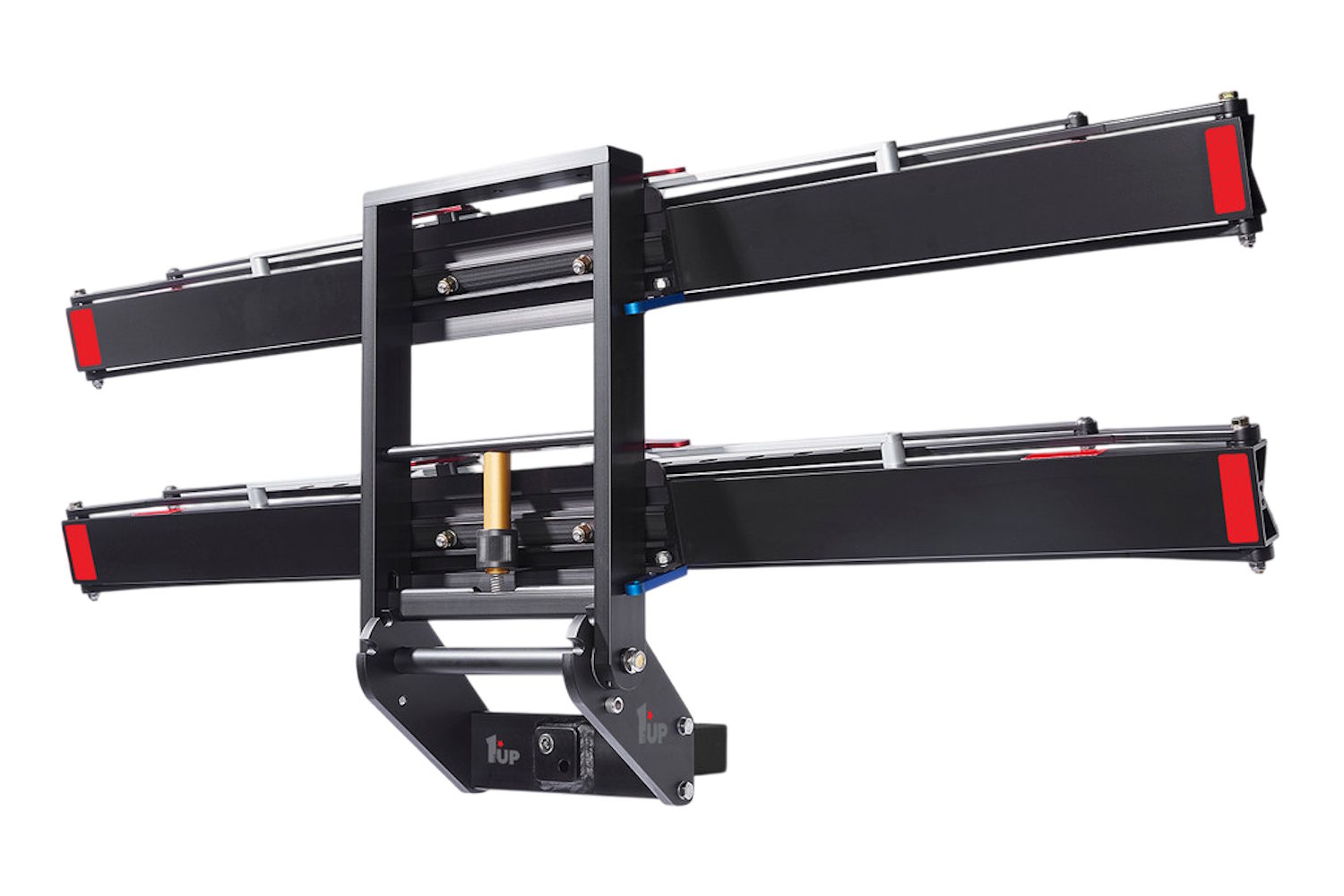
Bottom Line: The 1Up Heavy Duty is a legendary, all-metal platform rack built for extreme off-road durability and long-term serviceability. It’s the gold standard for riders who frequent washboard roads and rugged terrain, offering a rock-solid hold with zero frame contact.
The 2-bike 1Up Heavy Duty ($750) has long set the bar for keeping bikes secure, no matter how rough the road gets. While other racks rely on plastic components, 1Up utilizes a 100% aluminum construction that is designed to be fully serviceable. Today, it remains a favorite for overlanders and backcountry explorers who need a rack that can survive deep ruts, stream crossings, and thousands of miles of vibration.
The Tech: This tray-style rack handles everything from 16-inch to 29-inch wheels and tires up to 3 inches wide (expandable to 5 inches with the optional Fat Bike Kit). It is rated for 65 pounds per tray, making it compatible with most e-bikes. A hallmark of the 1Up design is the Dual-Arm over-the-tire hold, which touches only the rubber and never the bike frame. The 2-inch receiver version features a unique corner-expander anti-wobble system that is tightened with a proprietary security tool, effectively welding the rack to the vehicle’s hitch.
What We Like: The off-road prowess of this rack is unmatched. Lead tester Eric Phillips tested it on the roughest backroads of Crested Butte, Colorado, and was impressed by the upward-angled design that significantly improves ground clearance and departure angles for high-clearance vehicles. Because the rack is made of anodized and powder-coated aluminum, it is virtually impervious to rust and can be easily repaired with off-the-shelf hardware if a part is damaged. Best of all, it arrives fully assembled and ready to mount straight out of the box.
What We Don’t: Our main gripe? The ergonomics of the tilt-release handle, which is tucked awkwardly underneath the rack. It often requires two hands to operate, especially when fully loaded. It also lacks integrated locks, meaning you have to purchase 1Up’s proprietary hitch and cable locks separately. Compared to modern rivals like the Saris MHS 2, the 1Up feels more like a piece of industrial machinery than a consumer-friendly accessory — it’s functional, but less polished.
Should You Buy It? If you prioritize a rugged, all-metal build that will last for decades over integrated bells and whistles, this is the rack for you. It’s a tank designed for riders who venture off the map. While the EZ Pull Handle ($99) and lock kits are extra expenses, they turn this rugged base into one of the most capable, feature-rich systems on the market.
Read Review: Küat’s Piston Pro X Hitch Bike Rack Is One-Hand Operable, Extra Safe
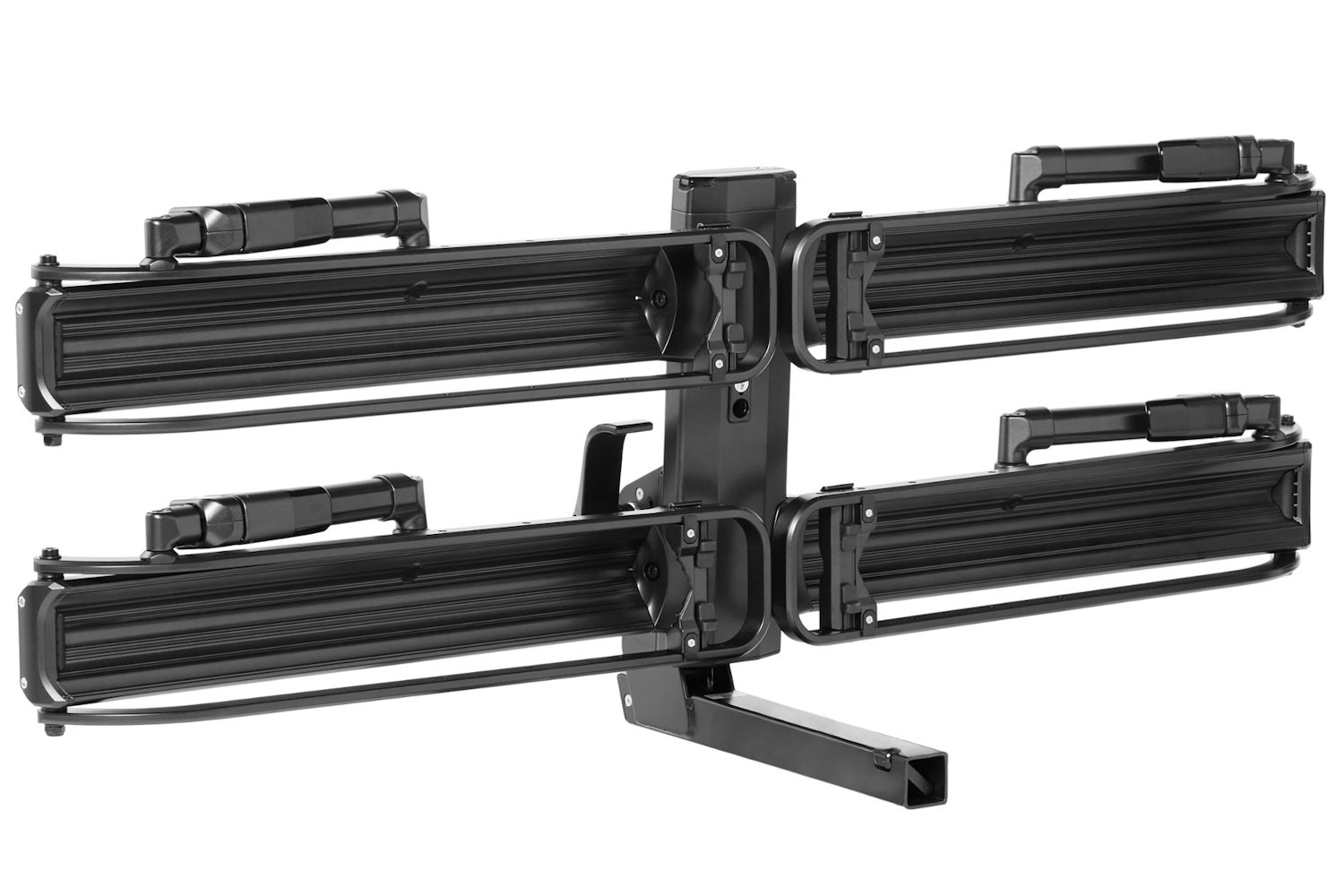
Bottom Line: The Küat Piston Pro X is a masterpiece of automotive engineering, combining ultra-premium materials with unmatched ease of use. If you want the most visually stunning, mechanically advanced rack on the market — and are comfortable with the $1,500+ price tag — this is an undisputed choice.
If budget isn’t a concern and you want the best-looking and highest-performing hitch rack available, the 2-bike Küat Piston Pro X ($1,589) is it. Not only does it have a super-sleek design, but it continues to set the standard with a high weight limit, incredibly versatile bike fit, and hydraulically actuated wheel clamps. It is arguably the best rack on the market — if you can afford it. Contributor Berne Broudy tested the Piston Pro X from heavy rain to muggy, warm days in the Northeastern U.S.
The Tech: The Piston Pro X features flat bike trays and opposing front- and rear-wheel clamps that secure the bike with zero frame or rim contact. Its namesake, OneTap hydraulic piston arms, open automatically with the touch of a lever; a true one-handed operation. It accommodates wheel sizes between 18 inches and 29 inches, tires up to 5 inches wide, and wheelbases up to 53 inches without any tools or adapters. Now, the weight limit remains a stout 67 pounds per bike (60 pounds for the 1.25-inch version), easily handling heavy e-bikes.
What We Like: This rack is as functional as it is beautiful. The genuine Kashima-coated struts ensure the arms slide smoothly for years, while the integrated LED taillights (which connect via a flat 4-pin harness) provide added safety by mirroring your vehicle’s turn signals and brake lights. The PedalPivot foot lever allows you to tilt the rack down for trunk access even when fully loaded, and the 10-year no-fade powder coat ensures it stays looking showroom-new.
What We Don’t: At 63 pounds, the Piston Pro X is heavy and bulky, making it a permanent fixture for most users rather than something you’d want to take off and store weekly. The price is also a significant hurdle — it is one of the most expensive racks ever produced, especially once you add the 2-bike expansion or the e-bike loading ramp. While it is nearly all metal, the high-tech hydraulic components introduce more complexity than a simple manual rack.
Should You Buy It? If you have a high-end vehicle and want a rack that matches its aesthetics and performance, the Piston Pro X is the ultimate choice. It’s perfect for e-bike owners who need effortless loading and riders who refuse to compromise on style or security. If you’ve got the cash to splash, this is the best hitch bike rack you can buy.
Carry capacity
100 lbs. per tray, 80 lbs. mounted to RV
Hitch receiver options
2”
Locks
Integrated hitch lock, integrated cable lock
Pros
- RV- and off-road-rated (100 lbs. capacity)
- Quick-adjust fender compatibility
- Integrated hitch and cable locks
- Light and license plate kit maintains full legality
Cons
- Pricey
- Tilt-away feature could interfere with truck tailgates
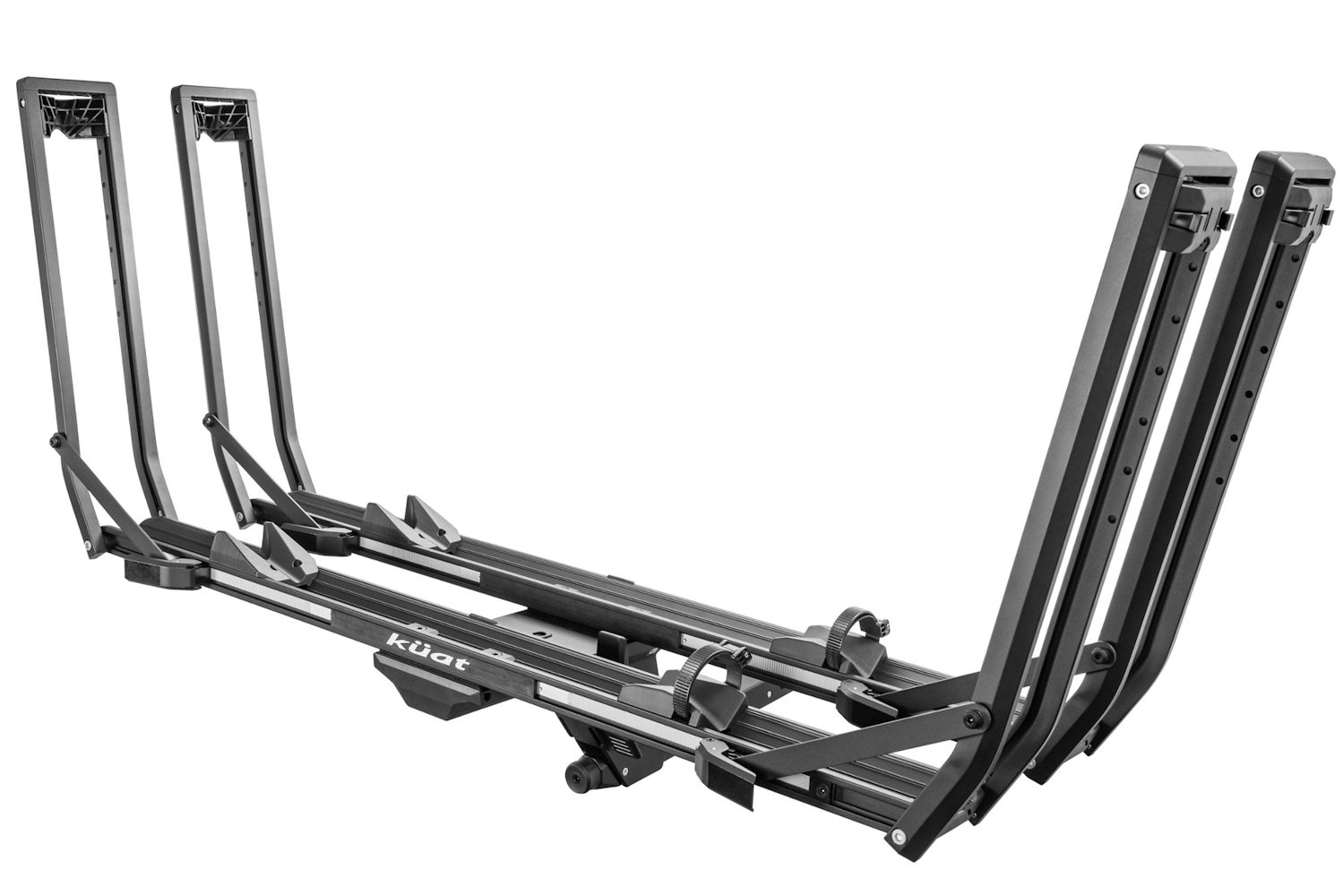
Bottom Line: The Küat Piston Ion is an overbuilt, heavy-duty masterpiece specifically engineered for the e-bike and RV crowd. With a massive 100-pound per tray capacity and an included loading ramp, it’s the premier choice for riders who need to transport the heaviest electric rigs without breaking their backs.
Küat knows how to make a rack that performs as well as it looks, and the 2-bike Küat Piston Ion ($1,289) is no exception. Today, it stands out as the ultimate e-bike solution, featuring a powder-coated exterior, integrated lighting, and a robust build suitable for RVs and off-road travel. We tested the rack on the roughest backroads of Crested Butte, Colorado, where lead tester Eric Phillips subjected it to everything from washboard gravel to technical trails.
The Tech: The Ion is designed for heavy lifting, with each tray rated for a staggering 100 pounds. Note that this rating drops to 80 pounds when mounted to an RV and 50 pounds when heading off-road. It is compatible with almost all wheel sizes (18 to 29 inches) and includes movable wheel chocks that are fender-friendly — a rarity in the platform world. For stability, it utilizes the patented Flatlock Hitch Cam, a tool-free anti-wobble system that hand-tightens to lock the rack into the receiver.
What We Like: This rack is a beast of convenience. It comes with an extendable loading ramp to eliminate the need for deadlifting heavy e-bikes, and it is rated for all RV types, including Class B motorhomes and Sprinter vans. We also love the optional light and license plate kit, which connects via a 4-pin trailer plug to ensure your turn signals and brake lights remain visible and your vehicle stays street-legal even with a full load.
What We Don’t: Our main issue is the Hitch Cam geometry. When fully tightened, it slightly shifts the rack to one side. During Phillips’ testing with a 2014 Ford F-150, this shift caused the tailgate to hit the rack when lowered, which could lead to damage or interference with truck-bed drawer systems. Additionally, while the loading ramp is a back-saver, it must be stored separately in your vehicle rather than on the rack itself, making it one more thing to remember (or lose).
Should You Buy It? If you own a heavy e-bike or travel in a camper van, the Piston Ion is the most secure and capable transport option on the market. It provides immense confidence when the pavement ends, ensuring your expensive investment makes it to the trailhead safely. The high-end finish and integrated security mean you’ll likely never want to take it off your hitch.
Carry capacity
40 lbs. per bike
Hitch receiver options
1.25″ and 2″
Locks
SpeedKnob locks rack to vehicle, cable lock for bikes sold separately
Pros
- Ease of use
- Lightweight and easy to store
- Affordable
- Integrated bottle opener
Cons
- Cable lock not included
- Impossible to avoid frame contact
- Frame adapters are separate purchases
Bottom Line: The Yakima RidgeBack is the ultimate set it and forget it hanging rack for families or groups on a budget. While it trades the precision of a platform rack for a simpler hanging design, it is one of the most reliable, user-friendly ways to transport four bikes without breaking the bank.
We’ve often felt that the best features are the ones you don’t notice, and the 4-bike Yakima RidgeBack ($479) is an excellent example of this. It strikes a perfect blend of features and simplicity. Now, it remains a top choice for those who need high-capacity transport that is easy to store and even easier to install.
The Tech: The RidgeBack is a hanging-style rack that supports up to four bikes by the top tube. It features two support arms equipped with eight padded, anti-sway cradles — two per bike — designed to minimize bike-to-bike contact. The ZipStrip ratcheting straps are fully removable and offer a much faster securement than traditional rubber straps. Installation is entirely tool-free thanks to the locking SpeedKnob, which expands the wedge inside the hitch receiver to eliminate wobble.
What We Like: This rack is remarkably easy to live with. It arrives fully assembled in the box and can be mounted in minutes. The UpperHand lever makes tilting the rack down for trunk access a one-handed affair, and the entire unit folds flat against the vehicle when not in use. As a bonus, Yakima’s signature integrated bottle opener is located at the end of the arm for post-ride celebrations.
What We Don’t: Because this is a hanging rack, frame contact is unavoidable, making it a poor choice for high-end carbon frames or bikes with delicate paint jobs. It is optimized for traditional double-diamond frames with horizontal top tubes; full-suspension mountain bikes or step-through frames often require the TubeTop adapter ($39) to sit level. Additionally, while the SpeedKnob locks the rack to the car, the HandCuff lock to secure the bikes is a separate $49 purchase.
Should You Buy It? If you are a less frequent user or a family looking for an affordable, high-quality way to carry four bikes for weekend getaways, the RidgeBack is a winner. It reliably gets your bikes from point A to point B with a focus on simplicity and ease of storage.
Carry capacity
60 lbs. per bike
Hitch receiver options
2″
Locks
Integrated hitch lock and bike cable lock
Pros
- 180-degree arm swing for full use of the back of the vehicle even with bikes loaded
- Less expensive than a swing-away extension plus bike rack
- User-friendly rack with versatile bike fit
Cons
- Complicated assembly takes some trial and error to get right
- Add-on for additional bikes not available
Bottom Line: The RockyMounts BackStage is the only platform rack on the market with a built-in 180-degree swing-away arm, offering unparalleled access to the rear of your vehicle. It’s the gold standard for van lifers and truck camper owners who need to open their rear doors completely without unloading their bikes.
Most quality hitch racks have a tilt feature to allow limited access to the rear of the vehicle, but for truly unfettered access, a swing-away rack is where it’s at. The 2-bike RockyMounts BackStage Swing Away Platform ($900) is a rare exception in the industry — it comes pre-mounted to a swing-away arm and costs less than many premium racks do without one. Today, it remains the top recommendation for campers and overlanders.
The Tech: The BackStage essentially integrates a MonoRail platform into a heavy-duty swinging arm. It accommodates wheel sizes from 20 inches to 29 inches, tires up to 5 inches wide, and wheelbases up to 50 inches. Bikes are secured via front wheel hooks and rear ratcheting straps with zero frame contact. With a 60-pound per bike weight limit, it is fully e-bike compatible. The rack includes an anti-wobble cam, a threaded hitch pin, and integrated locks for both the hitch and the bikes.
What We Like: The standout feature is the pivoting arm that articulates out 180 degrees, allowing the entire rack to swing clear of the vehicle even when fully loaded. This is a game-changer for those with sprinter vans or truck campers who need to open large rear doors. Because the swing-away mechanism is integrated rather than an aftermarket add-on, the rack stays relatively light at 63 pounds, maintaining a better center of gravity than modular setups.
What We Don’t: The primary drawback is that the BackStage is not compatible with add-ons, so you are strictly limited to two bikes. It is also only available for 2-inch receivers, which rules out smaller SUVs and crossovers with 1.25-inch hitches. Additionally, the initial assembly takes more time and effort than the pre-assembled flagship models from Thule or Yakima.
Should You Buy It? If you live out of the back of your vehicle or frequently need to access a rear kitchen or bed, the BackStage is worth every penny. It provides the convenience of an expensive modular swing-away system in a more affordable, cohesive, and stable package.
Carry capacity
70 lbs. per bike on road; 42 lbs. per bike off-road
Hitch receiver options
1.25″ and 2″
Locks
Integrated bike lock and hitch receiver lock
Pros
- Accommodates a wide range of bike sizes and types
- High weight limit — good for e-bikes
- Ramp add-on available for loading heavy bikes
- Durable and secure while driving off-road
- Integrated bike lock is streamlined
Cons
- Tilt lever needs mindfulness — make sure it’s fully latched
- Significant max weight difference between paved and off-road use
- Heavy and bulky — difficult to move around and store
Bottom Line: The Yakima StageTwo is a high-clearance workhorse designed to handle off-road travel and heavy e-bike transport. Its stadium-tiered trays support maximum ground clearance and zero bike-on-bike interference.
By the end of road-tripping more than 600 miles throughout Southwest Colorado, we were impressed with the durability and streamlined style of the hitch-mounted Yakima StageTwo ($949). Despite wind-ridden hairpin turns through the Black Canyon and rowdy conditions on Kebler Pass, the bikes stayed put for Senior Editor Morgan Tilton throughout road trips. Today, it remains a premier choice for those who venture deep into the backcountry and need a rack that can handle both heavy loads and high-clearance trails.
The Tech: The updated StageTwo is built for the e-bike era, boasting an impressive 70 pounds per bike weight limit — though this is de-rated to 42 pounds for off-road use. It accommodates wheelbases up to 52 inches and tires up to 3.25 inches (expandable to 5 inches with the Fat Bike Kit). The design uses a sculpted front wheel hook and a rear security strap for zero frame contact. Installation is simplified by the tool-free SpeedKnob, which tightens and locks the rack into the receiver.
What We Like: Every aspect of this rack is approachable. We specifically appreciate the stadium-tiered trays, which stagger the bikes vertically to prevent handlebar and saddle interference. The forward-facing remote tilt lever is a standout feature that lets you tilt the rack with one hand, without reaching behind the bikes. Additionally, the integrated cable locks and the receiver lock use Yakima’s SKS (Same Key System), providing a unified security solution straight out of the box.
What We Don’t: At 66 pounds, the StageTwo is heavy and bulky, making it cumbersome to store when off the vehicle. While it offers lateral tray adjustment to further avoid bike-to-bike conflict, this is one of the few features that requires tools, unlike the tool-free lateral shifts found on the Thule Verse. It is also a premium-priced unit, especially once you add the 2-bike expansion or the aftermarket loading ramp.
Should You Buy It? If you frequently drive on rougher roads or carry heavy e-bikes and value a no-frame-contact hold, the StageTwo is a fantastic investment. It is rugged, looks great, and the stadium-tiered trays solve the tangled handlebars problem better than almost any other rack on the market.
Our Other Favorite Hitch Bike Racks
Our awarded bike hitch racks offer the best constellation of stability, security, ease of installation, and seamless operation. A handful of honorable mentions include vertical designs, budget-friendly tags, unique modularity, and solid durability.
Weight
Recon 4: 72 lbs. / Recon 5: 80 lbs. / Recon 6: 87 lbs.
Number of bikes
4-, 5-, or 6-bike options
Carry capacity
45 lbs. per basket
Hitch receiver options
2”
Locks
Integrated hitch lock, no bike lock
Pros
- Highly durable materials, anodized, and powder-coated aluminum
- Integrated anti-wobble features perfect for rough roads
- Unique fully bolt-on design so everything is swappable/replaceable
- High-tension strap system holds bike securely
Cons
- No integrated bike locks
- Bike straps are completely separate from rack
- Fabric bike straps are a high-wear point
- Fully bolted design requires long assembly
Bottom Line: The 1Up Recon is a premier vertical shuttle rack built for high-capacity transport and extreme off-road stability. With its fully bolted, 100% serviceable design, it’s the ultimate choice for core riders and shuttle crews who need to carry up to six bikes over rough terrain.
Freshly redesigned, the 4-bike 1Up Recon ($1,100) isn’t just tougher, it’s smarter. Focused on durability, usability, and real-world repairability, this rack is built for riders who put serious miles on their gear. Today, it remains a standout for its unique blend of steel and aluminum, resulting in a lighter-weight yet incredibly rugged aesthetic.
The Tech: The Recon utilizes a vertical orientation where bikes are held by the front wheel in updated aluminum baskets. These baskets fit everything from skinny gravel tires to fat bikes with zero adapters required. The rack features a fully bolted construction — meaning every single part can be replaced if damaged — and an integrated anti-wobble hitch. While the standard model holds four bikes at 45 pounds per basket, it can be expanded to a 5-bike or 6-bike configuration (2-inch receivers only).
What We Like: When the road gets rough, the Recon really shines. Lead tester Eric Phillips put it through the wringer on heavily washboarded dirt roads in Crested Butte, Colorado, and loved the rock-solid security. On top of the anti-wobble hitch, tension straps on each side provide extra left-to-right stability. The pivot feature is also a highlight; it lowers the rack closer to the ground, making it much easier to lift and drop the front tires into the baskets compared to fixed vertical racks.
What We Don’t: The attachment system is unique and can be a bit polarizing. It uses stability straps that loop over the pedal and hook onto the rack. While this makes the bikes feel extremely tight with zero bounce, the straps are completely separate from the rack, making them easy to lose. Additionally, with only 6-inch spacing between bikes and a 45-pound limit, this is not the best rack for bulky e-mountain bikes. Competitors like the VelociRAX offer more breathing room and higher weight limits per bike.
Should You Buy It? If you are a core rider who frequently shuttles groups or drives high-clearance off-road trails, the Recon is a standout piece of kit. It is overbuilt in all the right ways and refreshingly serviceable. If you don’t mind a slightly more involved loading process, the payoff is a rack that will keep rolling as long as your bikes do.
Weight
37 lbs. (2-bike, 2″ receiver size)
Number of bikes
2 (up to 4 with add-ons), also comes in 1-bike and 3-bike versions)
Carry capacity
60 lbs. per bike (2″ receiver size), 40 lbs. per bike (1.25″ receiver size)
Hitch receiver options
1.25″ and 2″
Locks
Semi-integrated cable lock and FlatLock Hitch Cam (2″ receiver size)
Pros
- Comparatively affordable
- Wide range of bike fit
- Lightweight
- Add-ons available to increase capacity
Cons
- Lots of plastic parts
- Less refined than more expensive options
- Quite a bit of assembly required
Bottom Line: The Küat Transfer V2 is a top-tier budget platform rack that offers premium features like zero frame contact and high weight capacity without the high-end price tag. It is the best choice for riders who want Küat’s legendary engineering in a lighter, more streamlined package.
If you’re looking to save a little cash while still getting a well-performing hitch rack, the 2-bike Küat Transfer V2 ($549) is an excellent option. Today, it remains a staple for those who need a versatile, lightweight rack that doesn’t sacrifice security. Unlike most platform-style hitch racks, the Transfer features a unique U-shaped bar design that keeps the weight down to just 37 pounds while maintaining a high carry capacity.
The Tech: The Transfer V2 uses a pivoting wheel hook system to capture the front wheel with zero frame contact. Out of the box, it accommodates wheel sizes from 18 inches to 29 inches and wheelbases up to 50 inches. While it fits most standard tires, fat bikes up to 5 inches wide require the Phat Bike Kit ($15) for the rear strap. Notably, the 2-inch receiver model supports bikes up to 60 pounds each, making it e-bike compatible, though this drops to 40 lbs for the 1.25-inch version or when used on an RV.
What We Like: This rack punches above its weight class with security and stability. It includes a semi-integrated cable lock long enough to loop through two frames and the FlatLock hitch cam, which uses a security tool to expand the rack inside the receiver and eliminate wobble. We appreciate the modularity of the lineup; if your needs grow, you can add a 1-bike add-on to the 2-bike base to expand your capacity.
What We Don’t: To hit this price point, Küat utilizes more plastic components than their premium Piston or NV lines, which may raise long-term durability concerns. The assembly is also more time-consuming than competitors, and the ratcheting arms are noticeably louder and less smooth than high-end models. Additionally, the tilt-release lever is positioned in a way that can be awkward to reach when the rack is fully loaded with bikes.
Should You Buy It? If you want the security of a platform rack but are put off by the $1,000+ price tag of flagship models, the Transfer V2 is the winner. It’s perfect for solo riders or couples who need a reliable, lightweight rack that is easy to remove and store when not in use.
Carry capacity
80 lbs. per bike
Hitch receiver options
2”
Locks
Hitch pin lock and integrated cable lock
Pros
- 80-pound weight limit — can handle heavy e-bikes
- Tool-free installation
- Sturdy, wobble-free
- Very secure bike hold
- No frame contact — front wheel hook can’t even scuff up forks
Cons
- Expensive
- Heavy and bulky when not in use
- No add-ons to expand capacity
- No compatible loading ramp accessory
Bottom Line: The Saris Edge is a heavy-duty contender with an 80-pound weight capacity and a clever fork-safe wheel hook. It’s a top-tier choice for the heaviest electric bikes and maximum security without frame contact.
The 2-bike Saris Edge ($1,000) is the brand’s latest flagship hitch rack, representing a significant shift from their budget-friendly roots toward high-end performance. Nowadays, it stands out as one of the few racks capable of handling nearly any bike in existence thanks to its massive 80-pound per bike weight limit and an exceptionally user-friendly, frameless attachment system. Former editor Jeremy Benson tested the Saris Edge for a month on a 600-mile road trip from Reno, Nevada, to the Alabama Hills and Death Valley National Park in California.
The Tech: The Edge is built for compatibility, fitting wheelbases up to 53 inches and wheel sizes from 24 to 29 inches. It is particularly versatile with tire widths, swallowing up to 5-inch fat tires on 27.5-inch wheels — or 3-inch tires on 29ers — and remaining fully fender-compatible. The attachment system uses an articulating arm with a telescoping hook and a long, sliding rear ratchet strap equipped with a riser block to prevent bike-on-bike interference. For security, it features a tool-free anti-wobble system and a unique dual-sided 10mm integrated cable lock that meets in the middle to secure both bike frames.
What We Like: The most innovative feature is the fixed-angle front wheel hook; unlike most racks, the hook is designed to stop before it can make contact with your bike’s fork, preventing the paint scuffs and structural wear common with other designs. During our test period, which included hundreds of miles on washboard dirt and gravel roads, the rack stayed impressively stable. We also found the tilt-release handle to be one of the most ergonomic in its class, making it easy to access the rear of the vehicle even when loaded with heavy e-bikes.
What We Don’t: Despite being priced at the very top of the market, Saris does not offer a loading ramp accessory. Lifting an 80-pound e-bike onto a 66-pound rack is a recipe for back strain. Additionally, the Edge is a strictly 2-bike system with no option for add-on trays to expand capacity. It is also quite bulky, requiring significant garage space when not mounted to your vehicle.
Should You Buy It? If you own exceptionally heavy e-bikes and are tired of racks that scuff your expensive suspension forks, the Saris Edge is a breath of fresh air. It is a rugged, stable, and well-engineered piece of equipment that handles the big and heavy category better than almost anything else — provided you are comfortable lifting your bikes into place.
Bike Capacity
5 (3 to 7, depending on the model)
Carry Capacity
100 lbs. per bike (2″)
Hitch Receiver Compatibility
2″ (2.5″ and 3″ using hitch adaptor)
Locks
Integrated locking pin for hitch attachment, loop for after-market cable lock
Pros
- Excellent release lever and hydraulic dampers provides slow lower
- Generous 15-inch spacing between baskets
- Anti-rattle hitch expander works well
- Excellent ground clearance
Cons
- No integrated locks for bikes
Bottom Line: The VelociRAX 5X Max is the ultimate high-capacity vertical rack for shuttle crews and families, boasting an industry-leading 100-pound per basket weight limit. Its hydraulic damping system and wide spacing make it the most refined and e-bike-friendly vertical carrier on the market.
There’s hardly a better option for carrying more than four bikes than a vertical hitch rack, and the updated 5-bike VelociRAX 5X Max ($1,149) is hard to beat. Today, the 5X Max has doubled down on carry capacity, increasing to 100 pounds per basket — making it the premier choice for loading heavy e-mountain bikes.
The Tech: The VelociRAX holds bikes vertically by the front tire, ensuring zero frame or handlebar contact. The rack features a massive 300-pound total weight capacity and accommodates everything from skinny road tires to fat bikes. The updated hand-operated release lever and integrated hydraulic dampers enable a slow, controlled lower even when fully loaded. Security is handled by an anti-rattle hitch immobilizer that expands inside the receiver to eliminate wobble and play.
What We Like: We love that the only bike part touching the rack is the tire. Professional athlete Dane Tudor tested the rack with nearly 250 pounds of bikes — including three e-MTBs — and found the connection to be rock-solid. Senior Editor Morgan Tilton highlighted the generous 15-inch spacing between baskets, which makes loading multiple bikes a breeze without the pedal-to-spoke tangles common on tighter racks. The EPDM rubber straps are also a standout; They are UV-resistant, stay pliable in freezing temps, and wrap securely around various tire widths.
What We Don’t: The greatest challenge with the VelociRAX is the visual bounce. Regardless of speed or bike weight, there is obvious movement of the bikes when the vehicle encounters bumps, which can be nerve-wracking to watch in the rearview mirror (though no bikes fell off during testing). Loading also requires a specific technique — using the rear brake to wheelie the bike into the basket — which can be a bit of a learning curve for shorter riders or those with limited upper-body strength.
Should You Buy It? If you have a large ride crew or a fleet of heavy e-mountain bikes, the 5X Max is the most capable accessory for the job. It offers significantly more weight capacity and better damping than competitors like the Lolo Racks 6-Bike, making it the gold standard for high-volume shuttling.
Carry capacity
35 lbs. per bike
Hitch receiver options
1.25″ and 2″
Pros
- Very inexpensive
- Lightweight and easy to store
- Easy installation
Cons
- No security features
- Frame contact carry
- Rack and bikes wobble around
Bottom Line: The Allen Sports Deluxe provides a functional way to transport four bikes for a fraction of the cost of premium models. It is a no-frills, lightweight solution for families and casual riders who need to get bikes to the park without a massive financial investment.
If you’re on a tight budget or can’t justify spending hundreds of dollars on a fancy bike rack, the 4-bike Allen Sports Deluxe Hitch Bike Rack ($170) is a practical choice. Today, it remains the most economical high-capacity carrier in our guide, proving that you don’t need a thousand-dollar setup for a weekend family outing.
The Tech: The Allen Deluxe is a hanging-style rack made of powder-coated steel that weighs only 23 pounds. It features two support arms with four sets of padded tie-down cradles that can be rotated to accommodate various frame styles. The rack is rated to carry bikes up to 35 pounds each, with a total capacity of 140 pounds for the 4-bike version. While it includes a no-wobble hitch bolt to help stabilize the connection to your 2-inch receiver, it lacks the integrated cams found on more expensive models.
What We Like: The simplicity is the selling point here. The rack arrives in just three main pieces and requires only four bolts for assembly — we had it out of the box and ready to mount in under 10 minutes. Its light weight makes it exceptionally easy for a single person to lift and install compared to 60-pound platform racks. We also appreciate the pin-locking tilt function, which allows the rack to swing down for rear-vehicle access, and the folding arms that give it a low profile when the bikes are off.
What We Don’t: As a hanging rack, frame contact is mandatory, and the bikes are prone to sway and bang into one another during transit. This is not the rack for expensive carbon frames or bikes with delicate custom paint. Additionally, there are zero security features — no hitch lock and no bike locks — and the front tires are free to spin and flop unless you secure them with secondary bungees. During our testing, we noticed significant rack-to-vehicle wobble on bumpy roads, even with the no-wobble bolt fully tightened.
Should You Buy It? If you are an infrequent user looking for the most affordable way to carry a family’s worth of bikes for occasional getaways, the Allen Deluxe gets the job done. While we recommend adding a few bungee cords and a cable lock to your purchase, the total setup still costs less than half the price of even moderately priced competitors.
Carry capacity
40 lbs. per bike
Hitch receiver options
1.25″, 2″
Locks
Hitch pin lock and cable lock for bikes
Pros
- Easy install
- Lightweight and low profile
- Good-looking
- Tilts away from vehicle while fully loaded
Cons
- Lower weight capacity- 40 lbs.
- Limited wheelbase length – doesn’t work with longer bikes
- Not compatible with add-ons
Bottom Line: The Küat Sherpa 2.0 is the best lightweight platform rack on the market, offering a premium aesthetic and effortless handling for riders who don’t need to carry heavy e-bikes. Weighing just 32 pounds, it is the premier choice for users who frequently remove and store their rack between weekend adventures.
The 2-bike Küat Sherpa 2.0 ($759) is a streamlined hitch rack that scores points for its lightweight and ease of use. Today, it remains a favorite for those who want a high-end look without the bulk of a 60-pound platform. It sports tool-free installation — just hand-tighten the hitch cam, and you’re set — and a foot-activated tilt-away feature to let you get at your gear in the back of the vehicle, even when it’s loaded with bikes.
The Tech: The Sherpa 2.0 features folding front tire cradles and an adjustable ratchet arm that secures the bike with zero frame contact. It holds wheelbases up to 47 inches and can handle tires up to 3 inches wide. The rack is built entirely of aluminum, keeping the weight at a manageable 32 pounds. While it includes a hitch pin lock and a semi-integrated cable lock, its load capacity is capped at 40 pounds per bike, making it a better fit for road, gravel, and lightweight trail bikes rather than heavy electric rigs.
What We Like: The biggest draw is the weight-to-performance ratio. Carrying the Sherpa is a pleasure compared to premium rivals that weigh nearly twice as much, making it the most user-friendly option for solo installers. We also love the low-profile arc design and premium finish options (including Black, Gray, and Pearl), which look more like an automotive accessory than a utilitarian rack. The foot-assisted pivot is another highlight, allowing you to drop the rack with a simple tap when your hands are full of gear.
What We Don’t: It loses ground due to its lower weight limit and comparatively limited bike compatibility. Many modern long-travel mountain bikes now exceed the 47-inch wheelbase limit, and the 3-inch tire width cap rules out most fat bikes. Additionally, unlike the more robust NV 2.0 or Piston lines, the Sherpa is not RV compatible and cannot be expanded with add-on trays to carry more than two bikes.
Should You Buy It? If you value aesthetics and ease of handling over heavy-duty weight capacity, the Sherpa 2.0 is a winner. It’s perfect for gravel grinders and road cyclists who want a sleek, lightweight rack that is as easy to take off as it is to use. If you have a long-wheelbase enduro bike or a heavy e-bike, however, you’ll need to step up to a beefier model.
Weight
105 lbs. (2 33-lb. trays, 39-lb. base hitch)
Number of bikes
2 (3 bikes with add-on)
Carry capacity
80 lbs. per bike
Hitch receiver options
2″
Locks
Locking hitch pin, integrated bike lock cables
Pros
- Easy to operate
- Quick load time
- Modular system to dial it in to your needs
- High weight limit
Cons
- Cost-wise the pieces add up
- On the arms, the release levers can get a tad stubborn
- The rack and bikes wobble on rocky, bumpy terrain
Bottom Line: The highly adaptable Saris MHS (Modular Hitch System) lets riders customize their hauling solution with bike trays and cargo baskets, plus a high-capacity dual-arm design.
If you are looking for a more customizable approach, the modular Saris MHS rack is worth checking out. Now, it remains a top contender for riders who want to choose their own adventure, offering three different base hitch options that can be combined with a sleek, strong tray system that is quick and easy to operate.
The Tech: The Saris MHS 2+1 Base ($240) can be stacked with the Saris MHS DUO 1-Bike Trays ($450 each) to create a custom configuration. The dual-wheel clamp design makes contact only with the tires for a zero-frame-contact hold. It is built to accommodate the heaviest rigs, supporting e-bikes up to 80 pounds, fat-tire bikes as wide as 5 inches, and wheelbases up to 52 inches. It is even compatible with bikes with fenders. For those needing more room, the MHS 3+1 Base carries up to four bikes, while the 1+1 Base fits both 2-inch and 1.25-inch receivers.
What We Like: The modularity is the star of the show. You can easily swap a bike tray for an MHS Cargo Basket to hold coolers or luggage, making it more than just a bike rack. We appreciate how securely the bikes sit once sandwiched between the opposing wheel clamps — the ratcheting system provides a clear audible click to ensure a snug fit. The system feels incredibly robust, and the ability to alternate bike directions and adjust tray positions helps significantly in avoiding handlebar-to-saddle interference.
What We Don’t: The MHS is not for the faint of heart when it comes to physical operation. You cannot be afraid to muscle the release levers, as they can become a bit stuck or stiff at times. The same applies to the wheel arms; you really have to give them a firm push to ensure they lock properly around the tires. Additionally, building a full 3-bike or 4-bike system can become very expensive and heavy once you factor in the cost of individual trays and the weight of the reinforced steel base.
Should You Buy It? If you want a rack that can transform from a single-bike commuter setup into a 4-bike family hauler or a cargo carrier for a camping trip, the Saris MHS is the winner. It is ideal for e-bike owners who need a high weight limit and users who value the ability to repair or expand their rack over time rather than buying a whole new system.
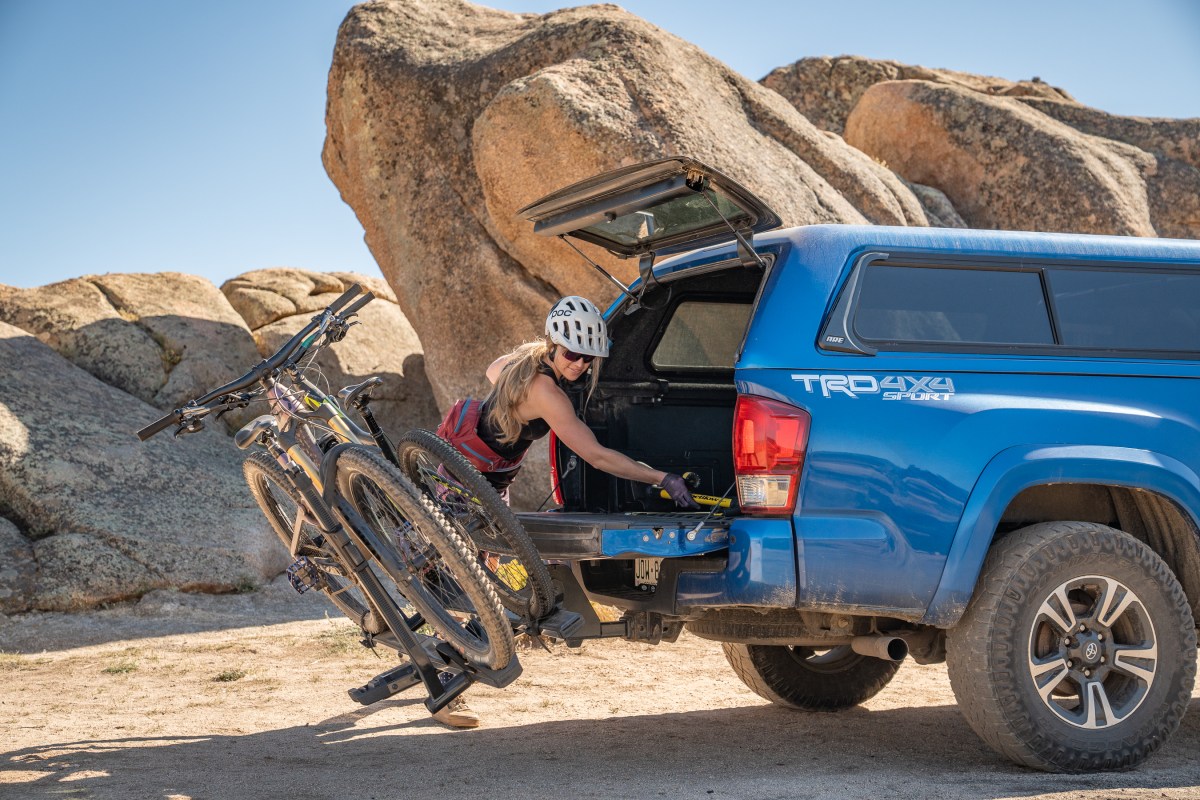
Hitch Bike Racks Comparison Chart
Our Expert Testers & Vehicles
GearJunkie testers spend a lot of time in the saddle, which means we use hitch bike racks a lot.
With astute examination from six experts, each hitch bike rack has been tested for 3-16 weeks across all four seasons. We carried more than 20 different types of bikes including carbon e-MTBs (Specialized Turbo Levo 4), 74-pound e-bikes, fat bikes, gravel bikes, 20-inch BMX, and commuter bikes with fenders.
These racks traveled with our crew across Colorado, from Death Valley National Park to Vermont, and in British Columbia.
We hauled these racks with seven different rigs, including:
- Ford F-150
- Ford F-150 Raptor
- Jeep Cherokee
- Subaru Crosstrek
- Toyota Tacoma
- GMC Sierra 1500
The Crew
- Lead tester, professional photographer and gear writer Eric Phillips lives in Crested Butte, Colo., where more than 750 miles of mountain bike trails exist in the Gunnison Valley and surrounding area.
- Senior Editor Morgan Tilton is also based in Crested Butte, Colo., and road trips across North America on mountain bike trips, racking up thousands of miles per rack.
- Professional athlete Dane Tudor contributes field testing notes from regional trips to trailheads and larger-scope test laps for Gravity Logic bike park builds across North America.
- GearJunkie former editor Jeremy Benson has professionally tested bikes and related gear for nearly 10 years including more than 20 different hitch bike racks. He uses bike racks to transport his cargo to local trailheads, gravel and mountain bike races, and on weekend getaways across the west.
- Berne Broudy, based in Vermont, has contributed testing.
- Chelsey Magness is a professional adventure racer and parent who travels frequently with bikes to trailheads, races, and weekend getaways with family and friends.
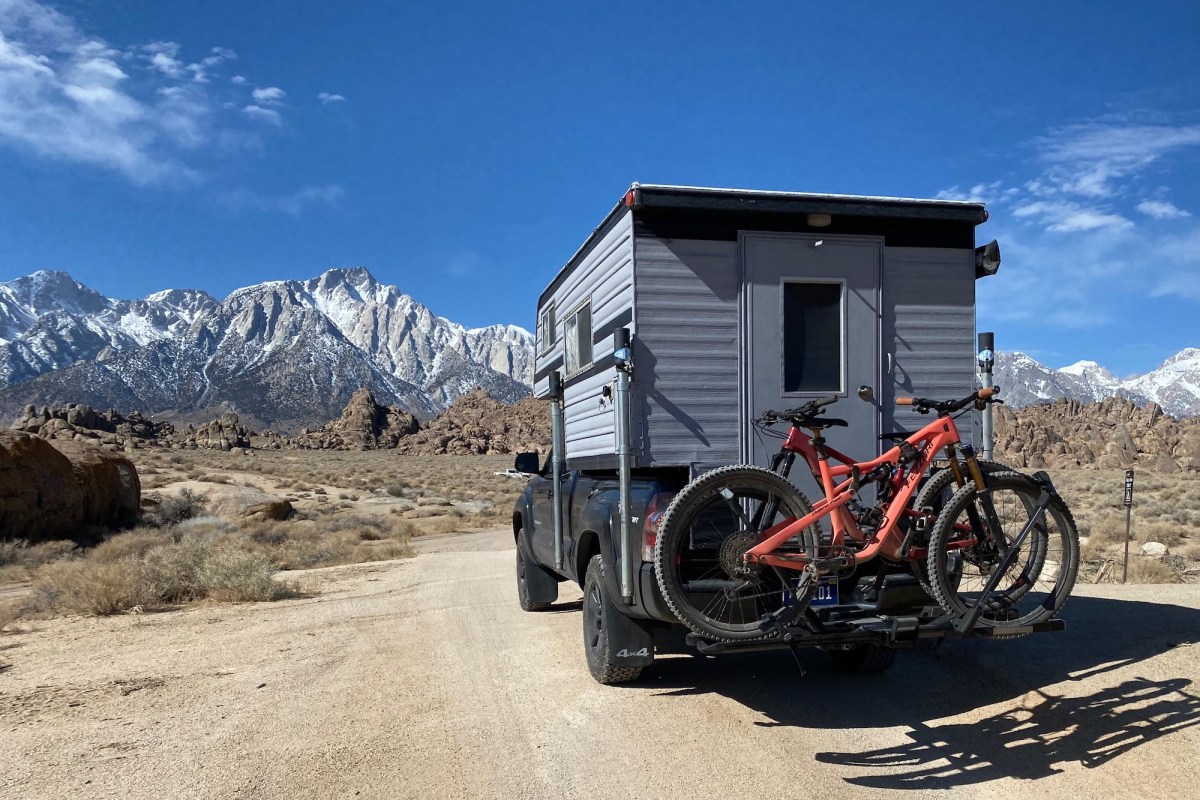
How We Tested Hitch Bike Racks
Our field tests include the assembly, installation and removal, then loading and unloading of the bikes. We examine bike compatibility, bike attachment systems, ease of loading, rack wobble, and in-rack stability. We consider overall security including the rack-to-hitch system and cargo protection.
Whether you’re pedaling a mountain bike or electric bike, we’re confident you’ll find a rack on our list to help transport your steed.
If you’re looking for more ways to outfit your adventure rig, scope out our comprehensive guides to the rooftop tents and rooftop cargo boxes.
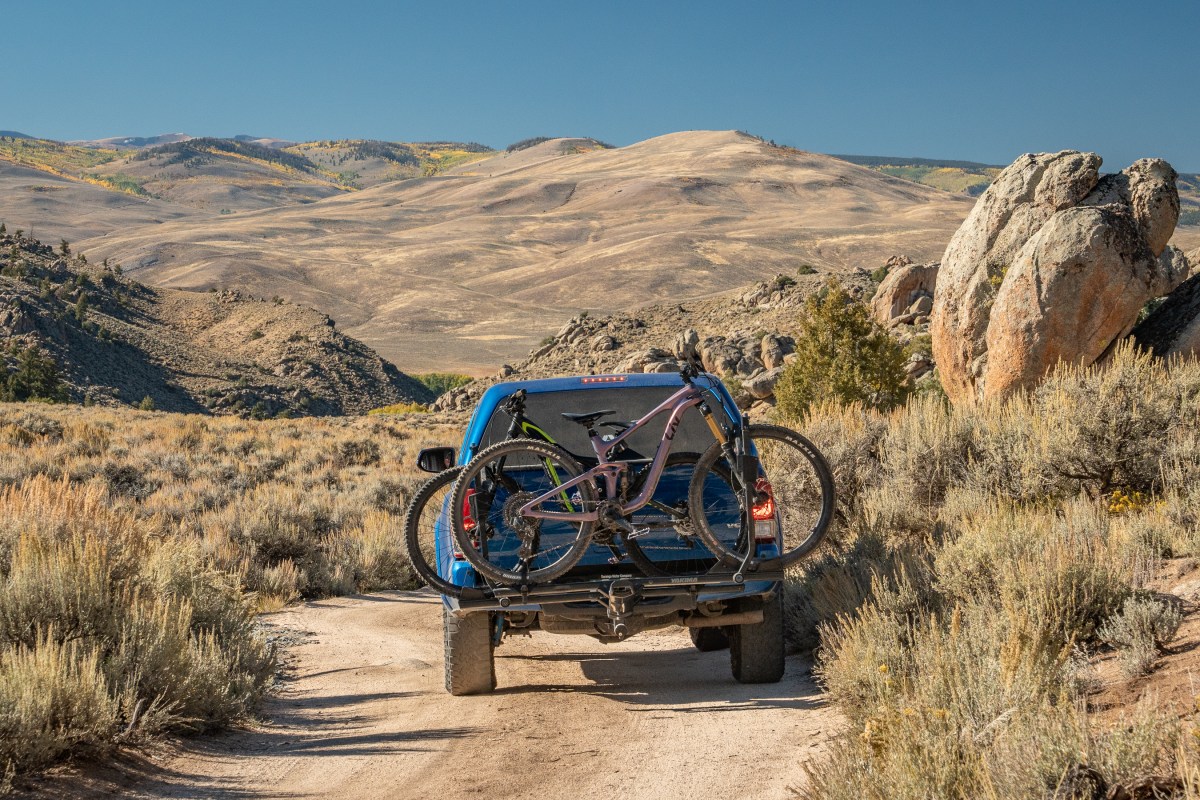
Our Hitch Bike Rack Rating System
To help riders find the best way to transport their fleet, we evaluate each hitch rack based on four primary characteristics from a scale of 1-10, with 10 being absolute perfection:
- Ease of Assembly examines the experience of preparing the rack for use out of the box. We look at how many components require bolting, the clarity of the instructions, and whether specialized tools are needed. While some models arrive fully assembled, others may require an hour of garage time before they’re ready for the vehicle.
- Ease of Installation focuses on the process of mounting the rack to the vehicle’s hitch receiver. This characteristic considers the overall weight and bulk of the rack — critical for those who don’t leave the rack on year-round or solo loaders — and the quality of the anti-wobble system. We prioritize tool-free, hand-tightened cams and integrated wheels that make maneuvering heavy 60-plus-pound racks significantly more manageable.
- Ease of Loading scopes out the daily user experience of securing bikes. We inspect the design of the wheel hooks or trays, looking for smooth ratcheting mechanisms and intuitive release handles. This element also considers how much physical lifting is required (vital for heavy e-bikes) and how easily the rack tilts or swings away to allow rear vehicle access when fully loaded.
- Security and Stability looks at the rack’s peace-of-mind factor during transit and when parked. We test how much the bikes move or sway on rough washboard roads and evaluate the robustness of integrated locking systems. We inspect whether the rack locks to the vehicle and how effectively the included cables or pins deter theft of the bikes themselves.
The Overall Rating is a halo digit that considers additional factors, such as the price point, the quality of materials (aluminum vs. plastic), versatility across various bike styles, and long-term durability. It is our final impression after months of field testing and side-by-side comparison across paved highways and rugged dirt backroads.
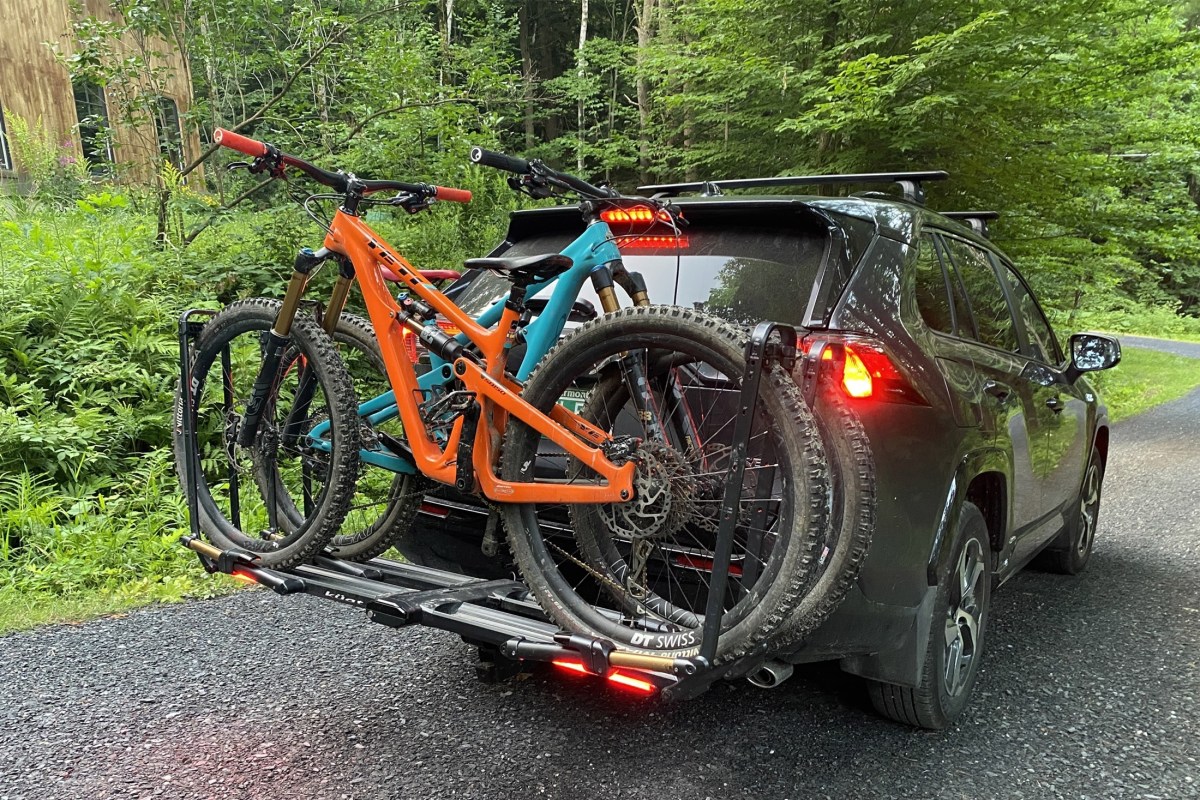
Buyer’s Guide: How to Choose a Hitch Bike Rack
Unless you want to transport your bikes with a roof bike rack, you’re in the right place. A variety of hitch bike racks exist.
- Platform racks hold bikes horizontally by supporting them from the bottom on a platform or tray. This design is the most stable and is ideal for heavy e-bikes or carbon frames, as most models secure the bike by the tires with zero frame contact.
- Hanging racks also carry bikes horizontally but, as the name suggests, they suspend the bikes from support arms by the top tube of the frame. These are typically the most affordable and lightweight options, though they may require an adapter for bikes with unconventional frame shapes.
- Vertical racks are a newer, space-saving style that carries bikes upright (perpendicular to the ground). Depending on the brand, they secure bikes by the front wheel (like a VelociRAX), the handlebars (like a Lolo Rack), or the fork. This style is the gold standard for shuttling large groups, as some models can carry up to seven bikes at once.
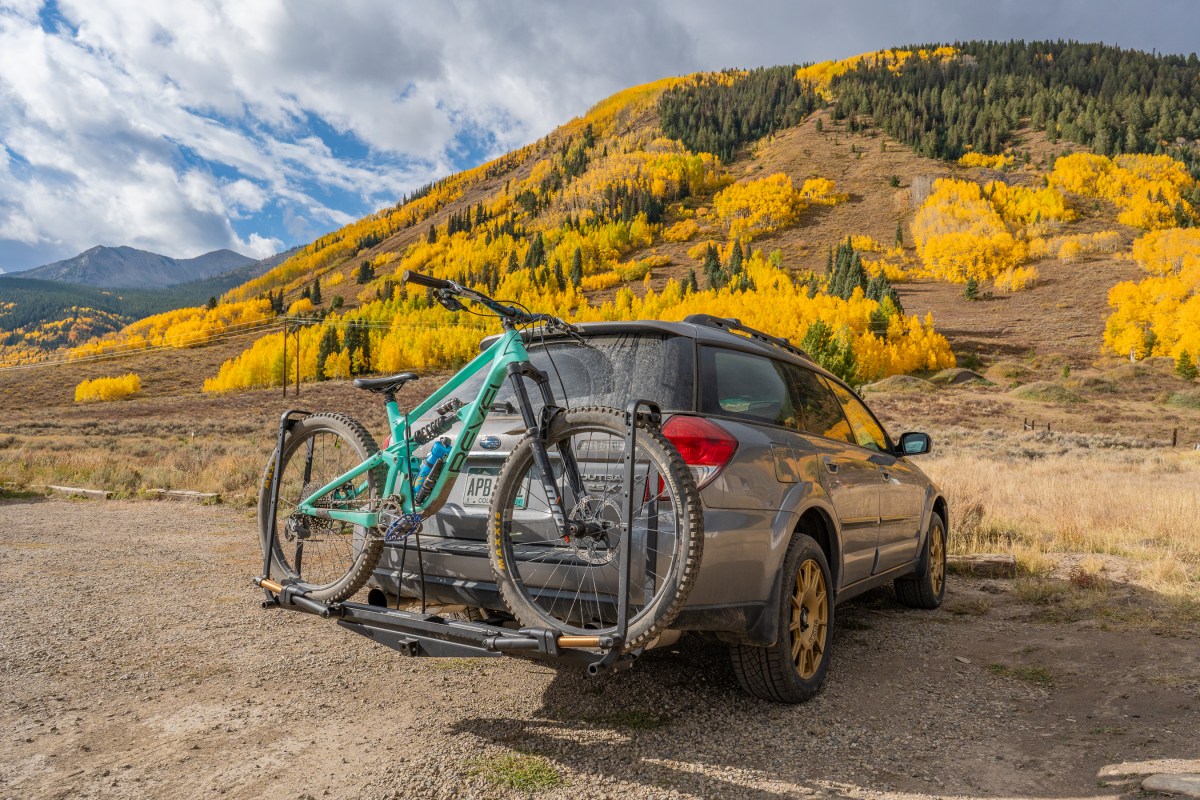
Platform Hitch Bike Racks
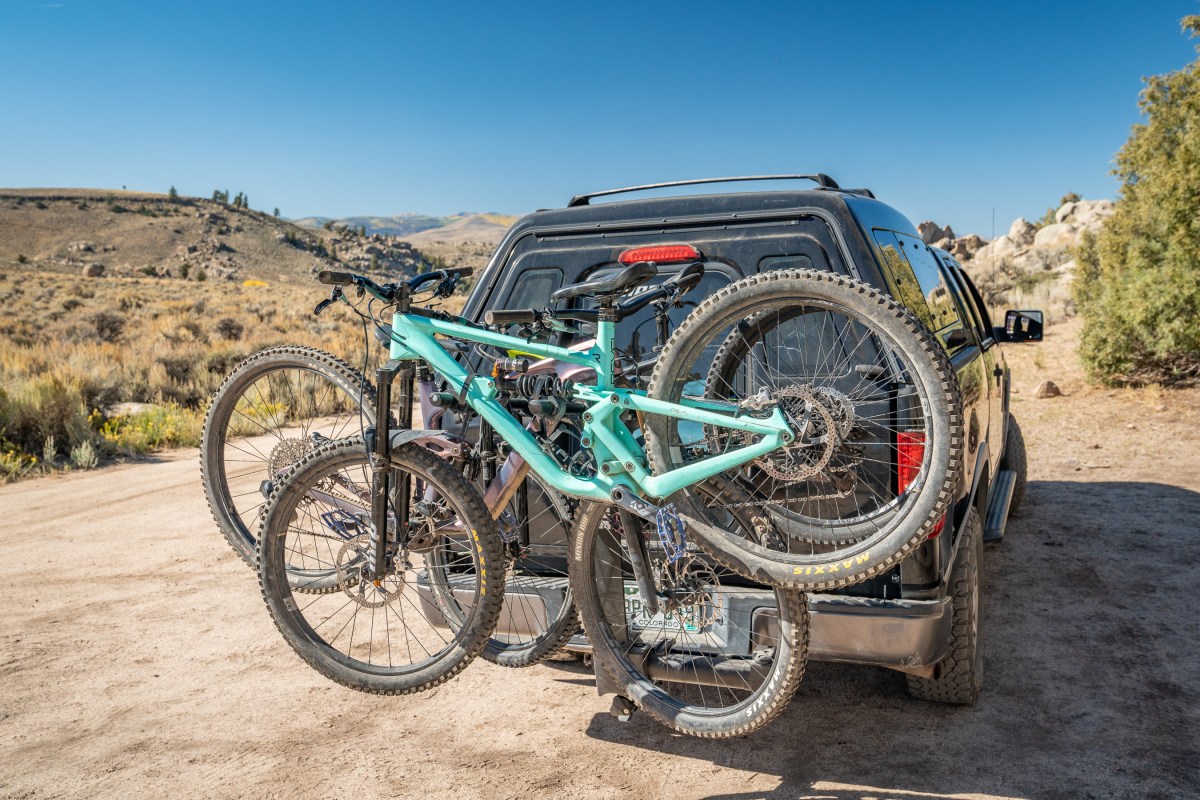
Platform racks use trays to support bikes from below, offering the lowest loading height and the easiest lifting of any hitch style. Most modern units employ front-wheel hooks to achieve zero frame contact, making them the safest choice for carbon fiber or custom-painted bikes.
These racks are highly versatile, featuring adjustable trays that minimize bike-on-bike interference and accommodate nearly any wheel size, suspension design, or wheelbase. While platform racks are the gold standard for serious cyclists due to their ease of use, they are typically heavier, bulkier, and more expensive than hanging alternatives. Most carry two bikes by default, though many premium models offer optional add-ons to expand capacity.
Hanging Hitch Bike Racks
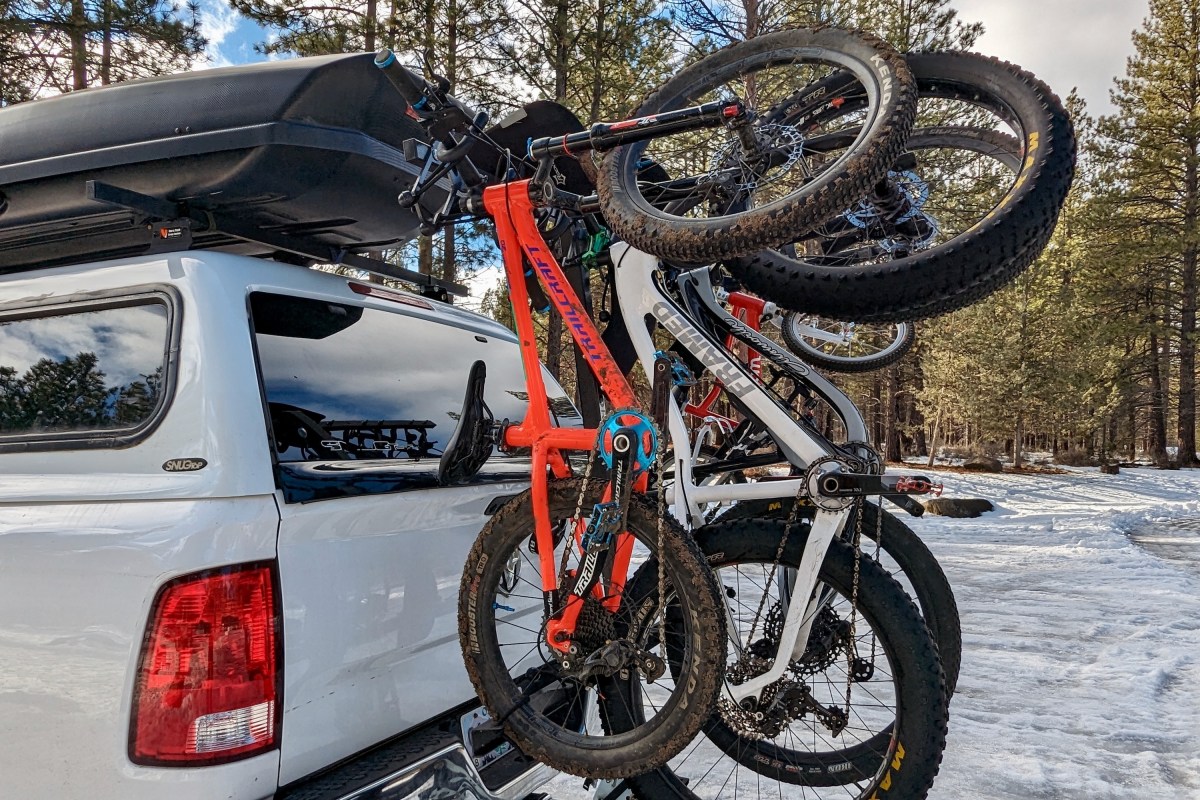
Hanging racks typically utilize two support arms to suspend bikes by their frames. This style is often the most affordable and lightweight, making it easy to install, remove, and store. Many hanging racks can carry up to four bikes without additional hardware.
However, the primary disadvantage is mandatory frame contact, which can lead to paint abrasion or structural damage—a critical concern for carbon fiber frames. Additionally, hanging racks often struggle with non-traditional geometries, such as step-through frames or full-suspension mountain bikes, frequently requiring a top-tube adapter to sit level. To prevent bikes from swaying and bumping into one another, it is highly recommended to secure the front tires to the frames using secondary bungee cords or straps.
Vertical Hitch Bike Racks
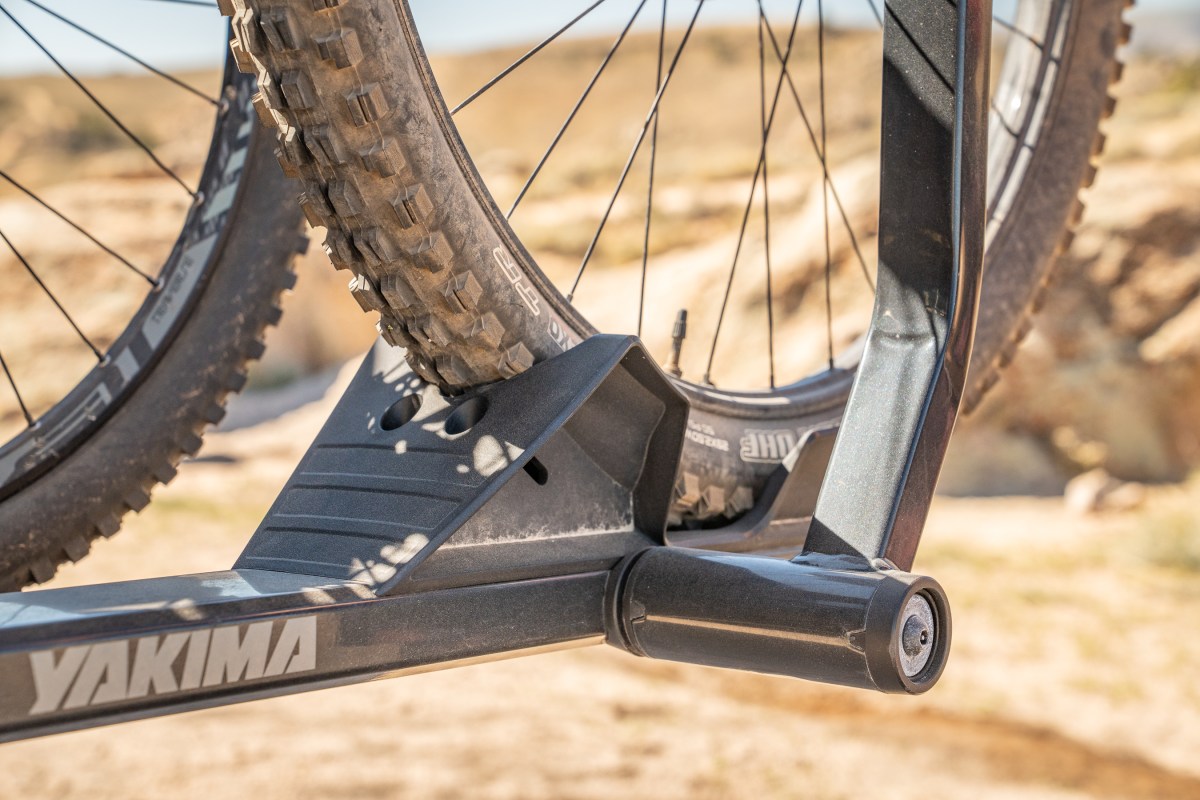
Vertical Racks originated as a solution for high-capacity mountain bike shuttling, carrying up to six (or even seven) bikes in a space-saving upright orientation. While early designs were limited to suspension forks, modern versions secure bikes by the front wheel or handlebars, making them compatible with road, gravel, and kids’ bikes. This style is the premier choice for large families, ride crews, and dedicated shuttle laps.
The primary advantage is the ability to exceed the typical four-bike limit of other styles. However, these racks are exceptionally heavy, bulky, and difficult to store when off the vehicle. While the initial price tag is high, vertical racks are often more cost-effective than purchasing a premium platform rack plus multiple expansion add-ons.
Which Rack Style Is Right for You?
Choosing a rack style is a balance of three factors: how much you spent on your bike, how many people are coming with you, and how much you hate lifting heavy objects.
1. The Platform Rack: The Gold Standard for Modern Bikes
- Best for: E-bike owners, carbon-frame enthusiasts, and solo/duo riders.
- The Reality: If you’ve invested in a modern mountain bike or a $5,000+ gravel rig, a platform rack like the Thule Verse or Kuat Piston Pro X is almost mandatory. By securing the bike via the tires, you eliminate the risk of frame-rub or structural damage to carbon tubes.
- The E-Bike Factor: Since e-bikes often weigh 50–80 pounds, the low loading height (and compatibility with ramps) makes platform racks the only safe and ergonomic choice for heavy hauling.
2. The Hanging Rack: The Budget-Friendly Classic
- Best for: Casual weekenders, “shoestring” budgets, and standard aluminum frames.
- The Reality: If you’re just getting the kids’ bikes to a local park or moving older cruisers to a vacation home, an inexpensive hanging rack like the Allen Deluxe or Yakima RidgeBack is perfect. They are lighter, easier to store in a garage, and significantly cheaper.
- The Trade-off: You will deal with bike-on-bike contact and frame-rub. If you care about your paint job, you’ll need a handful of bungee cords and a “TubeTop” adapter for any step-through or full-suspension frames.
3. The Vertical Rack: The Shuttle Crew’s Dream
- Best for: Large families, NICA coaches, and mountain bike shuttle laps.
- The Reality: Once you need to carry more than four bikes, platform racks become astronomically expensive and incredibly long (sticking out 4+ feet behind your car). Vertical racks like the VelociRAX or 1Up Recon solve this by stacking bikes upright.
- The Pro Move: While the upfront cost is high (~$900–$1,200), they are actually cheaper than buying a premium platform rack plus two separate 2-bike add-ons. They keep the weight closer to your bumper, which is better for your car’s suspension and departure angle.
Expert Guide Decision Matrix:
- 1–2 Bikes? Buy a Platform Rack. It’s the best user experience.
- 3–5 Bikes on a budget? Buy a Hanging Rack. Just watch for frame scratches.
- 4–7 Bikes / Heavy Shuttling? Buy a Vertical Rack. It’s the only way to move a squad without a trailer.
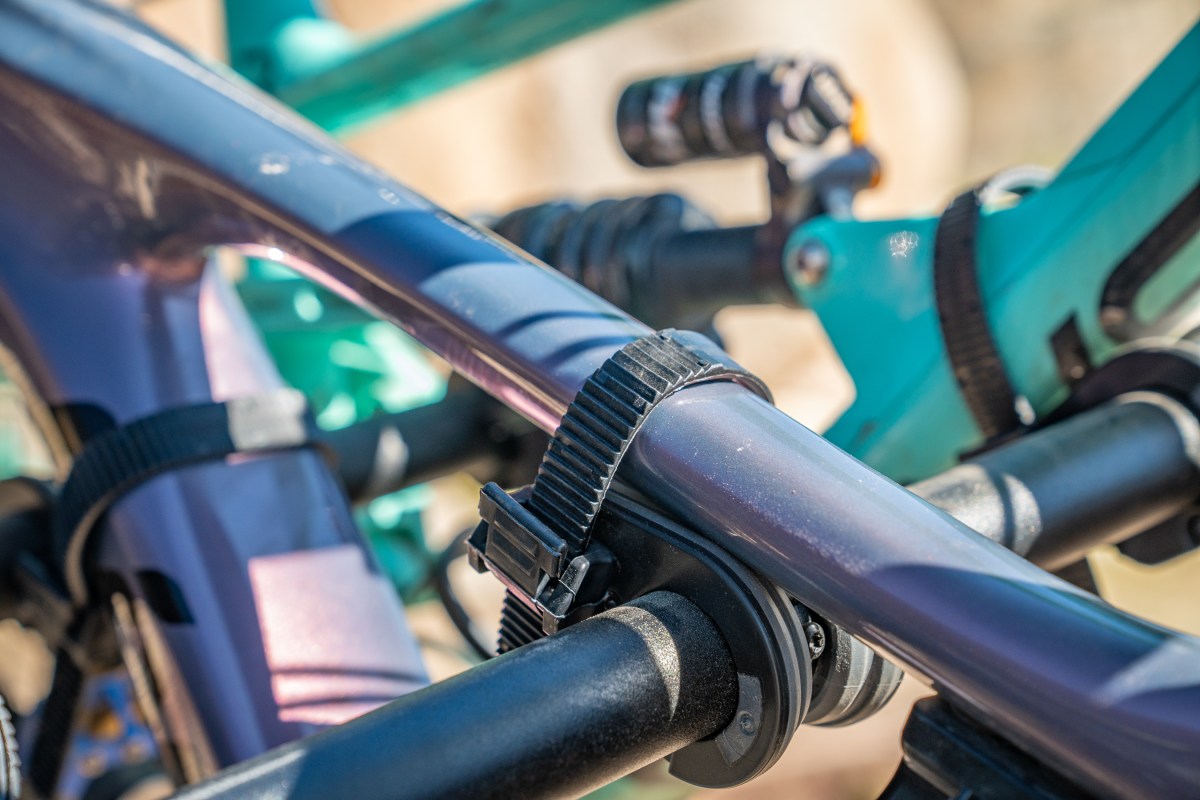
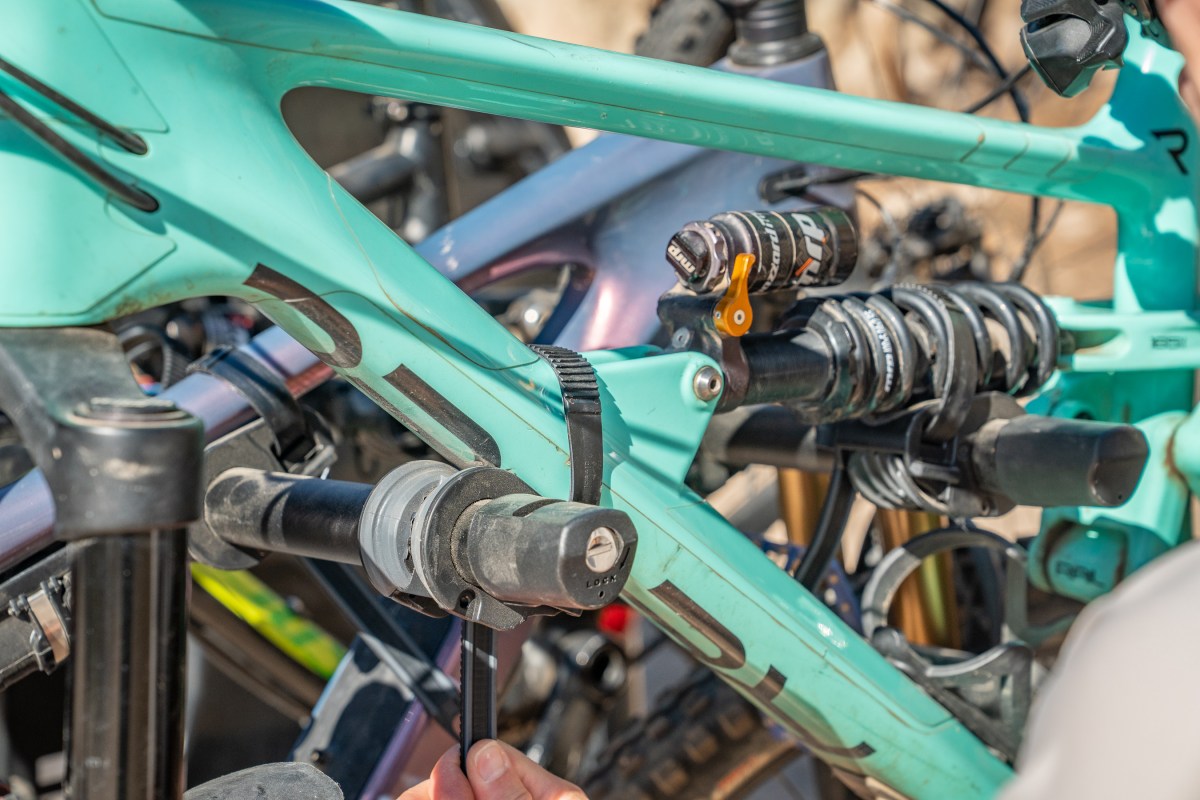
Bike Attachment: Frames vs. Tires
Hitch racks use several methods to secure your bike. While all are designed for safety, the primary difference lies in whether the rack touches your bike frame or only the tires.
Strap & Cradle Systems (Frame Contact)
Commonly found on hanging racks, this system uses cradles to support the bike’s weight and rubber or plastic straps to cinch the top tube in place.
- The Benefit: It’s a simple, cost-effective, and proven design.
- The Risk: Continuous contact with the frame can lead to paint abrasion or cable rub. Over long road trips, vibrations can cause straps to wear through paint — or even into carbon fiber — if the bike isn’t perfectly snug.
- The Lifecycle: Straps are wear items that degrade over time due to UV exposure. High-quality racks often include secondary straps as a contingency, but they should be inspected annually for cracking.
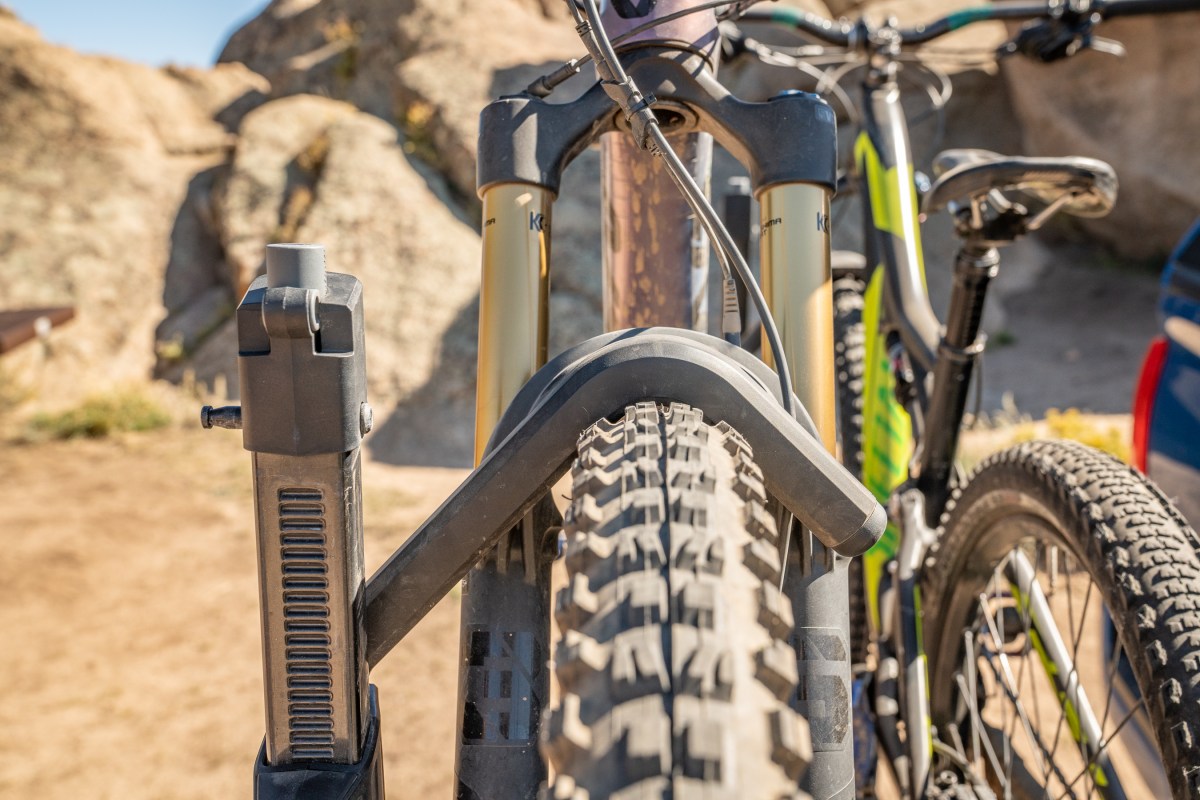
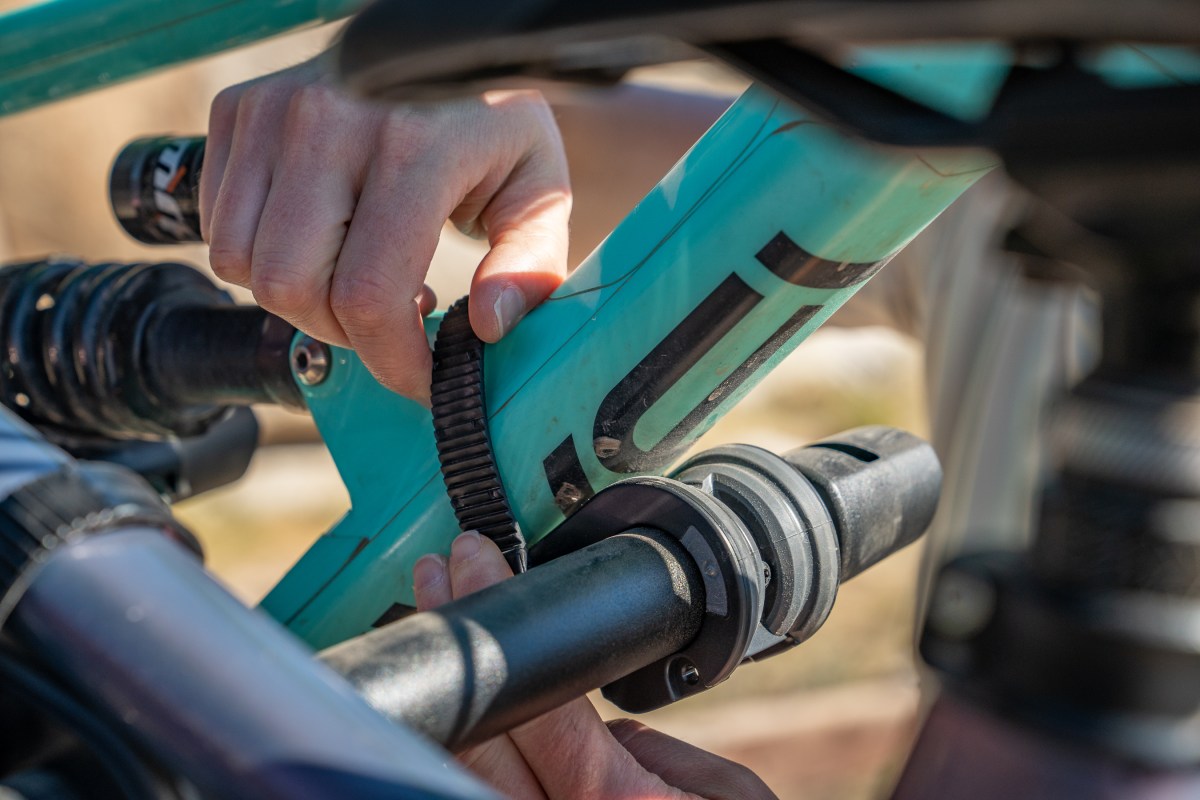
Wheel Hooks & Clamps (Zero Frame Contact)
Found on platform and vertical racks, these systems use ratcheting arms to compress the tires into the trays or baskets.
The Benefit: By eliminating frame contact, you remove the risk of paint damage and structural stress on lightweight carbon tubes. This is the preferred method for high-end mountain, road, and electric bikes.
The Versatility: Because they grip the tires, these systems aren’t affected by funky frame shapes, making them compatible with step-through cruisers and complex full-suspension designs without extra adapters.
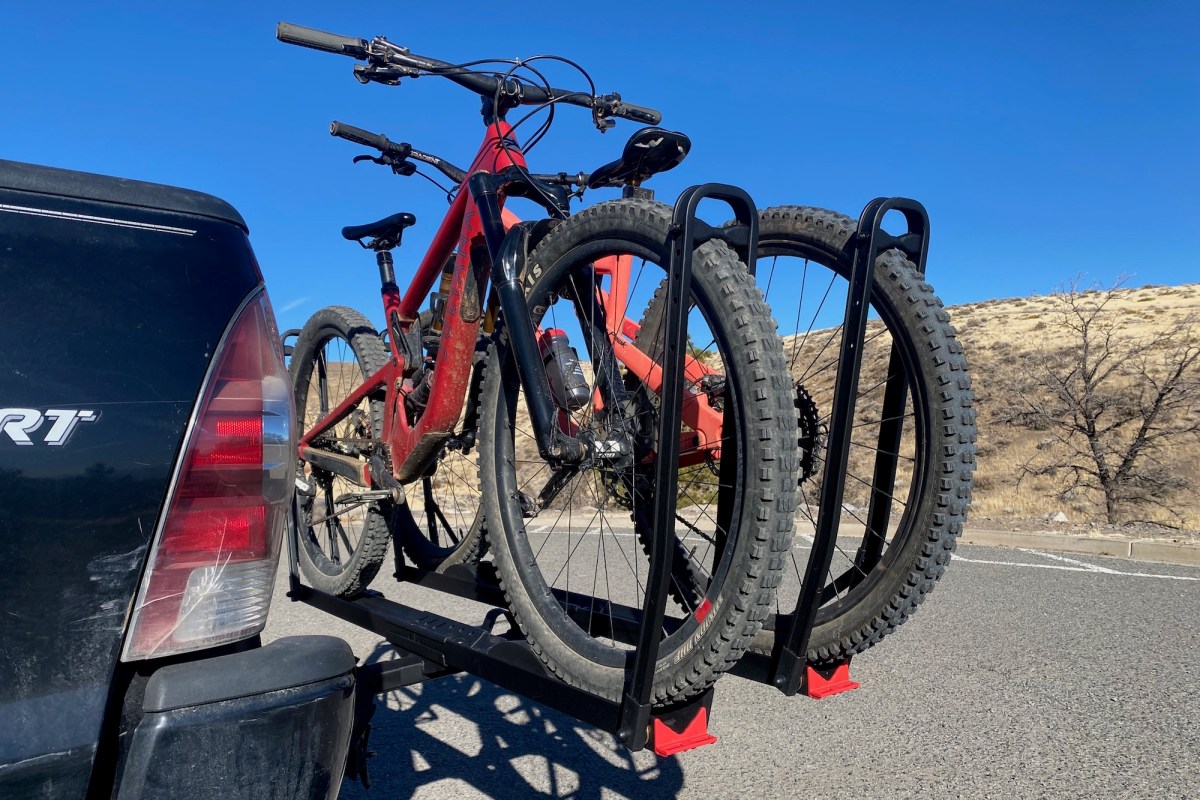
Vertical Racks: Forks, Tires, & Bars
Vertical racks are designed for high-density transport while ensuring bikes do not touch each other. The primary difference between models is where the weight of the bike is supported.
- Fork-Crown Mounts: These capture the bike by the crown of the suspension fork. While extremely secure for mountain bikes, they are generally not compatible with rigid forks (road or gravel bikes) and can cause paint abrasion on the fork crown over time.
- Front-Wheel Cradles: These hang the bike by the tire, making them more versatile than fork mounts. Because they offer zero frame or fork contact, they are safer for a wider range of bikes (road, gravel, and kids). Note that you may need different cradle sizes to accommodate both skinny road tires and 5-inch fat bike tires.
- Handlebar Mounts: By suspending bikes from the bars, these racks are arguably the most versatile in the vertical category. They accommodate almost any bike style regardless of wheel size, tire width, or fork type, though they do require lifting the bike slightly higher during loading.
Regardless of the mounting style, the rear wheel is typically secured to a lower support bar using a heavy-duty strap or bungee to prevent the bike from swaying or bouncing into the vehicle.
Capacity: How Many Bikes?
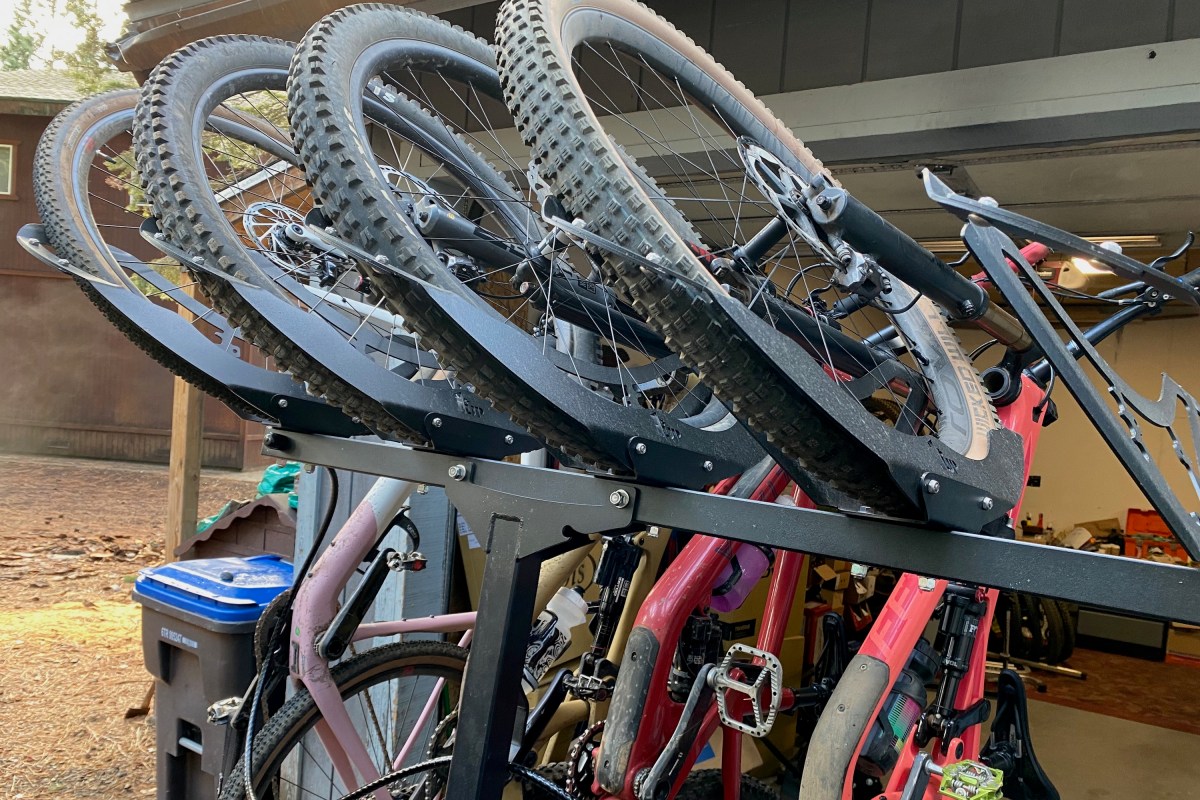
The first step in selecting a rack is determining your maximum passenger count. While you can always carry fewer bikes than a rack’s rated capacity, you should never exceed it.
Vertical Racks (4–7 Bikes): These are the high-capacity champions. Designed for large groups and shuttle laps, they are typically sold in 4-bike or 6-bike versions (with some brands like VelociRAX offering up to 7 slots).
Platform Racks (1–4 Bikes): Most models start as a 2-bike base. Many premium racks are modular, allowing you to buy 1- or 2-bike add-ons as your family or quiver grows, typically maxing out at four bikes total.
Hanging Racks (2–5 Bikes): These offer the most bikes for the least money. Models like the Yakima Ridgeback and Allen Sports Deluxe are commonly sold in 2-, 4-, or 5-bike configurations.
Bike Weight & E-Bike Compatibility
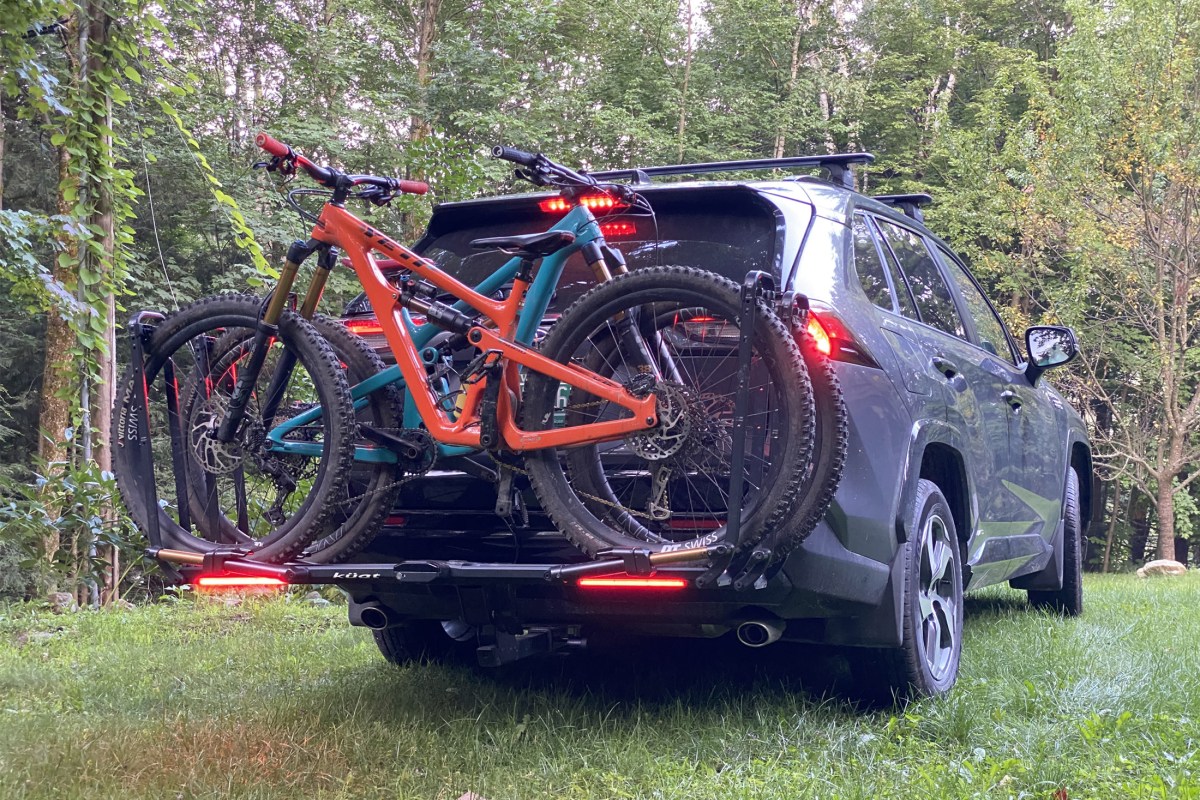
The rise of electric bikes — which frequently weigh 50–80 pounds — has fundamentally changed hitch rack requirements. Before buying, you must confirm the per-tray weight limit of a rack, as exceeding these limits can lead to catastrophic failure on the highway.
- Heavy-Duty Champions: Platform racks lead the category. The Yakima StageTwo boasts a class-leading 70-pound limit (de-rated to 42 pounds for off-road use), while the Saris Edge handles up to 80 pounds per bike.
- Premium Standards: High-end models like the Thule Verse and RockyMounts BackStage are rated for 60 pounds, which covers most electric mountain bikes but may exclude heavy-duty cruisers or fat-tire e-bikes.
- The Add-on Penalty: Be aware that many racks de-rate their weight capacity when you add extra trays. For example, the Kuat Piston Pro X drops from 67 pounds per bike (2-bike setup) to 40 pounds per bike once you expand to a 4-bike configuration.
Solving the Loading Struggle
Deadlifting a 75-pound e-bike onto a rack is a common source of back strain. To address this, several 2026 models are compatible with aftermarket loading ramps:
- Thule Foldable Loading Ramp: A $100 accessory compatible with the new Verse and Epos lines.
- Yakima RampUp: A $119 telescoping ramp designed specifically for the StageTwo.
- Kuat E-Bike Ramp: A $129 steel ramp that clamps onto the Piston Pro X or NV 2.0 series.
Access: Tilt vs. Swing-Away
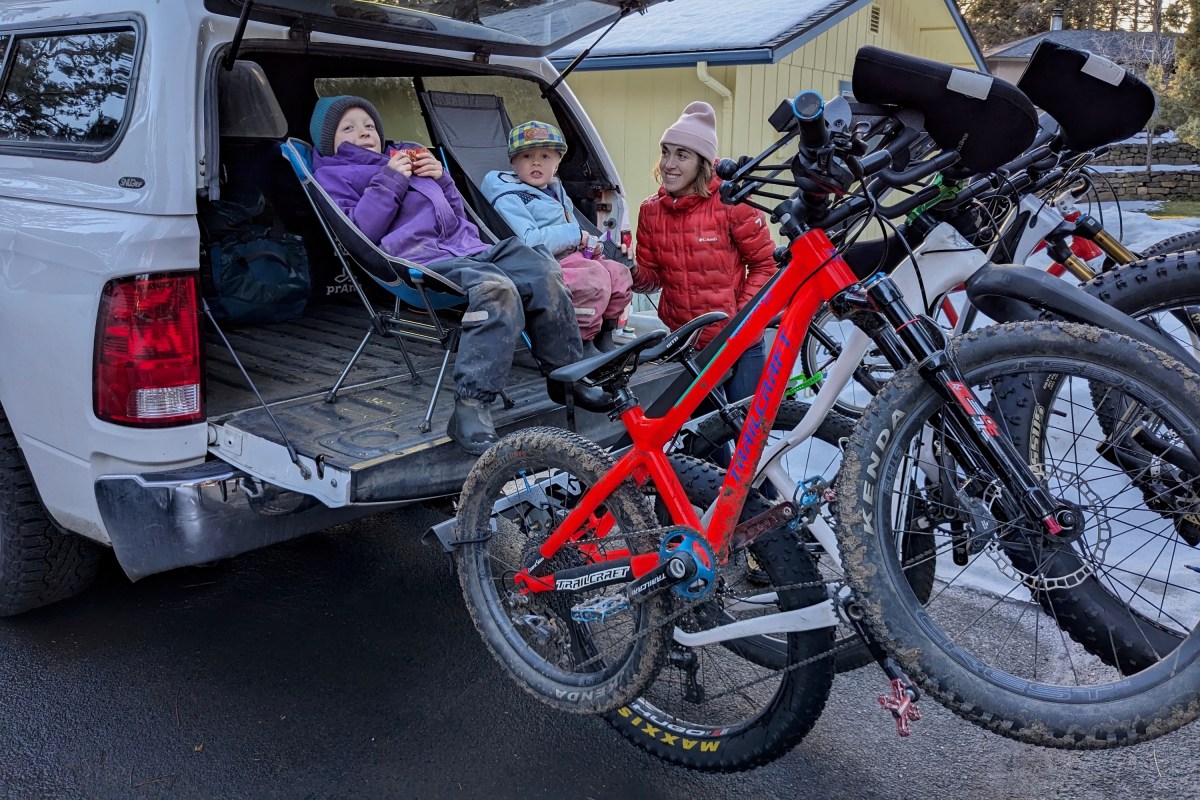
Most modern racks include a pivot mechanism to help you reach the gear in your trunk or truck bed without removing the entire system.
The Tilt Feature (Standard)
The most common adjustment is the tilt, which allows the rack to drop down at a 45-degree angle.
- Convenience: Look for racks that tilt with bikes loaded. This allows you to open a hatchback or drop a tailgate for quick access to a backpack or to let a dog out.
- Ease of Use: High-end models like the Thule Verse or Yakima StageTwo feature remote levers at the end of the rack, so you don’t have to reach through dirty bike frames to find the release.
- Storage: The tilt mechanism also allows the rack to fold up vertically against the bumper when not in use, reducing the vehicle’s footprint for easier parking.
The Swing-Away Feature (Full Access)
For users who need total, unobstructed access to the rear — such as camper van owners or truck campers — a swing-away rack is the ultimate solution.
- The Trade-off: Swing-away functionality adds significant weight (the BackStage is 75 pounds) and cost. You can buy aftermarket swing adapters for other racks, but they often add 30+ pounds and can be quite expensive.
- 180-Degree Access: Instead of just dropping down, these racks pivot out and away to the side of the vehicle.
- RockyMounts BackStage: This remains our top pick for this category. It is the only platform rack on the market with a built-in swing-away arm, allowing you to move two bikes completely out of the way of rear doors or tailgates.
Compatibility: Wheels, Tires, and Wheelbases
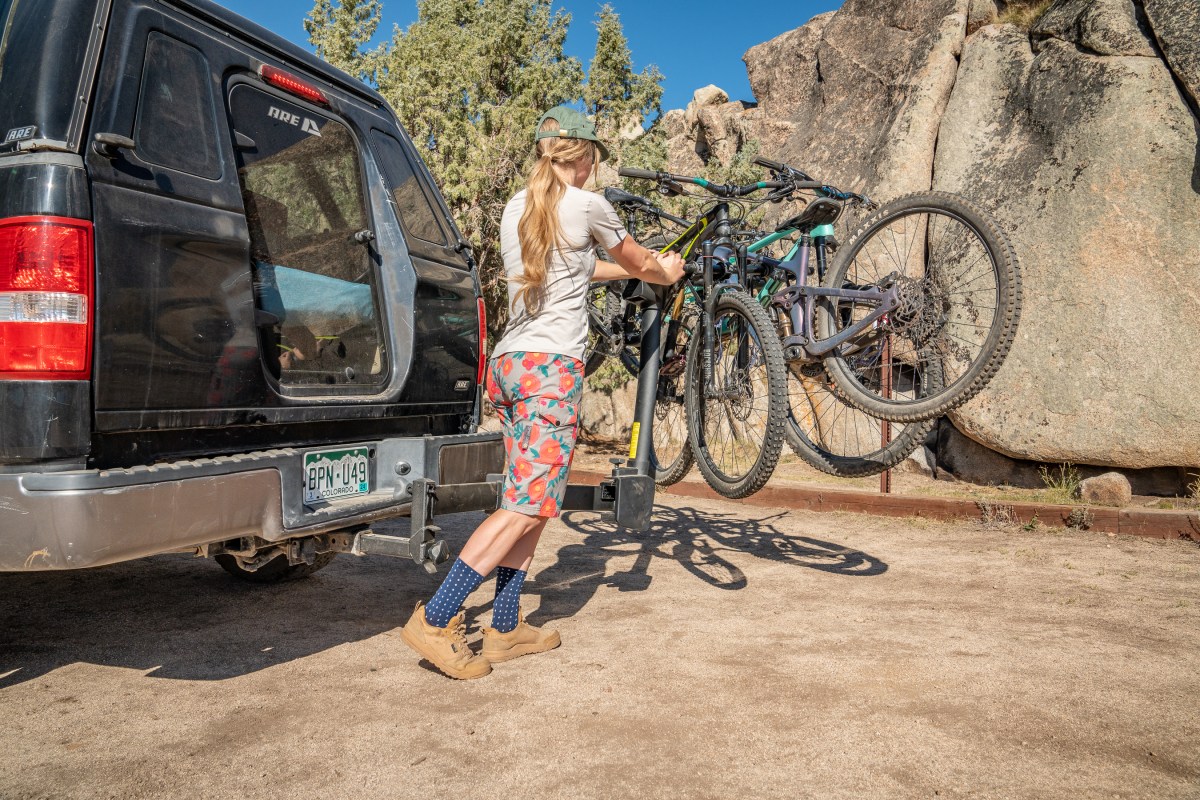
A rack is only as good as its ability to hold your specific bike. Before purchasing, you must cross-reference your bike’s quiver against three critical measurements: wheel diameter, tire width, and wheelbase length.
Platform Racks: The Precision Fit
Because platform racks secure bikes via the tires, they have the strictest fit parameters.
- Tire Width: Most 2026 platform racks (like the Thule Verse) now accommodate everything from 23mm road tires to 5-inch fat bike tires. However, some still require a Fat Bike Kit (longer straps and wider cradles) to fit anything over 3 inches.
- Wheelbase: Modern mountain bikes are getting longer. Ensure the rack can handle your bike’s wheelbase (the distance between the axles). The Saris Edge and Thule Verse lead the pack with a massive 53-inch (1,350mm) maximum, fitting almost any long-travel enduro or downhill bike.
- Wheel Size: While 29-inch and 700c wheels are standard, ensure the rack can downsize to 20-inch or 24-inch wheels if you plan on hauling kids’ bikes.
Hanging Racks: Frame Over Wheels
Hanging racks are indifferent to tire width or wheelbase because they support the bike by the top tube.
- The Frame Challenge: While they don’t care about wheels, they struggle with non-traditional frames. BMX bikes, step-through cruisers, and full-suspension mountain bikes often lack the space to slide onto the support arms.
- The Solution: For these bikes, you’ll likely need a Top-Tube Adapter (an artificial bar that clips between the seat post and handlebars) to create a level hanging surface.
Vertical Racks: The High-Clearance Solution
Vertical racks are generally very forgiving of wheelbase length because the bike hangs down, but the cradle or basket size is key.
Basket Fit: If the basket is too narrow, a fat tire won’t seat. If it’s too wide, a skinny road tire may wobble. Racks like the 1Up Recon use universal baskets, while others may require specific inserts for different tire categories.
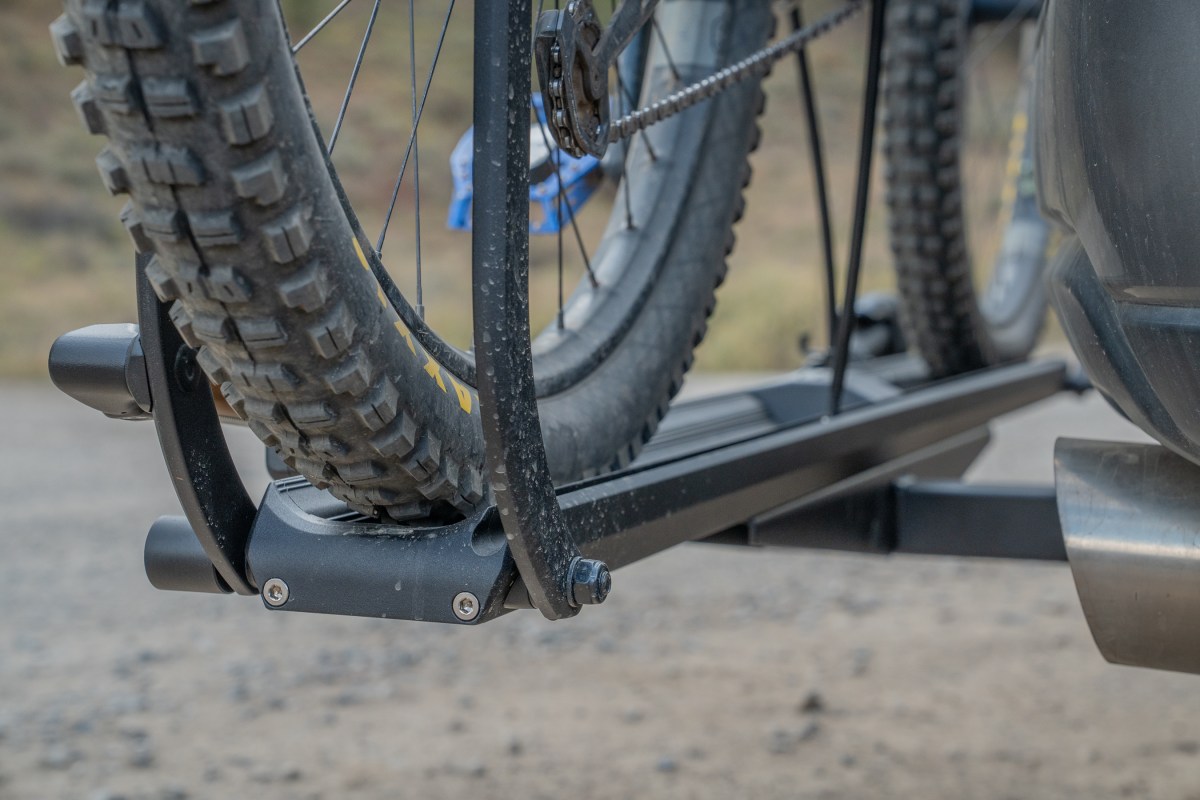
The Receiver: 1.25″ vs. 2″
Your vehicle’s hitch receiver is the foundation of your rack system. These days, most passenger vehicles utilize one of two standard sizes. It is critical to verify your size before purchasing, as they are not interchangeable without an adapter (which can reduce your rack’s weight capacity).
- 1.25-Inch (Class I & II): Typically found on sedans, crossovers, and compact SUVs. These are designed for lighter loads, usually maxing out at two bikes.
- Pro Tip: If you have a 1.25″ hitch, ensure your chosen rack — like the Kuat Sherpa 2.0 — is specifically offered in that size.
- 2-Inch (Class III & IV): The industry standard for trucks, mid-size to full-size SUVs, and vans. This larger size is significantly stronger, offers more stability (less bounce), and is mandatory for carrying three or more bikes or heavy e-bikes. If you have a choice, always install a 2″ hitch. It offers the widest range of accessory compatibility and higher weight safety margins.
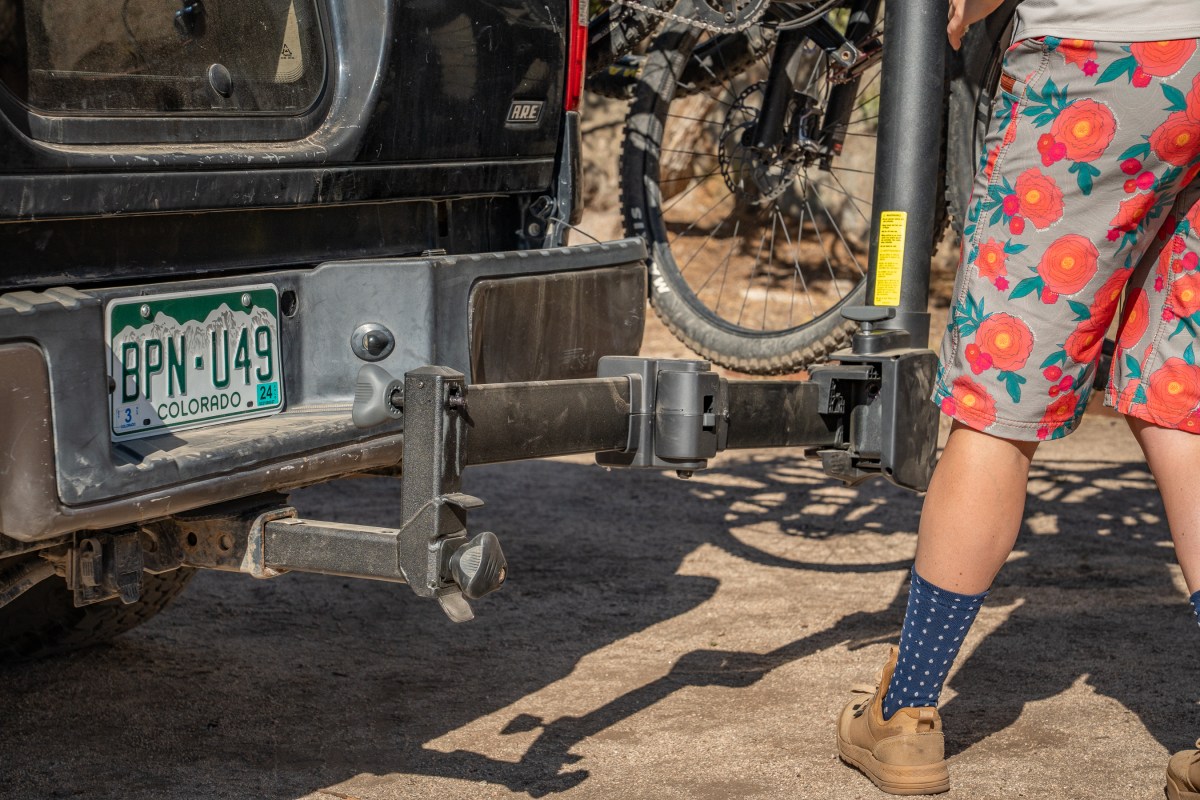
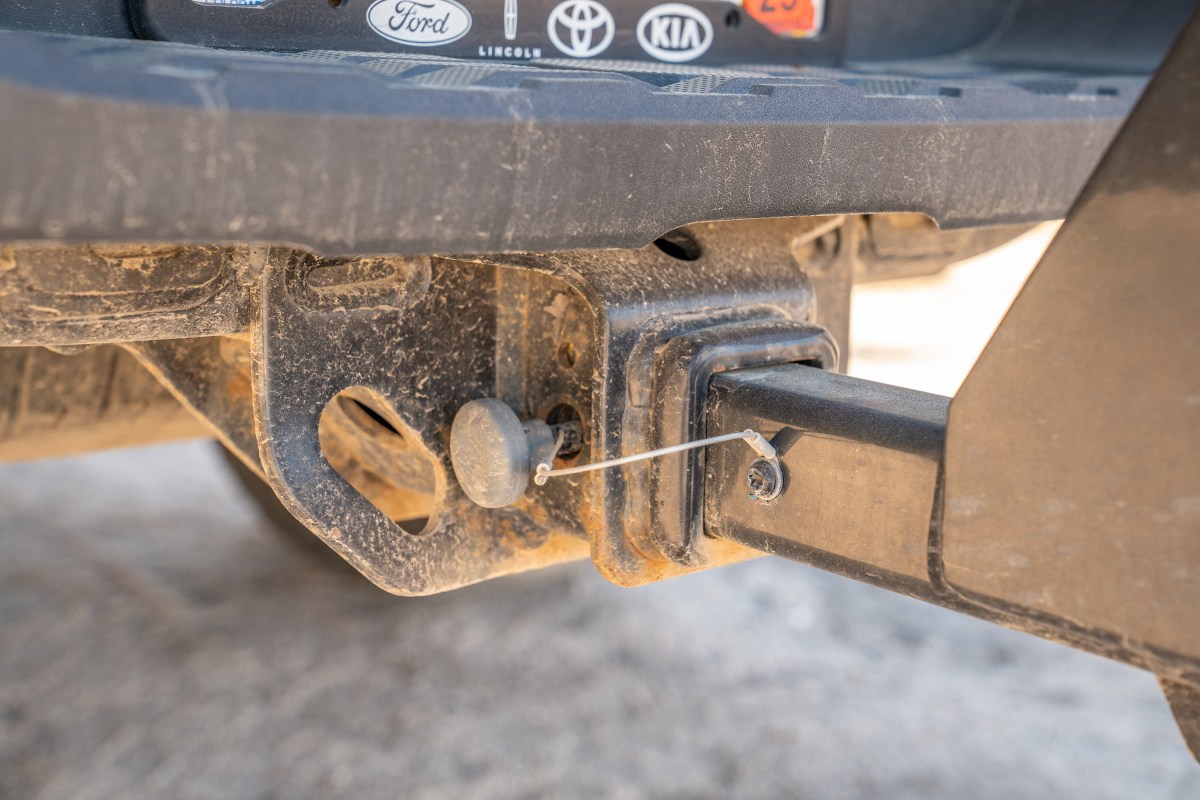
Security: Protecting Your Investment
A bike rack has two primary vulnerabilities: the bikes can be stolen from the trays, and the rack itself can be removed from the vehicle. Today, theft remains a major concern, especially since a premium rack and two e-bikes can easily represent a $15,000+ investment.
1. Rack-to-Vehicle Security
The most common way to lose a rack is via the hitch receiver.
- Integrated Locks: High-end racks like the Thule Verse and Küat Piston Pro X use tool-free installation knobs that lock. Once engaged, the knob spins freely, making it impossible for a thief to loosen the anti-wobble system. While integrated locks are theft-deterrents, they aren’t theft-proof. We strongly recommend adding a secondary lock for longer durations.
- Locking Hitch Pins: Standard on most mid-to-high-range models, these pins go through the receiver and require a key to remove. If your rack — like the Allen Deluxe — doesn’t include one, an aftermarket locking hitch pin is a mandatory $25 investment.
2. Bike-to-Rack Security
Integrated locks are designed for convenience during short stops at a trailhead or gas station.
- Chassis-Mounted Locks: The Küat Piston Pro X and Saris Edge offer more robust, larger-diameter cables or semi-integrated systems that provide better resistance but still serve primarily as a deterrent.
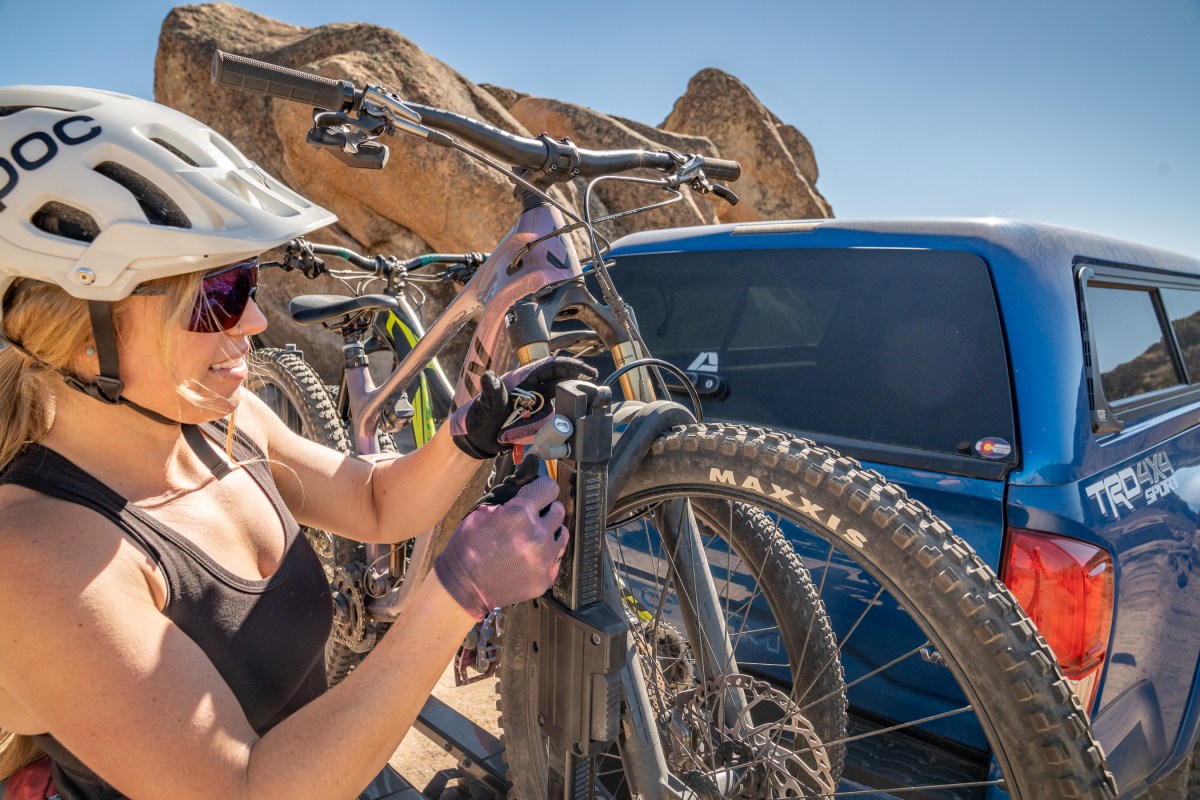
- Retractable Cables: Brands like Yakima and Thule feature cables that pull out of the rack arm or tray and loop through the bike frame. While convenient, these are typically thin and can be cut in seconds with handheld bolt cutters.
Durability & Serviceability
Today, a hitch rack is viewed as a lifetime investment. While the primary steel or aluminum hitch beam rarely fails, the durability of a rack is truly measured by its resistance to the elements and how easily it can be repaired after years of abuse.
1. Materials: Metal vs. Plastic
The most durable racks prioritize all-metal construction.
- The Gold Standard: Brands like 1Up-USA and Küat (Piston series) are renowned for using 99%–100% metal. 1Up, in particular, uses no plastic in its structural components, making it virtually bombproof against UV degradation and impact.
- The Corrosion Factor: If you live in a coastal area or drive on salted winter roads, look for racks that have passed rigorous 750-hour salt spray tests. Aluminum racks are naturally rust-proof, while high-end steel racks use thick powder coating and e-coating to prevent internal corrosion.
2. Serviceability: The Forever Rack Philosophy
The mark of a premium rack is that it is repairable, not disposable.
- Modular Designs: 1Up and the Saris MHS system are entirely bolted together rather than welded. If a single tray or arm is damaged in a fender-bender, you can order that specific part and replace it with a standard wrench rather than replacing the entire $1,000 unit.
- Wear Items: Straps and bungees are high-wear items. While modern ratcheting plastic straps are more UV-resistant than old-school rubber, they will eventually dry out. Choose brands that offer inexpensive, easy-to-find replacement straps.
3. Mechanical Failures
Shepherd’s Hooks: These large ratcheting arms are extremely reliable, but because they are the primary point of contact, they bear the most stress during transit. Check for any play in the pivot points annually to ensure the ratchet teeth aren’t wearing down.
Pistons vs. Springs: Premium racks like the Küat Piston Pro X use genuine Kashima-coated struts (similar to high-end mountain bike suspension) to open the arms. While these are incredibly smooth and durable, they are more complex than the simple mechanical ratchets found on the 1Up Heavy Duty, which rely on pure metal-on-metal engagement.
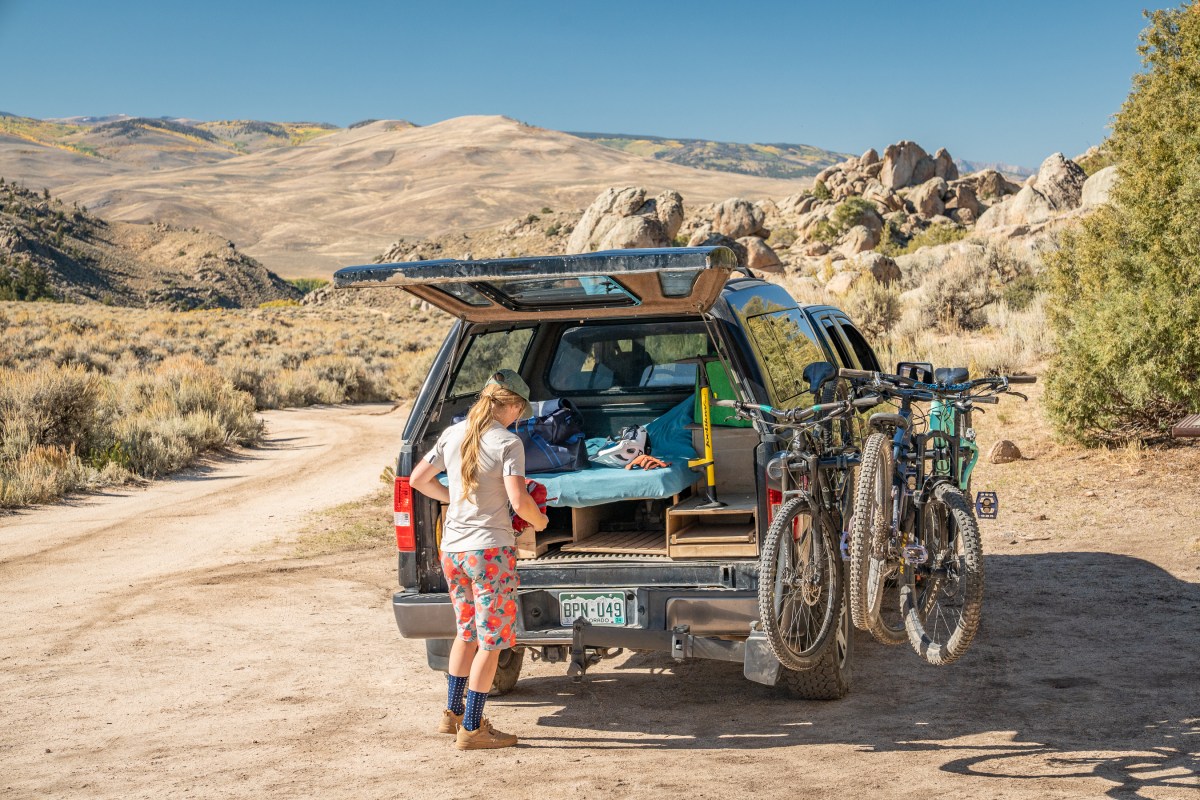
Price & Value
Hitch rack prices range from under $200 to well over $1,000, with higher costs typically reflecting advanced zero-frame-contact technology and e-bike-ready weight capacities. Ultimately, investing in a premium rack buys you superior ergonomics and the peace of mind that your high-value bikes will remain in showroom condition across thousands of miles.
Budget ($400)
Any model under $400 falls into the budget category, a space dominated by hanging-style racks that suspend bikes by the top tube. While these racks lack the refined ergonomics of premium systems, they remain a reliable, functional choice for users who aren’t concerned with minor frame contact or bikes potentially touching during transit.
The most cost-effective option we’ve tested is the Allen Sports Deluxe Hitch Bike Rack ($170), which provides a high-capacity solution for hauling four bikes at a fraction of the cost of its competitors. If your primary goal is maximizing carrying capacity on a strict budget, it remains the most affordable four-bike transporter available.
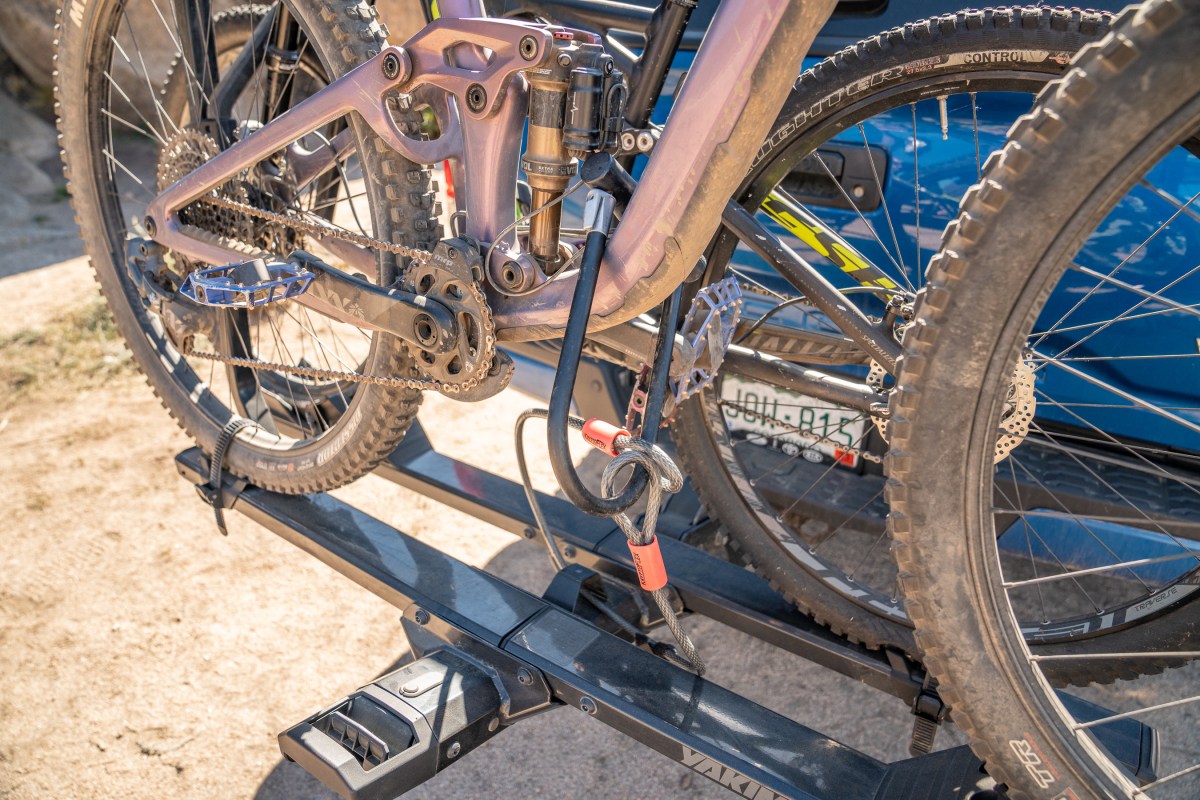
Mid-Tier ($400-$950)
The $400 to $800 range is the sweet spot for most cyclists, offering a significant jump in quality and ergonomics. These are primarily platform-style racks that provide a wide range of bike fits and secure your gear with zero frame contact, making them much easier to load than budget alternatives.
The Küat Transfer V2 ($549) remains the standout value in this category. It’s a lightweight 37-lb rack capable of hauling everything from road bikes to 60-lb e-bikes. As you approach the $900 mark, you gain premium convenience features like the RockyMounts BackStage ($900), which swings 180 degrees for full vehicle access.
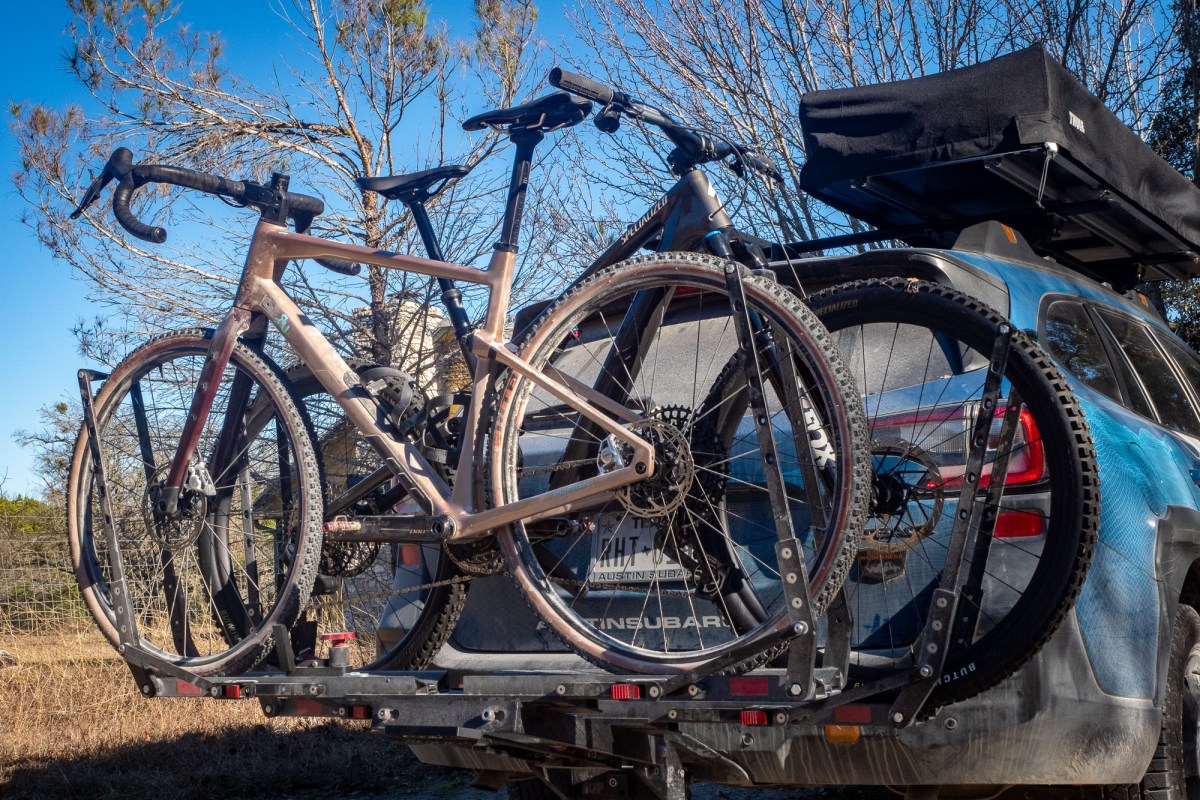
Premium ($950-$1,000+)
Approaching and exceeding the $1,000 mark enters premium territory, where you aren’t just paying for a name, but for superior ergonomics, specialized features, and higher bike capacities. Most high-density vertical racks fall into this bracket; while the upfront cost is significant, the “per-bike” price is often more reasonable than expanding a platform rack, and they provide the only reliable way to transport five to seven bikes simultaneously.
The Thule Verse ($1,000) is currently our top-rated choice in this category, building on the brand’s legacy with refined ergonomics and class-leading bike compatibility. For those seeking the absolute pinnacle of luxury, the Küat Piston Pro X ($1,589) offers an unmatched all-metal finish and genuine Kashima-coated struts. While its price is nearly double that of the Verse for a two-bike capacity, its ease of use and integrated LED taillights make it a standout for enthusiasts who want the best-looking and best-performing rack on the market.
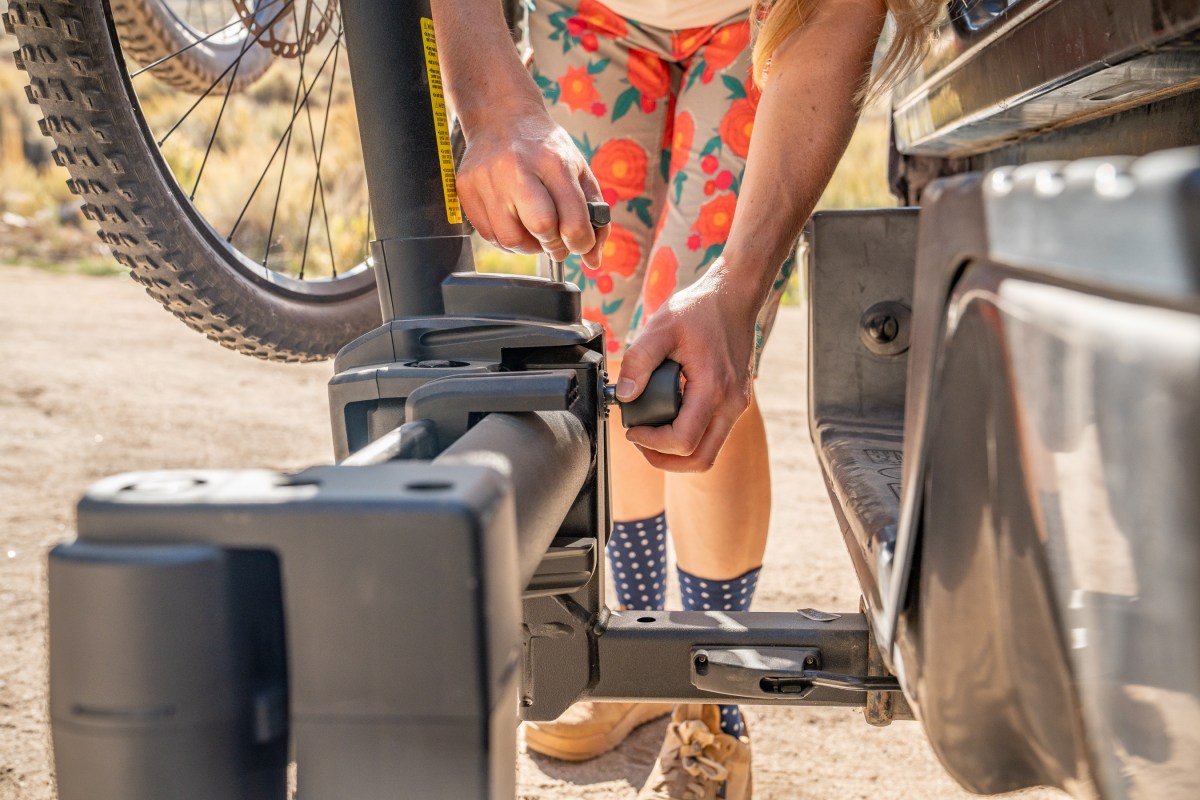
Frequently Asked Questions
The best hitch rack is a personal calculation that balances your bike’s value against your vehicle’s capabilities and your total budget.
Casual riders transporting standard aluminum frames would do fine with a budget-friendly hanging rack between $100 and $200. That style provides a functional, lightweight solution, provided you don’t mind the bikes touching during transit.
For carbon frames or heavy e-bikes, a platform rack is the superior choice because it secures the bike by the tires with zero frame contact and sits lower to the ground for much easier loading.
As you move into the premium $1,000+ price bracket, the investment pays off in advanced ergonomics, integrated security cables, and specialized pivot mechanisms that allow full access to your trunk without unloading. These high-end racks offer the highest weight capacities and integrated safety features like LED taillights, which are essential for heavy hauling and long-distance road trips.
Hanging and platform racks both offer four-bike configurations, but they differ significantly in stability.
Hanging racks secure bikes from the top tube, allowing them to swing and potentially collide during transit. While spacing out fewer bikes can minimize this risk, a full four-bike load requires careful cradle adjustment to prevent damage.
Platform racks solve this issue by locking both wheels into place, providing far superior stability and preventing bike-on-bike contact. Additionally, their lower tray height makes lifting heavy bikes into position much easier. While the upfront cost is higher than hanging alternatives, the added security and ease of use typically make the platform style a better long-term investment.
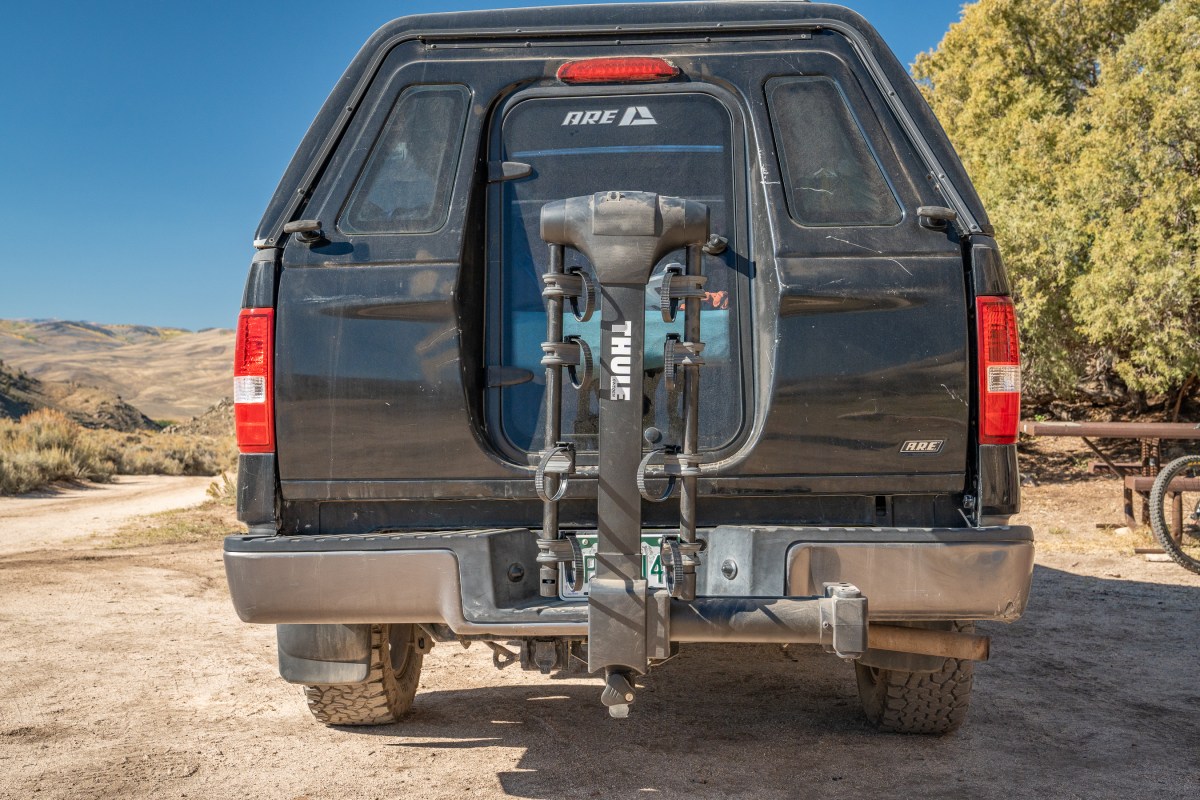
Hitch-mounted racks are the premier choice for protecting your vehicle’s exterior because they eliminate all contact with the car’s body. Unlike trunk-mounted racks, which rely on straps and clips that can rub and dull your paint, a hitch rack keeps your gear suspended safely away from the bumper and hatch.
However, vehicle damage can still occur through user error. The most common mistake is opening a hatchback or tailgate while the rack is in its upright position, which can cause the hatch to strike the rack and result in deep dents or scratches. To prevent this, always utilize your rack’s tilt or swing-away feature before accessing the rear cargo area.
You must be mindful of the proximity gap between your bikes and the vehicle. On bumpy roads, a platform rack positioned too close to the rear of an SUV can allow handlebars to vibrate against or even shatter a back window. Most premium racks allow you to adjust the trays laterally to increase clearance. Similarly, if you use a hanging rack, ensure the front wheels are secured with a bungee cord or strap to prevent them from swaying and scuffing your vehicle’s finish during transit.
Platform-style racks are the gold standard for ease of use due to their low loading height and intuitive wheel-attachment systems. For those who prioritize a hassle-free experience, lightweight two-tray aluminum models like the Küat Sherpa 2.0 or modular racks with tool-free AutoAttach systems are the easiest to install and remove solo.
If you frequently haul heavy e-bikes, look for specialized models like the Yakima StageTwo or Thule Verse, which are compatible with aftermarket loading ramps that allow you to roll bikes into place rather than lifting them.
While the Küat Piston Pro X remains the most user-friendly rack we’ve tested thanks to its hydraulic-assisted arms, its high price and weight mean that a lighter, ramp-compatible platform is often the more practical choice for most riders.
Hitch-mounted racks are the top choice for protecting both your vehicle and your gear, as they eliminate the paint-rubbing straps associated with trunk mounts and the heavy overhead lifting required by roof racks. Because they anchor directly into a steel receiver, hitch racks provide a rock-solid connection that is significantly more aerodynamic and secure than alternative mounting styles.
Installation is also exceptionally efficient. Most modern racks secure with a single locking steel pin or a tool-free dial, making it easy to swap the rack between vehicles or remove it entirely for garage storage. By positioning bikes at an ergonomic waist height, hitch racks remain the most user-friendly and fuel-efficient way to transport a wide variety of bicycles.
Read the full article here
