



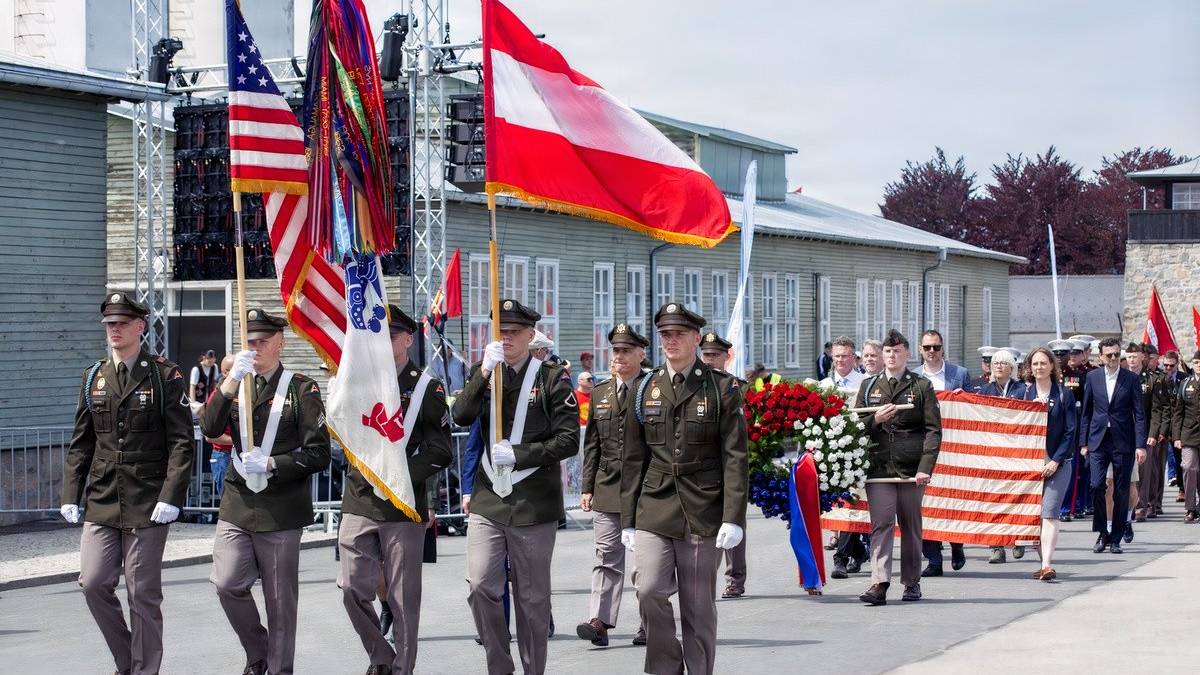

Fourteen soldiers from the 7th Army Training Command represented the Americans who liberated one of the worst Nazi concentration camps at a ceremony in Austria on May 10.
The troops, assigned to the Joint Multinational Readiness Center’s 1st Battalion, 4th Infantry Regiment, provided the color and honor guards for the Mauthausen Memorial’s annual International Liberation and Commemoration Ceremony, according to the U.S. Army. JMRC troops have filled that role for three straight years. U.S. Marines from the American Embassy in Vienna also joined the formation.
“Each of us here, every country represented, must use courage and clear vision to defend and transmit the truth of what happened here,” Ellen Germain, the State Department’s Special Envoy for Holocaust Issues, said at the ceremony. “Together, we remember those who died here, we thank the American Soldiers who liberated the camps, and we promise to do our best to ensure that it never happens again.”
The History of Mauthausen
The Nazis opened Mauthausen in August 1938, shortly after annexing Austria, near the city of Linz.
It held a distinction no other camp in the system shared at the time. The SS gave it a Category III classification, a designation reserved for prisoners considered beyond rehabilitation. Their files were stamped with the initials “RU,” a German abbreviation meaning “return undesirable.” They were sent there to die through labor.
The camp’s granite quarries were the primary instrument of that policy. Prisoners hauled blocks weighing more than 100 pounds up a 186-step stone staircase the SS called the Todesstiege, or the Stairs of Death.
A gas chamber went into operation in March of 1942, with Soviet prisoners of war among the first to be killed there.
Over seven years, roughly 190,000 people passed through Mauthausen and more than 40 of its subcamps. At least 90,000 were killed.
The killing did not stop even as the war in Europe reached its final days. On April 20, 1945, the SS selected and killed roughly 3,000 sick prisoners from the camp’s medical barracks. Eight days later, the gas chamber was used one final time.
The SS abandoned the camp on May 3. Prisoners who had organized an internal committee in late April assumed control and waited for the Americans.
They finally arrived on May 5. The 41st Cavalry Reconnaissance Squadron of the 11th Armored Division, operating under Gen. George S. Patton Jr.’s 3rd U.S. Army, reached the camp after a Swiss Red Cross delegate directed American soldiers to the site. Staff Sgt. Albert J. Kosiek led the first American patrol on the scene.
Two days later, Col. Richard Seibel arrived with additional troops and assumed command, spending the next 35 days overseeing medical treatment, burials and the repatriation of survivors who could travel.
American troops found nearly 40,000 prisoners alive. Thousands more would die in the days that followed, too weakened to recover.
Mauthausen was the last major concentration camp freed by Allied forces during the war.
From Liberation to Remembrance
Before the Americans arrived, a group of prisoners had secretly assembled an American flag using scraps of bedsheets, SS laundry and strips cut from Nazi banners.
They did not know how many stars the flag should carry, so they sewed 56.
When the prisoners presented the flag to Col. Seibel, he ordered it raised over the camp. He eventually gave it to Mauthausen survivor Simon Wiesenthal, who went on to devote his life to tracking down Nazi war criminals. The flag is now held by the Museum of Tolerance in Los Angeles, which presented a replica to the memorial during the 80th anniversary ceremony in 2025.
U.S. forces began to withdraw from Mauthausen in late July 1945. Soviet troops then used the grounds as a barracks until early 1946.
In June 1947, Soviet occupation authorities transferred the site to the Republic of Austria, which formally designated it as a public memorial in 1949. Annual liberation ceremonies have taken place every May since 1946, first organized by survivors themselves.
The memorial grounds today hold more than 20 national monuments and burial sites containing 14,000 victims. The Mauthausen Committee Austria, the successor to the original survivors’ association, organizes the ceremony alongside the International Mauthausen Committee, a body representing 21 nations.
The 2026 Ceremony
This year’s event was held under the theme “Perpetrators in National Socialism.” The U.S. delegation was led by Ambassador Art Fisher, Col. Jonathan Drake of the U.S. Embassy in Vienna, and Germain.
Fisher told attendees the story of the 56-star flag.
“It’s sometimes at the darkest point in life, and at night, that we see the light,” Fisher said. “It’s important that as a society, we remember that light. That light is so important to continue to shed on what happened here, so that darkness can never return.”
Drake, the embassy’s defense attaché, noted that the 71st Infantry Division and 11th Armored Division were among 36 U.S. Army divisions credited as concentration camp liberators during the war. That designation applies to any unit that reached a camp within 48 hours of its discovery.
“The Soldiers of these divisions were battle-hardened,” Drake said. “They had been through an incredible amount of things. They had seen all sorts of untold hardship. Nothing they saw prepared them for what they would see here. They thought the worst of the war was behind them, but the scenes of cruelty, starvation and systematic torture and death would horrify them and stay with them the rest of their lives.”
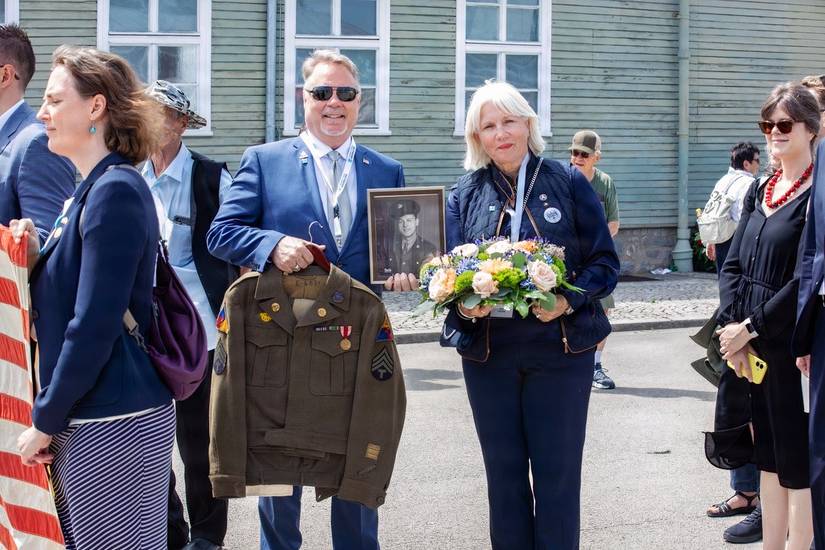
Several family members of liberators and survivors joined the procession. Paul Blackstone and Robert Pettit, grandsons of Capt. Jack Blackstone of the 26th Infantry Regiment attended. Robert Esterley III honored his father, whose WWII uniform he donated to the memorial. David Greenfield, son of a Holocaust survivor, and Helen Ayer Patton, granddaughter of the general whose 3rd Army freed the camp, also participated.
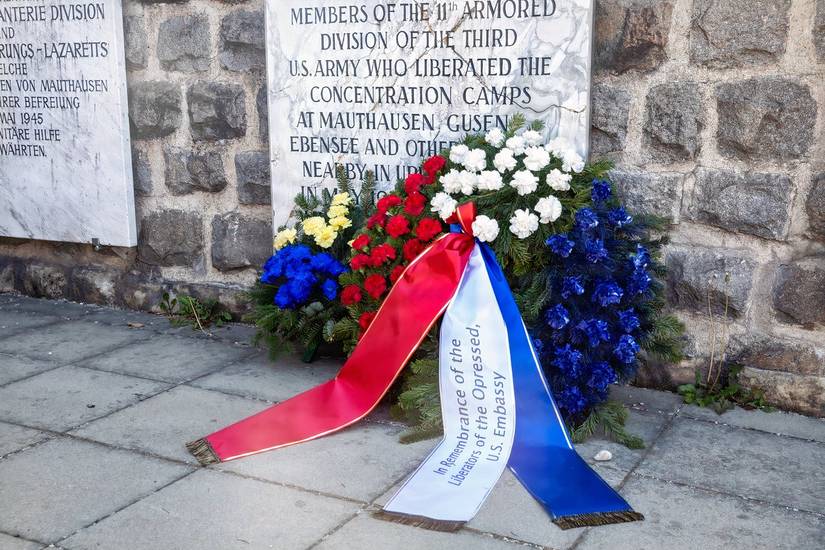
The soldiers’ wreath ribbon read, “In Remembrance of the Liberators of the Oppressed.”
Read the full article here
