



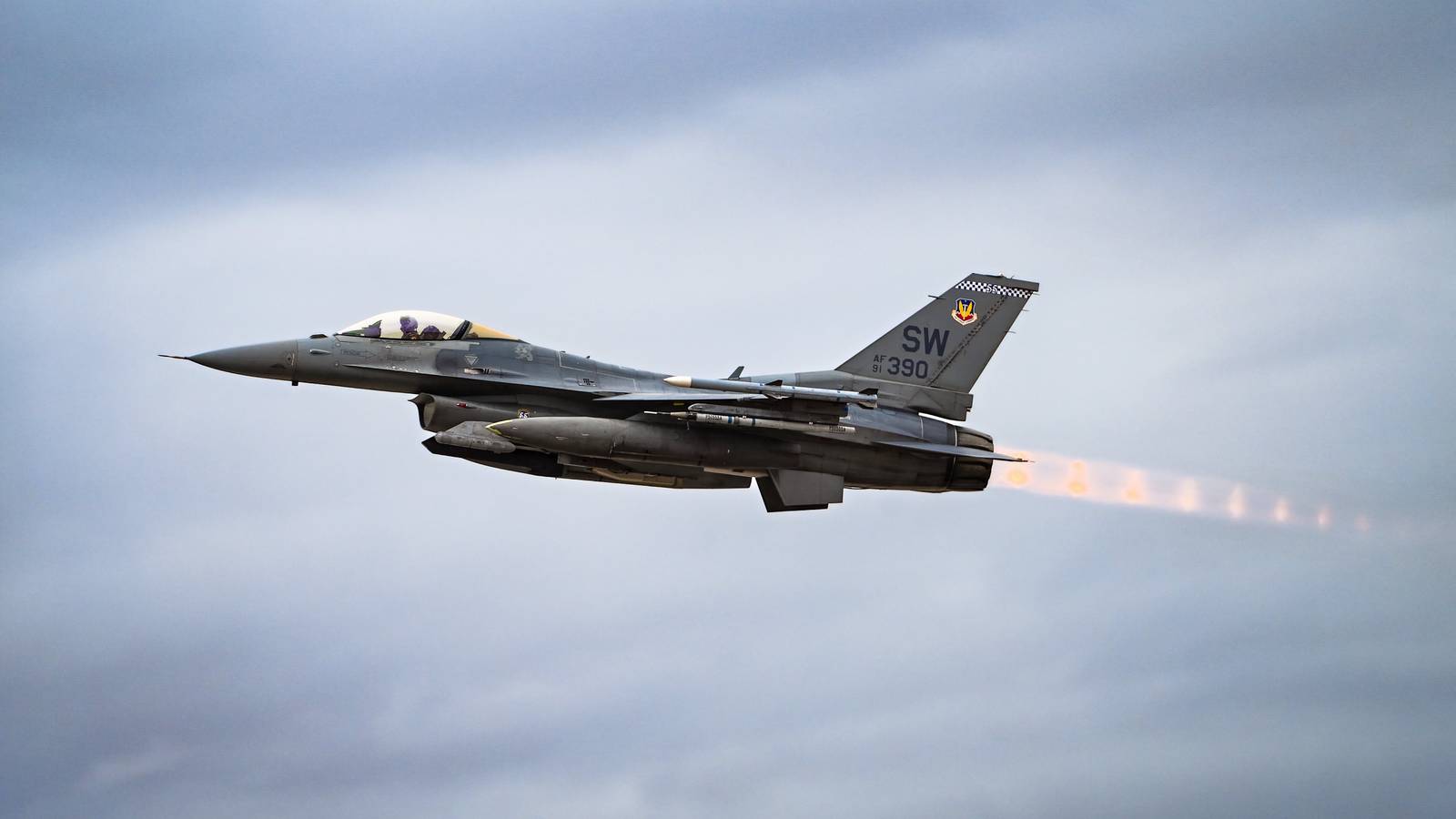

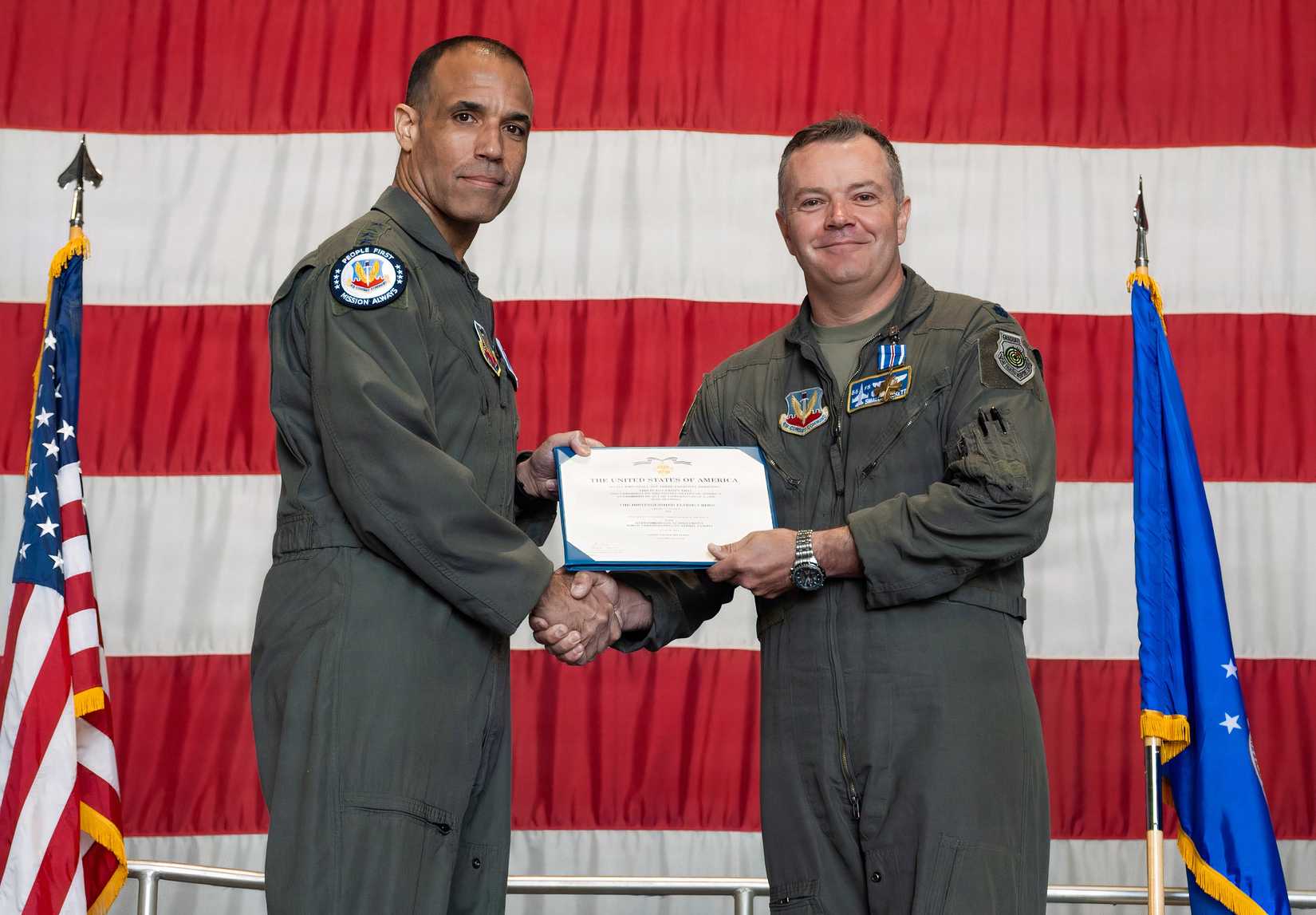
Six F-16 Fighting Falcon pilots from Shaw Air Force Base, South Carolina, received the Distinguished Flying Cross on May 5 for flying into heavily defended Iranian airspace during Operation Midnight Hammer, the June 2025 strikes that targeted Iran’s nuclear facilities.
Gen. Adrian Spain, commander of Air Combat Command, presented the awards during a ceremony at Shaw. The six pilots are all assigned to the 55th Fighter Squadron, part of the 20th Fighter Wing.
“Operation Midnight Hammer, the strike that helped end the 12-day war, doesn’t happen without these six Airmen,” Spain said.
The Pilots and the Mission
The pilots who received the decoration were Lt. Col. Christopher M. Beckett, the 55th Fighter Squadron commander; Maj. Matthew J. Croghan; Maj. Alexander J. Trembly; Capt. Abigail D. Maio; Capt. Megan C. Langas; and Capt. Daniel J. Dodson, according to Air & Space Forces Magazine.
On June 22, 2025, the pilots flew into Iranian airspace ahead of seven B-2 Spirit stealth bombers targeting the Fordow and Natanz nuclear enrichment facilities. The B-2s dropped 30,000-pound GBU-57 Massive Ordnance Penetrator bombs on both sites.
The overall operation involved more than 125 U.S. aircraft, including F-22s, F-35s, F-15Es, and aerial refueling tankers, according to Gen. Dan Caine, Chairman of the Joint Chiefs of Staff, in a Pentagon briefing after the strikes. U.S. forces employed roughly 75 precision-guided munitions against enemy targets.
The 55th Fighter Squadron flies the Wild Weasel mission, a specialized role focused on suppressing and destroying enemy air defenses using AGM-88 High-Speed Anti-Radiation Missiles. The 20th Fighter Wing is the only wing in Air Combat Command dedicated to this mission, which requires its pilots to fly directly into an adversary’s air defense network so that other aircraft can operate behind them.
“We are the only ones that are available to go anywhere at any time and execute the Wild Weasel mission,” Beckett said. “So it is a unique position to be in that we have to be prepared for any and all locations, which means any and all threats, which means when we start looking at our training, we have to be able to focus on a wide spectrum.”
The Wild Weasels
In a video released by the 20th Fighter Wing in December 2025, an unnamed 55th Fighter Squadron pilot described the lead-up to the mission.
“When tensions kind of started escalating between the two countries, we were kind of on standby, watching things happen,” the pilot said. “Then, as we started getting the words that we might get involved, it became like a week straight of mission planning. And so we were in and out of the vault 12 hours a day, just trying to get everything prepped, make sure that we could execute at a moment’s notice.”
Beckett later described the danger his pilots faced during the operation.
“When I look at it as a commander, bringing home everybody was questionable during some of these missions,” he said.
Meanwhile, the 20th Fighter Wing described the Midnight Hammer mission as “high-risk flights into heavily defended airspace” that involved “direct combat with adversaries.”
“That mission reminded every adversary watching that American airpower can be delivered anywhere, anytime, and for better or worse, make it look easy,” Spain said. “But we know it’s not easy.”
A Rare Award
The Distinguished Flying Cross is the fourth-highest award for heroism across the U.S. military. Congress established the decoration on July 2, 1926. It is awarded for heroism or extraordinary achievement during aerial flight. The acts recognized must be “entirely distinctive, involving operations that are not routine.”
Capt. Charles A. Lindbergh was the first to receive the medal in 1927, for his solo transatlantic flight. Recipients over the past century have included former President George H.W. Bush for his World War II service as a Navy torpedo bomber pilot, and astronauts from the Mercury, Gemini and Apollo programs.
Spain emphasized the rarity of the award and praised the training and teamwork that produced the result.
“These results don’t happen by accident,” Spain said. “It was a product of years of discipline, training and a refusal to accept anything less than excellence from themselves and from each other.”
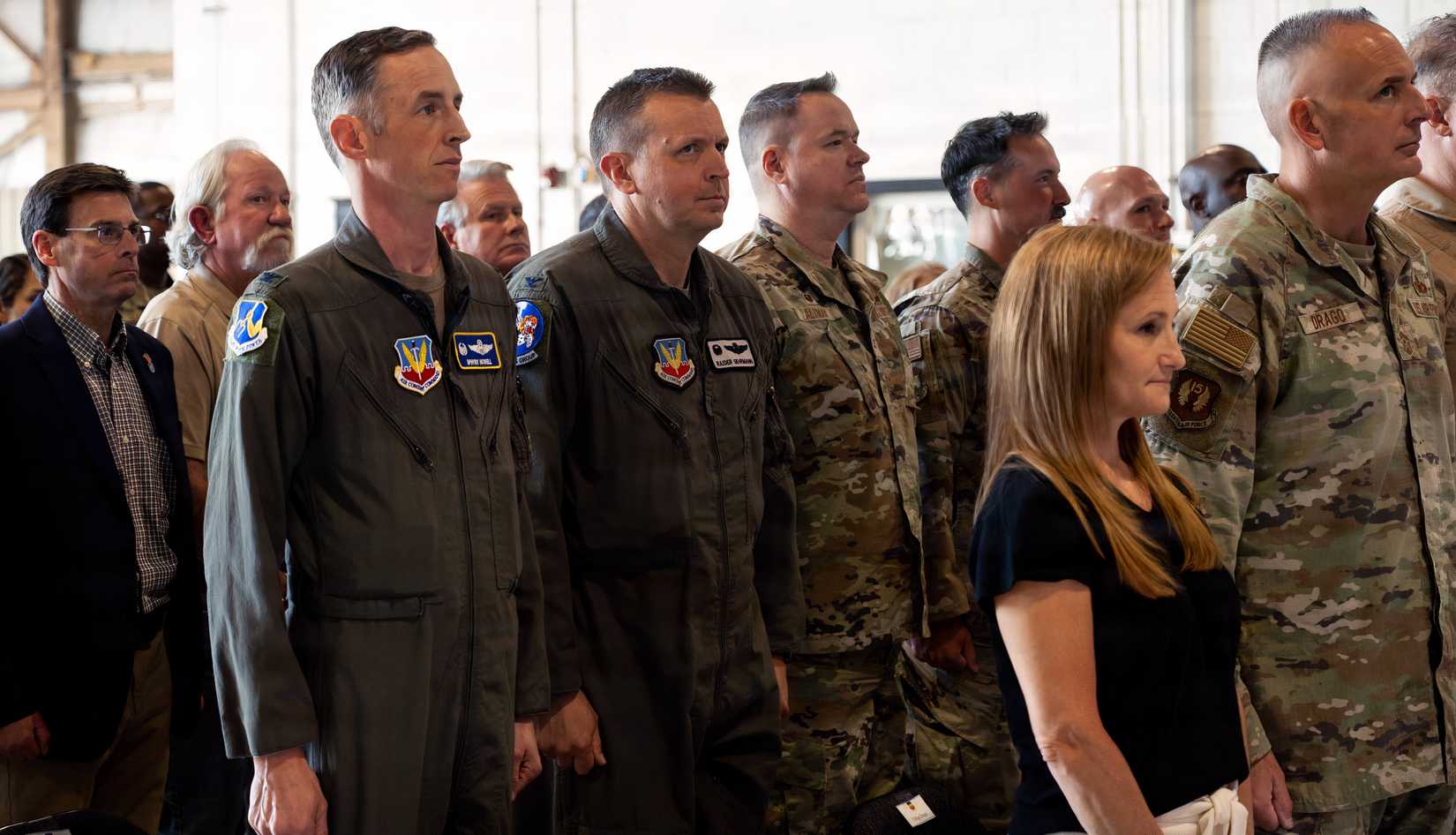
He also credited other Air Force members for providing support behind the six pilots.
“To the maintainers, the ops team, the intel professionals, the logisticians who launched those jets, make no mistake,” Spain said. “Valor like this is forged by the formation.”
The 55th Fighter Squadron’s honors add to a growing list of decorations tied to Operation Midnight Hammer. In March, KC-135 Stratotanker aircrew from the 92nd Air Refueling Wing at Fairchild Air Force Base, Washington, received Distinguished Flying Crosses and Bronze Stars for their refueling role during the mission.
Deployed units from the 20th Fighter Wing also earned the Gallant Unit Citation for their 2025 Middle East operations.
Other F-16 pilots from Shaw have continued flying combat missions in Operation Epic Fury, the ongoing U.S. campaign against Iran.
The 55th Fighter Squadron traces its lineage to Aug. 9, 1917, when it was organized as the 55th Aero Squadron at Kelly Field, Texas. The unit flew P-38 Lightnings and P-51 Mustangs in the skies over Europe during World War II, providing air cover during the Normandy invasion and escorting bombers during the Battle of the Bulge.
It was deployed to Turkey during Operation Desert Storm in 1991, flying more than 144 sorties without a loss. In 1997, it transitioned to the F-16 and took on the Wild Weasel mission at Shaw, which it continues to perfect to this day.
Read the full article here
