





The Institute for Primary Facts just opened the Donald J. Trump and Jeffrey Epstein Memorial Reading Room, a library putting on public display more than 3.5 million pages of the Epstein files.
Inside the New York installation, the Epstein files are no longer just another batch of documents floating through search results, social media posts, congressional hearings and half-remembered headlines. They are printed, bound and shelved. The archive takes up physical space, which is exactly the point.
The reading room, located in New York City’s Tribeca neighborhood, compiles the Epstein-related records released by the Department of Justice into thousands of individual volumes. Public reports have described the installation as containing roughly 3,437 to more than 3,700 volumes, depending on how the records are counted, with the full display weighing more than 17,000 pounds. It is open to the public by appointment from May 8 to 21.
For David Garrett, a spokesperson and lead organizer for the Institute for Primary Facts, the choice to make the documents physical was not a gimmick, but an argument.
“Printing out the Epstein files distinguishes them as real and tangible,” Garrett told Military.com.
Trump has denied wrongdoing related to Epstein, and the White House has rejected attempts to tie him to Epstein’s crimes.
Why Print the Epstein Files?
For the past few years, the Epstein case has existed in a strange corner of American public life, where court records, victim testimony, tabloid obsession, political suspicion and internet speculation all collapse into the same feed. The reading room tries to slow down the digital noise.
Garrett said searching the files on a phone or computer does not convey the scale of the case, nor the crimes described in the records that continue to draw widespread attention not only domestically but worldwide.
“Searching these files digitally–on a phone or a computer–does not convey the enormity of scale of the Epstein files and the crimes contained within. 3.5 million documents is a lot of evidence. 17,000 pounds of paper, nearly 3,500 volumes of 800 pages each.”
It’s striking to see the physicality of this evidence.
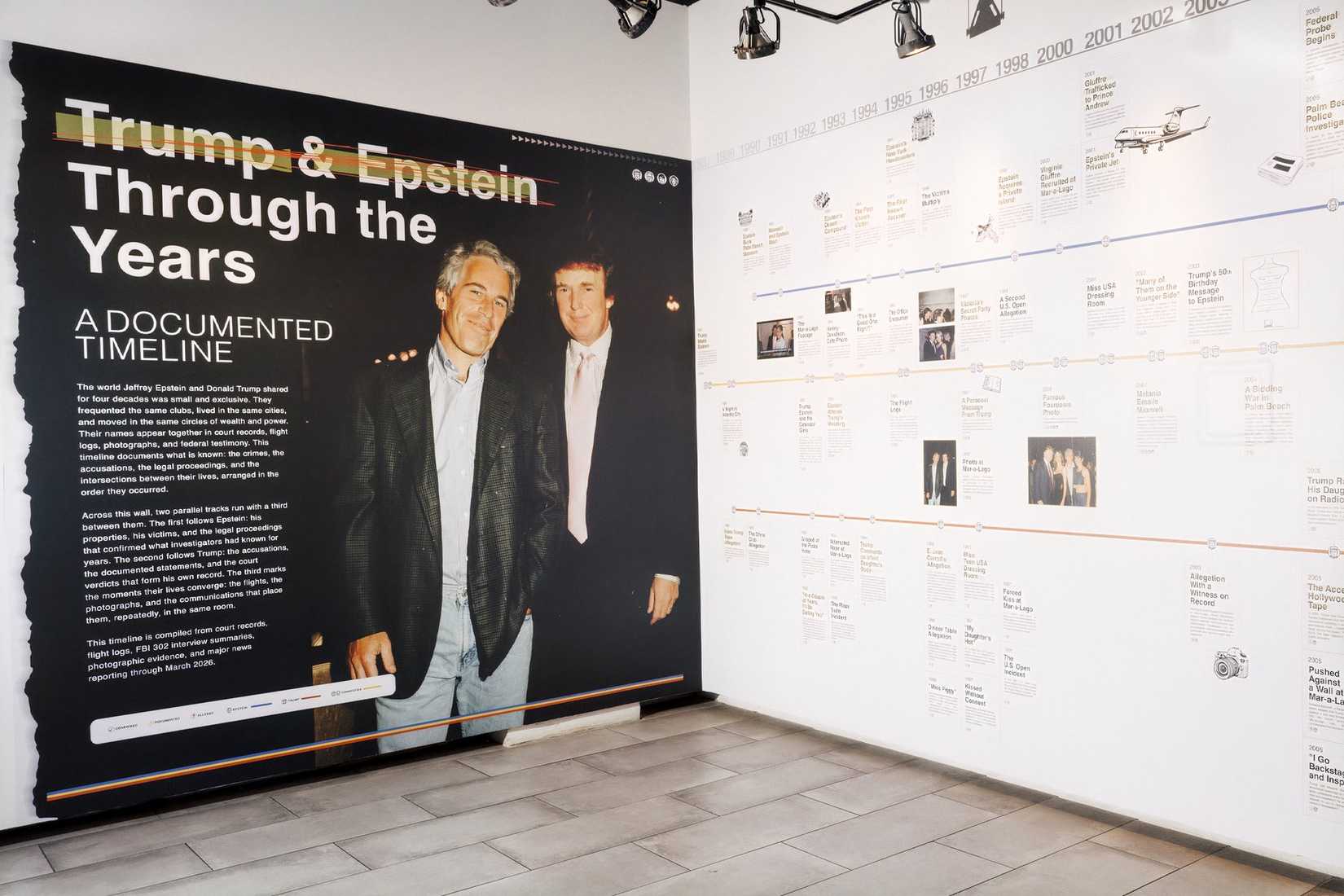
That physicality is what gives the installation its force, he said. Rows of white-bound volumes line the room. A timeline traces years of public records, legal proceedings, reported encounters and documented connections. At the center is a tribute to survivors and victims.
The result feels less like a traditional library, and instead forces visitors to confront volume after volume.
The Institute for Primary Facts, a nonprofit focused on civic literacy through immersive museum exhibits, said the reading room is meant to draw public attention back to the records themselves—and to the government’s handling of them.
The Archive Is Also a Pressure Campaign
The reading room is not being presented as a neutral display of old documents.
According to Garrett, the Institute hopes the installation builds support for the Justice Department to release the “full and properly redacted files.”
“So far, only public outrage and pressure have moved the needle.
That line gets close to the real nerve of the exhibit. The Epstein files have become one of those American scandals where the public record is both massive and, for many people, still not enough. Millions of pages have been released, including a large batch of documents from the Justice Department earlier this year.
Still, questions remain over what has been withheld, how redactions were handled, and whether the public has received the full picture. The DOJ released more than 3 million pages in January as part of the Epstein Files Transparency Act.
The reading room leans into that unresolved feeling. It does not ask visitors to scroll. It asks them to stand in the middle of the archive and feel how large the case is.
The title itself is deliberately provocative. The Donald J. Trump and Jeffrey Epstein Memorial Reading Room places Trump’s name alongside Epstein’s, reflecting the exhibit’s focus on their documented social relationship and the public records associated with it.
Garrett said the Institute expected the exhibit to raise larger questions about power, accountability and whether the law applies equally.
“We hope and believe that the Epstein case is unique,” he said. “The ages of the victims and the unbelievable number of crimes is hard to imagine. We hope and believe that the public will demand transparency and accountability.
“If achieved, we think this moment can provide hope to future generations that the rule of law still exists in America, and that it is applied equally, even to the rich and powerful.”
Access to the Files Is Limited
Despite the public-facing nature of the installation, not every visitor can open and search the bound records.
The institute said direct access is limited to credentialed members of the press, members of Congress, law enforcement, victims and survivors, and advocates for victims and survivors.
That restriction is tied to one of the most sensitive problems with the released records: survivor privacy.
Garrett said the institute found unredacted names and identifying information in the files after printing the volumes and doing its own review.
“The Trump Department of Justice failed to redact names and identifying information of many victims and survivors,” Garrett said. “After printing the volumes and performing due diligence, we found many instances of unredacted names, and in the end we felt that the risk of exposing sensitive information was too high.”
That choice gives the installation a built-in tension, calling for transparency while also limiting access. Garrett said the institute made that decision after consulting with survivors, victims and advocacy organizations.
“We always put the safety of the survivors and victims first,” Garrett said. “In the exhibition, the tribute to survivors and victims is in the center of the room, surrounded by the evidence of the crimes against them.”
In photographs provided to Military.com, the room is lined with bound records, but the center is occupied by a candlelit tribute. The archive surrounds the memorial, not the other way around.
A Scandal Americans Still Want to See for Themselves
The Epstein case now sits in a crowded shelf of American public memory, near other unresolved or heavily scrutinized records that people return to again and again: the JFK files, the Pentagon Papers, the Zapruder film.
Each became more than evidence. Each became a test of whether institutions had told the public the whole truth.
Garrett said the institute believes the Epstein case stands apart because of the number of victims and the nature of the alleged abuse.
Still, the reading room taps into the same national instinct. When trust collapses, people want to see the documents themselves. They want the file, the page, the signature, the redaction box. They want proof that carries weight.

The institute hopes visitors leave with a renewed demand for transparency and justice.
“The hundreds of victims and survivors deserve justice,” Garrett told Military.com, “and seeking justice is the only way we can hope to avoid horrible crimes like this from happening in the future.”
Read the full article here
