



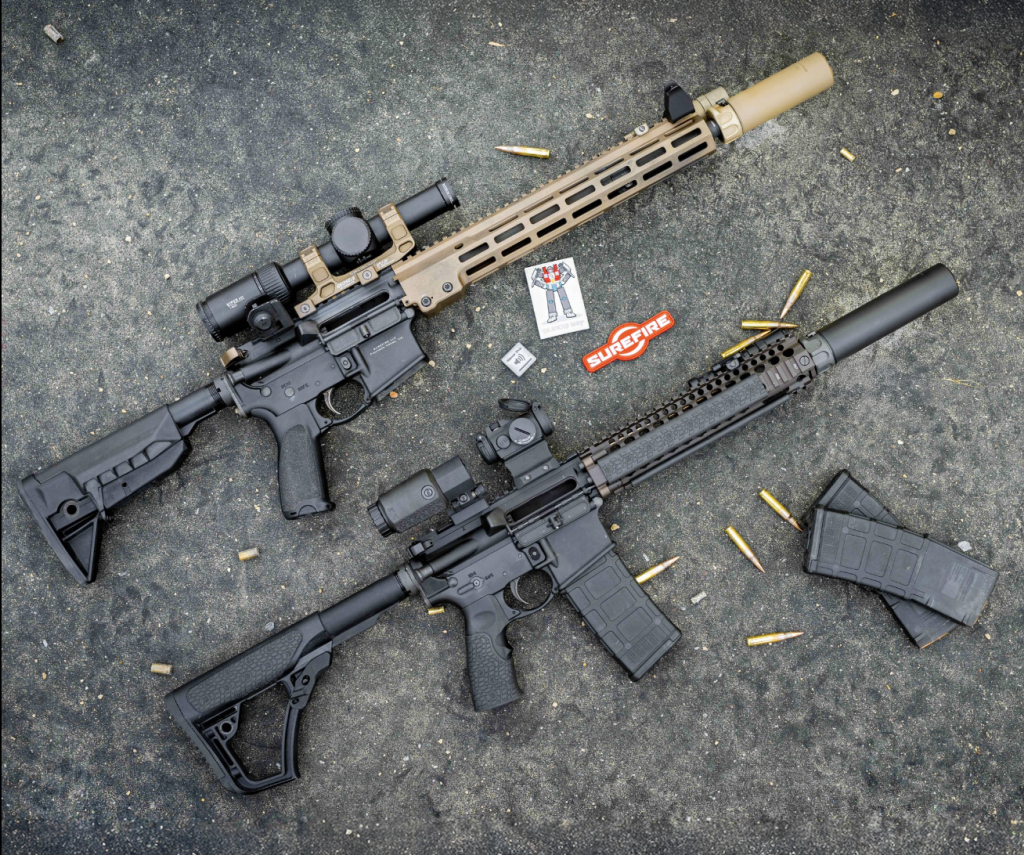

You just dropped serious money on a quality suppressor. You waited through the paperwork. Now you’re finally on the other side of that process, can threaded onto your barrel, and ready to experience the quietest, most satisfying range session of your life.
Then you feed it the same bulk steel-case plinking ammo you’ve been running through your AR for the past three years.
Here’s the thing: it’ll probably work. But “probably works” and “performs at its best” are two very different things when you’re shooting suppressed. The ammo you choose has a bigger impact on your suppressed shooting experience than most people realize, and understanding the relationship between ammo quality and suppressor performance is what separates a good suppressed setup from a great one.
The Short Answer: Ammo Quality Matters More When Suppressed
Suppressors don’t just make your gun quieter; they change the entire shooting experience. The reduced sound signature, reduced flash signature, and overall smoother shooting experience. Everything is more precise, more deliberate, and more enjoyable. And just like a quality suppressor amplifies all the good parts of shooting, it also amplifies inconsistencies in your ammunition.
Velocity spread, inconsistent powder burns, dirty propellants; these issues exist whether you’re shooting suppressed or not, but they matter more when you’ve invested in a top-shelf can. Running cheap ammo through a premium suppressor is a little like putting regular fuel in a high-performance engine. It’ll run. But you’re leaving performance on the table.
The clearest example of this is first-round pop (FRP). When a suppressor baffle stack has residual unburned powder or gas sitting in it, the first shot tends to be noticeably louder than subsequent shots. Cheaper ammunition with inconsistent powder charges or dirtier-burning propellants tends to exacerbate this effect and can increase carbon buildup inside your can over time, which means more frequent cleaning.
The Subsonic Equation
The single biggest thing you can do to get maximum performance from your suppressor is pair it with subsonic ammunition. That sonic crack you hear when a bullet breaks the sound barrier? Your suppressor can’t touch that; it’s a byproduct of the projectile itself, not whats attached to the muzzle. Running supersonic ammo through a suppressor significantly reduces the muzzle blast, but leaves that sharp, distinctive crack fully intact.
Subsonic ammo eliminates that crack entirely. Done right, the combination of a quality subsonic load and a well-built suppressor is genuinely quiet, the kind of Hollywood-quiet that makes first-time suppressed shooters stop, look around, and grin.
9mm is one of the most natural suppressor pairings in the game. Standard 147-grain loads stay comfortably subsonic and run reliably in most pistols without any modifications. Federal HST 147-grain JHP and Speer Gold Dot are solid real-world performers. If you want something purpose-built, SuperVel’s “Hush Puppy” loads are a premium option specifically engineered for suppressed use.
Paired with a compact 9mm suppressor from Silencer Shop, something in the 4–5 inch, sub-8-ounce range, you’re looking at a hearing-safe setup under 130 dB. That’s a genuinely usable defensive or competition setup, not just a range toy.
For rimfire shooters, Standard Velocity .22 LR is essentially subsonic by nature, which makes it one of the most naturally suppressor-friendly cartridges on the market. The cost is almost criminally low, around nine cents per round, and the experience is outstanding. A rimfire can on a Ruger 10/22 or CZ 457, running cheap bulk standard-velocity ammo, is about as much fun as you can have for the money. If you want to push further into Hollywood-quiet territory, purpose-made subsonic .22 LR loads can bring some setups under 110 dB, turning your rifle into a bolt-action in the process. The tradeoff in cycling is worth it for a backyard plinking session.
The .300 Blackout was literally engineered for suppressed, subsonic use. Loads in the 190–220 grain range are virtually all subsonic and carry enough mass to be effective for hunting. Hornady Black, SIG’s Elite 220gr Subsonic, and boutique options from Discreet Ballistics are excellent pairings with a full-featured multi-caliber rifle can.
5.56: The Most Common Suppressor Caliber Deserves Its Own Conversation
Most suppressors in the wild are riding on AR-platform rifles chambered in 5.56, so it’s worth breaking down the ammo options.
At the premium end, two loads dominate the discussion. Black Hills Mk262 Mod 1, a 77-grain Open Tip Match load originally developed for the Mk12 SPR, remains one of the best-performing 5.56 loads available for accuracy-focused applications. Its heavier projectile offers excellent external ballistics and remains stable in 1:7 twist barrels common on modern ARs, including short-barreled hosts. At distance, it holds velocity better than lighter projectiles and delivers consistent terminal performance. It’s pricier, but if you’re running a precision-oriented suppressed rifle and want to actually leverage the accuracy potential of your setup, Mk262 earns its keep.
The Barnes 70-grain TSX takes a different approach that’s arguably better suited to a wider range of real-world applications. As a solid copper expanding bullet, the TSX doesn’t rely on velocity-dependent fragmentation to do its job; it expands reliably and penetrates consistently regardless of light barriers it may come into contact with. That construction is exactly why it’s the kind of load that ends up in discussions about what serious operators actually carry.
If you want solid-copper performance without going full TSX, HOP Munitions’ 62-grain REX is worth knowing about. It follows the same design philosophy: solid copper construction, reliable expansion, consistent penetration, and a slightly lower weight that translates to higher muzzle velocity and a flatter trajectory out of common 14.5–16-inch carbines. It’s not trying to be a Mk262 clone, but it’s a legitimate option for shooters who want expanding solid copper performance in a suppressor-friendly package.
For high-volume training, Prvi Partizan 5.56 is a name that keeps coming up among shooters. Where many budget brass-case options disappoint with inconsistent velocity or reliability issues, Prvi has earned a reputation for punching well above its price point. If you’re going to run a few hundred rounds through your suppressed AR on a range day, Prvi is a smarter choice than grabbing whatever is cheapest on the shelf. Prove it in your specific rifle first, then buy in bulk.
The broader lesson with 5.56 and suppressors is that barrel length matters a lot. Shorter barrels bleed velocity faster, which affects both sound signature and terminal performance. Heavier, high-BC bullets like Mk262 perform better in short-barrel configurations for this reason. Match your ammo to your barrel length and your mission, not just your price point.
When to Spend More on Ammo
For hunting applications, premium ammo earns its price in terminal performance consistency and clean kills. Running a quality hunting load through your suppressed rifle, whether you’re chasing hogs with a .300 BLK or taking deer with a bolt gun, means verified point of impact, controlled expansion, and less variability at real-world hunting distances. The suppressor already gives you an edge in not blowing out your hearing or sending nearby animals running at the shot. Pair that with a quality hunting load, and you’ve got one of the cleanest, most effective hunting setups available.
For defensive carry, the math is even simpler. You’ve already bought the gun, the holster, and the suppressor. The premium hollow point is not where you cut costs. Federal HST, Speer Gold Dot, and similar loads have documented, proven terminal performance and wide feeding reliability across common defensive pistols. Run what works. Buy a couple of boxes, verify reliability and point of impact with your specific suppressor/host combination, and then keep it stocked.
For precision rifle work and competition, ammo consistency directly impacts performance. Match-grade loads reduce velocity spread across strings of fire, which translates directly to tighter vertical dispersion at distance. At 800–1,000 yards, even small velocity swings become misses. Running match-grade ammo through a precision suppressed setup is simply removing a variable that has no business being there.
When Cheap Ammo Is Perfectly Fine
High-round-count training and plinking are exactly what budget ammo is for. Once you’ve confirmed that a given load runs reliably in your specific firearm, buying it in bulk and building reps is the right play. The suppressor still does its job, the round still hits the target, and you get more trigger time for the same money.
The key is proving reliability before committing. Run a box or two of any new budget load through your setup before ordering 1,000 rounds. If it runs clean and cycles reliably, you’ve found your training ammo.
Budget bulk .22 LR deserves a special mention here. Even suppressed .22 LR with cheap standard velocity ammo is a genuinely excellent training tool. The manual of arms on a rimfire trainer, particularly platforms like the M&P 15-22 that mimic more centerfire-oriented guns, keeps your mechanics sharp at a fraction of the cost. Throw a rimfire suppressor in the mix, and you’ve got a setup that’s genuinely pleasant to shoot for extended sessions. Rimfire suppressors from Silencer Shop are also one of the best entry points into suppressor ownership; user-serviceable, full-auto rated, and capable of over 40 dB reduction at a price point well under $500.
Matching the Ammo to the Can
One piece of the puzzle that often gets overlooked is matching your suppressor choice to the ammo you intend to shoot. Not every suppressor is optimized for every application.
A compact 9mm pistol can is purpose-built for a relatively narrow velocity window. Running standard-pressure 147gr subsonic through it is ideal. Running 115gr +P through the same can is going to be louder, hotter, and harder on the internals. The suppressor works, but it’s not doing what it was built to do.
Silencer Shop’s website makes this matching process easier than it has to be; their suppressor finder tools and detailed specs let you search by caliber, host platform, and intended use so you’re not guessing. With the NFA stamp now effectively free, the barrier to entry has dropped significantly, which means more shooters are entering the suppressed world and more of them are asking the right questions about setup.
The Bottom Line
Buying a premium suppressor and feeding it the cheapest ammo you can find isn’t a disaster. But it’s a missed opportunity.
Use subsonic loads when you want maximum sound reduction. Run premium ammo when your life or the hunt depends on it. Use quality bulk training ammo to build reps and keep your fundamentals sharp. And when it comes time to pick your suppressor, buy from a source you can trust.
Silencer Shop has been the go-to destination for suppressor buyers since they simplified the whole process, from their nationwide kiosk network for enrollment to their industry-leading 99.5% application accuracy rate and free transfers when you buy direct. Whether you’re chasing maximum sound reductions or just want a more enjoyable range experience, start with the right suppressor. The ammo conversation gets a lot easier after that.
Read the full article here
