



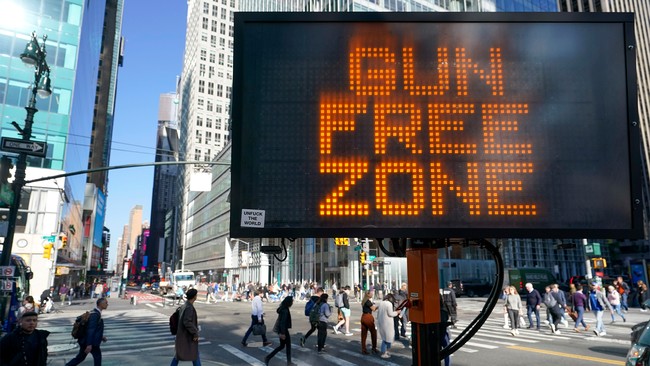

We’re still waiting on the Third Circuit to issue its opinion on New Jersey’s ban on “assault weapons” and “large capacity” magazines after oral arguments were held last fall, but an en banc panel of the appellate court took up more of New Jersey’s restrictions on the right to keep and bear arms on Wednesday morning; the various “sensitive places”, insurance requirements, and other mandates imposed on concealed carry applicants and licensees in the wake of the Bruen decision.
The very fact that the Third Circuit decided to take the case en banc after a three-judge panel upheld most of the “gun-free zones” created by the legislature is, in itself, a sign that a majority of the court disagree with the opinion to one degree or another.
During oral arguments, New Jersey essentially argued that virtually any place where people might gather could be deemed “sensitive”, despite the Supreme Court’s caution in Bruen that New York couldn’t ban concealed carry across Manhattan simply because its crowded and generally protected by police.
The judge asks what other public places Bruen prevents it from banning guns in. NJ says banks because it doesn’t think there’s a historical tradition of banning guns there.
Interesting, because other states have tried banning carry in banks after Bruen!
— Firearms Policy Coalition (@gunpolicy) February 11, 2026
New Jersey also argued that the court has to consider laws that were enacted more than 100 years after the ratification of the Second Amendment, and even decades after the ratification of the Fourteenth Amendment. The attorney representing the state asserted that in the mid-to-late 1800s, a number of legislatures responded to the “unprecedented societal concern” of guns being carried around vulnerable people like children, civic locations like courthouses and polling places, and spaces “where guns could jeopardize the safety of others.”
One Third Circuit judge pushed back on that claim, noting that the Statute of Northampton, created back in the 1300s, was a response to concerns over weapons being carried in public places. In other words, worries about armed violence was hardly unprecedented before the mid-to-late 1800s, and yet the historical record shows that there were very few restrictions on carrying arms before that time.
Erin Murphy, representing the plaintiffs in Seigel v. Platkin, argued that the broad bans on carrying that were adopted in a handful of states after 1860 are historical outliers, not evidence of a historic tradition of banning the lawful bearing of arms in almost every publicly accessible place, as New Jersey has done.
– Within 100 feet of a permitted public gathering;
– School, college, university or educational institution, as well as on school buses;
– Child care facilities including day care centers;
– Nursery schools, pre-schools, zoos, and summer camps;
– State, county or local government land designated as a gun free zone, including beaches, parks, or recreation areas like playgrounds;
– Youth sports events;
– Public libraries and museums;
– Bars and restaurants where alcohol is served;
– Entertainment venues like theaters, stadiums, arenas and racetracks;
– Casinos and other gaming venues, including hotels to which they are attached;
– Health care facilities like hospitals, treatment or diagnostic centers, residential healthcare facilities, and the like;
– Airports and public transportation hubs;
– Facilities licensed or regulated by the NJ Departments of Human Services, Health or Children and Families that provides treatment for addiction or mental health conditions;
– TV and film sets;
– Private property held open to the public unless the property owner provides his explicit consent to carry.
As Murphy contended, it can’t be that sensitive places can be so defined so broadly that it “bans carrying everywhere people want to go.”
Judge asks why it’s unreasonable for legislatures to ban guns in lots of places, when guns today can be used to kill lots of people?
Murphy says by that standard, there is no limiting principle. You can ban carry everywhere even slightly crowded. State even said you can only…
— SAF (@2AFDN) February 11, 2026
Pete Patterson, representing the plaintiffs in Koons v. Platkin, argued that truly “sensitive places” are those that are already subject to heightened security because of those locations, not because someone might want to carry a firearm there.
Q: what about polling places? Most today don’t have security.
Patterson says founding era polling places did, because there was no secret ballot. With adoption of secret ballot, intimidation no longer a concern and security faded.
— SAF (@2AFDN) February 11, 2026
That’s actually a great point. SCOTUS specifically pointed to “founding era” pollilng places in Bruen, not polling places in general. And it speaks to Patterson’s argument that lawmakers can’t just call a location a “sensitive place” in order to ban concealed carry, that there instead must be evidence that the State considers those places sensitive regardless of its carry laws.
Q: what if lots of 19th century laws, but no founding era laws?
Patterson points out that SCOTUS in Espinoza said that even more than 30 laws in the late 19th century, if contradicts founding, is irrelevant.
— SAF (@2AFDN) February 11, 2026
On rebuttal, New Jersey’s attorney again asserted that there is essentially no limiting principle in determining “sensitive places”. Even if there is nothing comparable to be found in statute around 1791 (or even 1868), it may be because the legislature wasn’t acting to the maximum extent of their authority. Several of the judges on the en banc panel expressed skepticism about that argument, and it sounds like the one of the main questions the panel will consider is how much weight to give laws enacted around the time of the Fourteenth Amendment’s ratification and the decades after.
Both the defendants and plaintiffs received some tough questions by the panel, and its hard for me to judge what the outcome in Koons and Seigel will be based solely on today’s oral arguments. Again, the fact that the Third Circuit decided to take these cases en banc indicates that a majority of justices have concerns about the panel’s decision upholding the vast majority of New Jersey’s Bruen response bill,, so that makes me cautiously optimistic that when we finally do get a ruling (hopefully later this year) it will hold that the vast majority of these supposedly “sensitive places” violate our Second Amendment rights.
Editor’s Note: The anti-gun left will stop at nothing to enact their radical gun control agenda and strip us of our Second Amendment rights.
Help us continue to report on and expose the Democrats’ gun control policies and schemes. Join Bearing Arms VIP and use promo code FIGHT to get 60% off your VIP membership.
Read the full article here
