



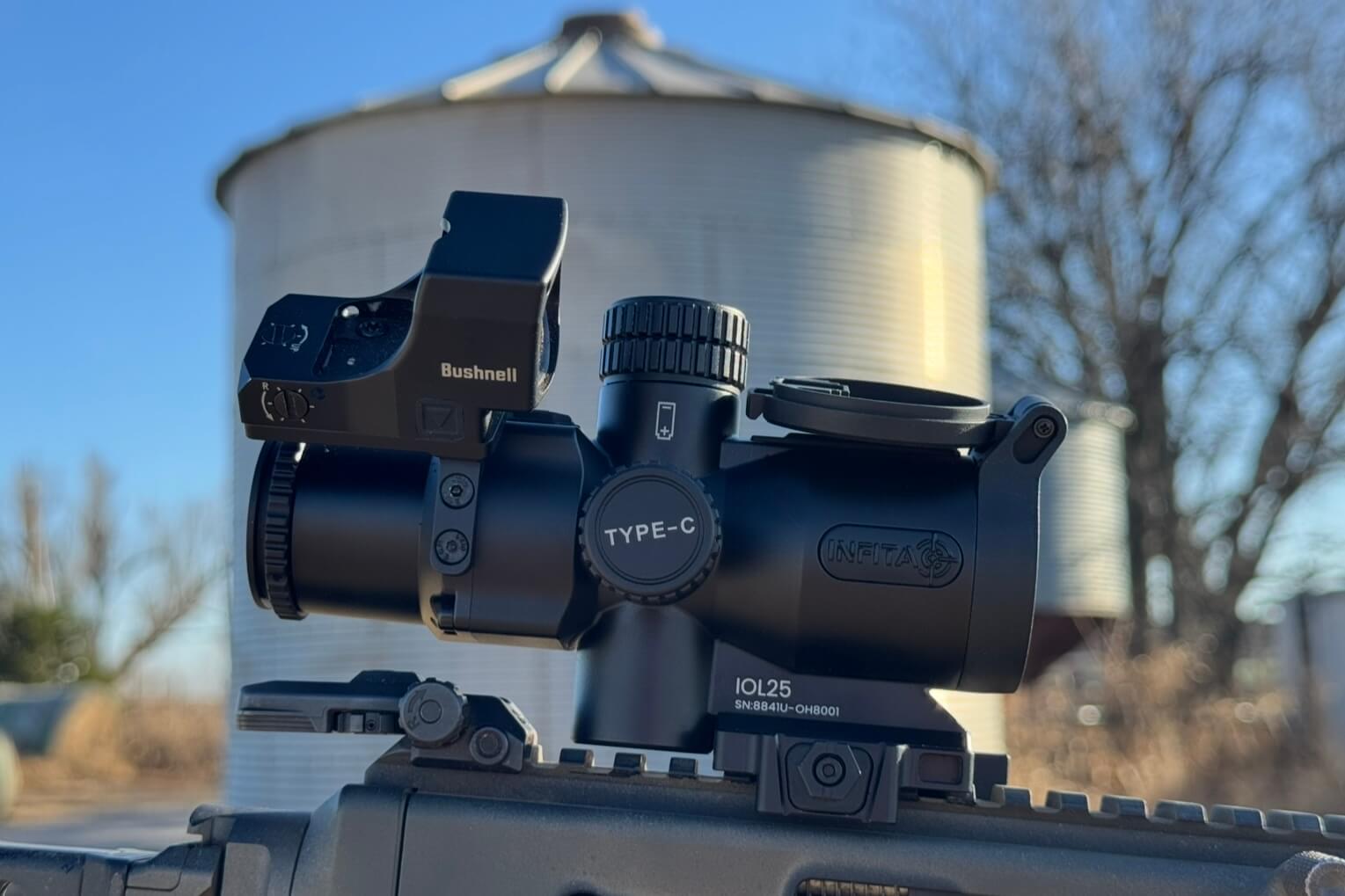

Tiny body, big utility. The Infitac IOL25 leans into features over raw pixels, delivering QD speed, offset red dot versatility, and a surprising kill flash that actually works.
Meet the IOL25 Thermal: Compact Build For Real Hunts
The Infitac IOTS IOL25 is a compact thermal rifle scope built around versatility while featuring a QD mount, offset red dot, and kill flash. While INFITAC markets it as a true multi-role system, in practice, the IOL25 makes the most sense as a lightweight, standalone rifle thermal with strong handheld scanning capability.
At its core, the IOL25 uses a 384×288, 12 micron sensor paired with a 25mm F1.0 objective lens, running at 50 Hz. On paper, that places it squarely in the crowded entry-level thermal market. It wins on features, not pixels, packing a lot of capability into a very compact housing.
Unboxed and Running: Everything You Need On Day One
Infitac includes a complete kit with the IOL25. Inside the box, you get the thermal itself, a QD Picatinny mount, a 45-degree offset red dot mount with an RMR footprint, mounting hardware and tools, two rechargeable 18650 batteries, two battery covers to accommodate varying battery lengths, a lens cap, a rubber eyeguard, a lens cloth, USB C cable, heated zeroing targets, and documentation.
The inclusion of the offset red dot mount and QD base is a big plus. Some thermals in this category require additional purchases to achieve similar flexibility. Having everything needed to run this as a rifle scope, scanner, or offset system straight out of the box adds real value.
Housing and Mounting: IP67 Aluminum, Field Tough
The IOL25 uses a 6061 T6 aluminum housing and carries an IP67 rating. It feels solid, well-machined, and appropriately rugged for hunting use. At just over 18 ounces, it stays manageable on lightweight rifles while still feeling substantial enough to hold up to some tumbles.
The QD mount is much appreciated. It locks up well and makes transitioning between handheld scanning and rifle-mounted use quick and easy. Once secured, repeatability was consistent throughout testing.
However, during early testing, the thermal did work loose from its base. The unit is secured to the mount by two screws, and from the factory, they were not torqued sufficiently. Torquing them to 20 in-lbs with blue Loctite completely solved the issue, and it stayed secure for the remainder of testing. This is something users should address immediately once purchased.
Controls and Menu on the IOL25: Simple Dial, Fast Adjustments
Control layout is well thought out. There are only two physical buttons outside of the main control dial: one for power and one for photo or video capture. This makes them easy to locate in the dark without fumbling around.
The control dial handles everything else. A short press enters menus, a long press accesses zeroing and deeper settings, and scrolling through options is intuitive. Long holding exits menus once adjustments are made. Overall, it is a clean and simple interface that avoids unnecessary complexity. This thermal offers 5 different color palettes, 7 different reticles, and four different reticle colors shown below:
Zeroing and Zoom on a 384 sensor: Workable Now, Room to Improve
Zeroing works, but there is room for improvement. When setting up a zero profile, the display automatically reverts to 2x magnification. After the first shot, this makes fine adjustments difficult because the target appears small on the screen. The ability to temporarily zoom in during zeroing would make the process much smoother and more precise.
Outside of zeroing, digital zoom options of 2x, 4x, and 8x are available. Like nearly all thermals, usable image quality drops quickly as you increase magnification. The sensor resolution stays the same, so zooming in is just magnifying existing pixels.
Thermal Performance and SRE: Detection Impresses
Image quality is acceptable, but slightly underwhelming given the price point. The sensor specifications suggest the image should be cleaner than it is. Even with the Super Resolution Engine enabled, the image still appears somewhat grainy compared to other thermals in this category.
That said, SRE does help. It sharpens edges and improves perceived detail, especially when identifying animals inside typical hunting distances. After testing, I would say SRE should be enabled at all times. Detection performance is excellent. Thermal detection is ultimately the primary advantage of these devices, and the IOL25 does not disappoint in that regard.
During testing, cattle were easily detected at roughly 2,700 yards. At that distance, they appear only as white blobs with no identifying detail, but the sensor clearly communicates that something is present. For scanning large properties or open terrain, the detection range is more than adequate.
In real hunting conditions, the IOL25 performed well enough to put pigs on the ground. Identification inside normal night hunting distances was sufficient, even if it was not class leading.
Kill Flash on a Thermal Scope: Rare and Useful in the Field
One of the most unique features of the IOL25 is the included flash killer. This is something I have never seen on thermal optics. It threads directly into the front of the housing, similar to a scope shade on a daytime optic.
In use, I did not notice any image degradation with the kill flash installed. It does a good job of reducing reflection without negatively impacting clarity. The downside is the potential for dirt or debris to get trapped between the lens and the device. Fortunately, it takes only seconds to remove and clean, so this is a minor concern.
Handheld Scanning: Fast Scan, Then Clip Back On
The compact size of the IOL25 makes it particularly well-suited for handheld scanning. Combined with the QD mount, it transitions easily between scanning and shooting roles. This dual-purpose capability is one of the strongest arguments in favor of the IOL25.
As a clip-on, it works, but it is not ideal. Image quality and magnification behavior limit how effective it is when stacked behind a daytime optic. Treating it as a dedicated standalone thermal with handheld capability makes far more sense to me.
Offset Red Dot Integration: Smart Setup, Watch The Screws
The ability to mount a red dot directly to the thermal is another standout feature. Having a 45-degree offset red dot gives you a daytime aiming solution and a backup option at night when paired with a weapon light.
This is a clever design choice and adds real versatility. The downside is that the mounting system relies on two screws. Once properly torqued, it holds reasonably well, but it is not immune to being bumped out of zero. Users should be aware that rough handling can affect their red dot’s zero.
Battery and Power: 18650 Convenience, Real Runtime
The IOL25 runs on a single 18650 battery and delivers around six hours of runtime at room temperature. External power is available via USB-C if longer operation is needed. However, 18650 batteries are commonly found, and it takes seconds to swap out with another charged battery whenever needed. Using a non-proprietary battery is a huge plus for any thermal system.
Value Check: IOL25 vs AGM Rattler TS35 384 and Pulsar Talion XG35
At $1,899, the IOL25 enters a very competitive space. Image clarity is slightly lacking for the price, and that is difficult to ignore. Thermals like the AGM Rattler TS35 384 offer nearly the same feature set with a proven track record, while options like the Pulsar Talion XG35 bring stronger image quality and refinement, albeit in a larger and heavier package.
Where the IOL25 fights back is in features. The compact size, QD mount, offset red dot integration, and kill flash are things you simply do not get together on most competing thermals. Those features add real-world usability that specs alone do not capture.
Final Take: Who Should Buy The IOL25
The Infitac IOTS IOL25 is a capable thermal rifle scope with great handheld scanning potential. It detects well, works reliably once properly mounted, and offers a feature set that stands out in a crowded market. Image quality is slightly underwhelming for the price, even with SRE enabled, but as an entry-level thermal, it does the job.
If raw clarity is your top priority, there are safer buys with longer track records. If you value compact size, modularity, and thoughtful design features like a QD mount, offset red dot, and kill flash, the IOL25 becomes much more compelling. For shooters who appreciate versatility and compact design, the IOL25 offers a unique take on what a modern thermal rifle scope can be.
IOL25 Specifications: What Matters In The Field
| Model | Infitac IOTS IOL25 |
|---|---|
| Sensor | 384×288, 12 micron |
| Objective Lens | 25mm F1.0 |
| Refresh Rate | 50 Hz |
| Ingress Protection | IP67 |
| Weight | just over 18 oz |
| Power | Single 18650, approx. 6 hours |
| Notable Features | QD mount, 45 degree offset red dot mount, kill flash, SRE |
| MSRP | $1,899 |
Pros and Cons: The Quick List
- Pros: Compact and rugged, QD mount included, offset red dot integration, useful kill flash, strong detection range, common 18650 power
- Cons: Image trails price, zeroing view locked at 2x, clip-on use is limited, mount screws require proper torque
Related Reads from GunsAmerica Digest
Read the full article here
