



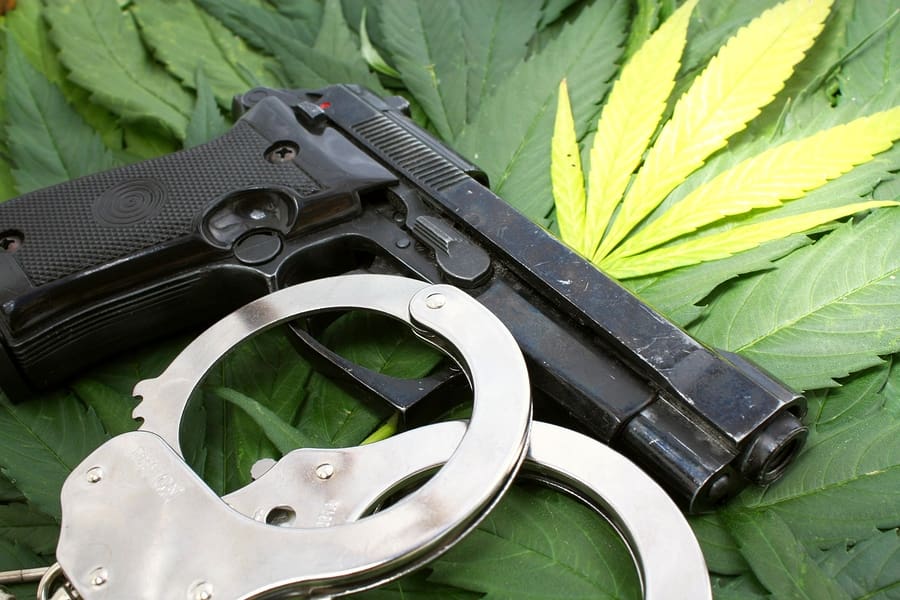

In an amicus brief filed recently before the U.S. Supreme Court, the powerful National Rifle Association came down solidly on the side of marijuana users retaining their right to keep and bear arms.
In the brief, filed January 30 in the case United States v. Hemani, the NRA, along with partners the Independence Institute and the FPC Action Foundation, urged the high court to strike down the federal prohibition on firearm possession by marijuana users.
The case challenges the federal law that bars firearm possession by anyone who “is an unlawful user of or addicted to any controlled substance.” The prohibition applies to marijuana users regardless of whether marijuana is legal under state law or used for medicinal purposes.
In the amicus brief, the NRA and its partner organizations argue that banning firearm possession by marijuana users who are not intoxicated is unconstitutional because it lacks any grounding in America’s historical tradition of firearm regulation.
“Historically, legislatures addressed the risks associated with firearms and intoxicants through narrow, conduct-based restrictions—temporarily limiting the carry, use, or purchase of firearms while a person was intoxicated—rather than categorically disarming individuals based on their status as users,” NRA-ILA wrote in a news item on its website. “Laws that completely disarmed Americans were always based on dangerousness, yet in this case, the government has made no serious effort to establish any connection between marijuana use and dangerousness.”
The brief states: “To justify firearms prohibition for marijuana users when they are not intoxicated, the government must prove that the ban is consistent with our nation’s historical tradition of firearm regulation. That tradition supports restrictions on the use of firearms while intoxicated, but it does not support disarming individuals when they are sober merely because they sometimes use intoxicants.”
It continues: “Throughout American history, legislatures recognized that intoxication could temporarily increase the danger of firearms misuse. But they did not respond by entirely disarming people based on their status as users. Instead, historical intoxication laws regulated conduct: restricting the carrying, discharge, or purchase of firearms only while a person was intoxicated and only for as long as that condition lasted. The historical record thus reflects a consistent tradition of narrow, situational restrictions rather than categorical disarmament.”
The brief further argues that while Bruen requires the government to prove that its ban “is consistent with the nation’s historical tradition of firearm regulation,” the government cites conspicuously few firearm regulations in justifying the law.
“Instead, the government relies on regulations that at most incidentally affected firearm possession: civil commitment, vagrancy, and surety laws,” the brief argues. “Attempting to shoehorn these regulations into a historical tradition of disarmament, the government claims that they targeted people who presented well-recognized dangers.”
Ultimately, the NRA is asking the court to strike down the law on the grounds that it infringes on the Second Amendment rights of millions of Americans.
“This Court should hold 18 U.S.C. § 922(g)(3) unconstitutional as applied to Hemani because the government failed to demonstrate that disarming him based on marijuana use is consistent with the nation’s historical tradition of firearm regulation,” the brief concludes.
Read the full article here
