



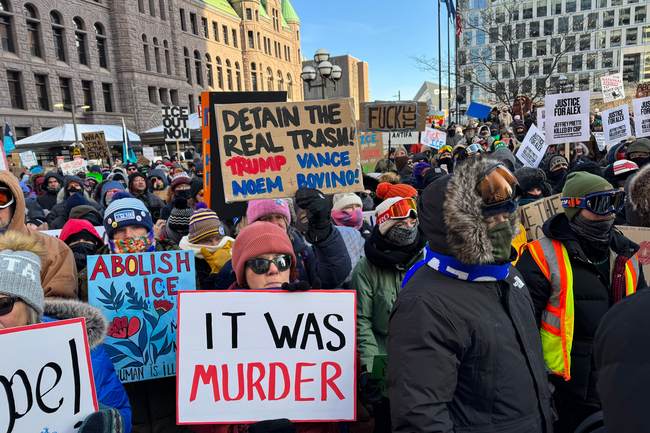

I’m getting more than a little sick of seeing the various pieces claiming that the shooting of Alex Pretti is somehow evidence that the Second Amendment isn’t for everyone. Pretti was unimpeded until he laid a hand on a federal agent, and it’s unlikely that he would have run into any issues with his Second Amendment rights otherwise.
I’m not saying he deserved what happened because of that, or the fact that he wasn’t exactly cooperating with the agents trying to arrest him, but I am saying that there’s more to the incident than the fact that he was carrying a firearm and got killed.
However, too many people see it just that way, and that’s what I expected when I saw a piece from The New Republic claiming that the Second Amendment failed Pretti.
What was interesting was that this one took a different, and not entirely invalid approach to the argument.
Alex Pretti’s killing at the hands of federal agents last week is an American tragedy. It has also exposed the fallacies and fault lines that shape how Americans live with widespread access to guns.
Put simply, the Supreme Court has handed down two irreconcilable lines of precedent over the past 20 years. The first is that Americans have a sacred constitutional right to carry guns in public. The second is that that police officers can kill people carrying guns in public with little risk of facing any legal consequences for doing so.
…
Running parallel to these rulings, however, is a consistent signal from the Supreme Court that law enforcement officials can kill people who pose a personal risk to them largely without risk of legal consequences.
A federal law known as Section 1983 allows people to sue state and local officials for violating their federal constitutional rights. Since the 1960s, the Supreme Court has substantially narrowed Section 1983 claims by inventing the doctrine of “qualified immunity.” In general terms, officers are only liable if their conduct violates a “clearly established right,” which can be interpreted with great particularity and narrowness by lower courts.
These hurdles are often highest in police use-of-force cases. As one justice wrote in a 1986 case, qualified immunity “provides ample protection to all but the plainly incompetent or those who knowingly violate the law.” The court also views police-involved cases with great deference toward officers’ subjective views about the situation at hand. In a 1989 case, the high court noted that police officers are entitled to great deference because they are “often forced to make split-second judgments—in circumstances that are tense, uncertain, and rapidly evolving—about the amount of force that is necessary in a particular situation.”
Now, taking an approach of blasting qualified immunity is quite a different take, and it’s not entirely without cause. I’ve seen a lot of people get away with some very shady actions under the guise of qualified immunity, so I’m not entirely enamoured with the concept.
And yes, that has included some questionable use of force cases.
However, qualified immunity isn’t exactly a “Get Out of Jail Free” card, either.
Perhaps most famously, qualified immunity didn’t help Derek Chauvin escape being tried for his role in the death of George Floyd. Another Minneapolis police officer, Mohamed Noor, went to prison for shooting Justine Damond in 2017 without any help from qualified immunity.
A couple of officers involved in the killing of Breonna Taylor also saw trial, with qualified immunity not doing much to save them from it.
See, the writer here brings up the “clearly established right,” which is part of it, but my understanding of qualified immunity includes that the action must be somehow consistent with the officer’s training and the department’s policies. An understandable misinterpretation might earn an officer a pass under qualified immunity, but gunning down an innocent woman who was simply having a conversation with police officers won’t.
So while qualified immunity pops up far more often than anyone should like to shield improper behavior of some law enforcement officials, it’s also not a universal shield against prosecution.
That’s not a matter of the Second Amendment failing Pretti. Neither are the administration’s troubling comments about Pretti, implying that carrying somehow means he deserved what happened.
Qualified immunity is a legitimate topic for discussion, to be sure, and I’m uncomfortable with just how broad that immunity can be, but let’s not pretend that the whole situation is inherently as simple as the people at The New Republic want folks to think.
This wasn’t some peaceful protest were activist stood to the side and simply made their voices heard. It was an attempt to interfere with federal agents enforcing the law, involved a person putting their hand on federal agents, then struggling against his arrest for doing so. The investigation will look into whether the agents were justified or not, but this isn’t just about someone having a gun on their person. There was a lot more than I’m not interested in letting anyone memory hole.
Editor’s Note: The mainstream media continues to lie about gun owners and the Second Amendment.
Help us continue to expose their left-wing bias by reading news you can trust. Join Bearing Arms VIP and use promo code FIGHT to get 60% off your membership.
Read the full article here
