



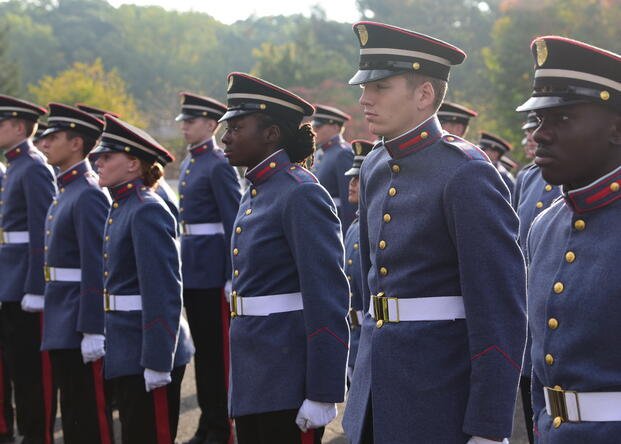

Valley Forge Military College (VFMC) has secured a $1 million federal education grant, marking the first time that there is an accrediting body for colleges that are specific to the military.
The private two-year military college located in Wayne, Pa., and in existence since 1935 secured the funding through the U.S. Department of Education’s Fund for the Improvement of Postsecondary Education–Strengthening Institutions Program (FIPSE-SP), under the department’s Fiscal Year 2025 “Promoting Accreditation Reform” that funds a finite number of national institutions to develop and pilot innovative accreditation models.
The highly competitive program will help finance VFMC’s establishment and testing of a new hybrid accrediting framework designed specifically for military-aligned associate and certificate programs. That includes exploration into virtual reality -enabled training and education where appropriate, leveraging experiential learning technologies to support skills application, and learner engagement.
VFMC is one of four colleges nationwide that has an early commissioning program that commissions U.S. Army officers in two years, for example.
“We had an organization we work with alert us to it and we looked at it and thought that through our own experience of going through accreditation—we found that sometimes there’s a disconnect between what military model education is and some of the intangibles it takes into it,” Col. Stuart Helgeson, president of VFMC since 2020, told Military.com.
“We thought this would be something that we could help with, work with partner schools, and look at creating either a hybrid accrediting agency that deals with the military model of schools that are military focused, or if there is a need, an all new accrediting body,” added Helgeson, formerly a Second Lieutenant in the U.S. Marine Corps whose active-duty service included operational deployments such as Exercise Alpine Warrior, Operation Desert Shield and Desert Storm (Iraq), Operation Provide Promise and Deny Flight (former Yugoslavia), and Operation Continue Hope (Somalia).
Last May, VFMC graduated 40 cadets as part of its 2025 class that finished with a cumulative 3.65 GPA throughout their four semesters. Fourteen cadets earned at least 80 credits to confer dual associate’s degrees, while 10 cadets supplemented their degrees with certificates.
Details of Grant Funding
The $1 million grant extends over four years with the intent to study, implement, and lead all the way up to design and eventual implementation. VFMC currently has 100 enrolled students.
It includes partnerships with Promising People and the National Occupational Competency Testing Institute (NOCTI), the former of which partnered with VFMC leadership throughout the process and provided grant strategy support, technical documentation, compliance alignment, and program design.
NOCTI helps validate standards, refine evaluation methods, and produce a replication toolkit intended for broader adoption by institutions serving military learners nationwide.
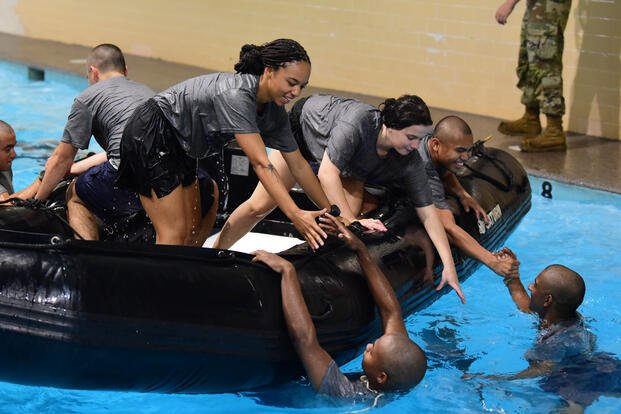
Most of the military colleges have an accreditation through one of the five accrediting bodies, Helgeson said, mentioning how there’s accreditation for nursing or law programs but not a separate accreditation of body for military programs “and all the intangibles that go into that education outside the classroom.”
He referenced having Corps Cadets teach aspects like character, physical development and personal motivation.
All these intangibles, how do they fit in?
That involves looking for guidance from other service academies, the other three military junior colleges, and the senior military colleges across the U.S.
Asked if a list of criteria must be met as part of the grant, Helgeson said VFMC hadn’t yet met with a grant officer.
“But we feel the grant is to study the existing [standards] and look at ways to provide an accrediting body that seeks recognition from the U.S. Department of Education for military standards,” he said. “And then also taking it to the current service schools that have soldiers, airmen, Marines, Space Force, Guardians—they take classes right now.
“How many of those are accredited? How many can be transferred to college credit? That’s a whole other line of operation we want to look at.”
‘Talking Two Different Languages’
VFMC accreditation is under the Middle States Commission on Higher Education, one of about a handful of military-specific accreditations. The United States Military Academy at West Point is also under Middle States, while American Military University, for example, is accredited by the Higher Learning Commission.
Helgeson said that sometimes conversations with accreditors can result in “talking two different languages” due to the military angles taught that may not be fully encapsulated in how traditional accrediting bodies work.
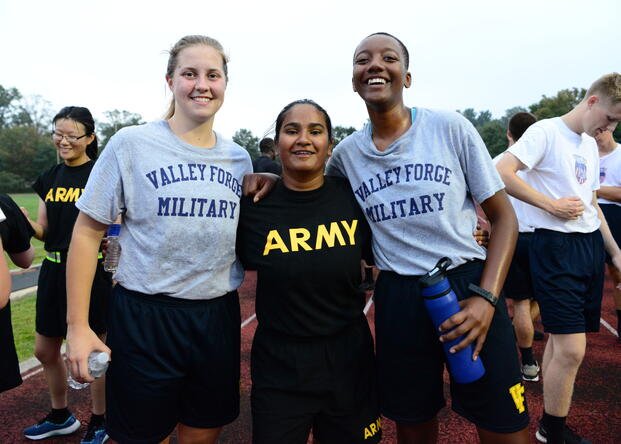
He acknowledged the physical and monetary toll to reach accreditation, amounting to plenty of work that requires completion based on the size of the institution, various assessments, and ultimately developing a more streamlined approach that can be implemented universally by military schools that can show that they are meeting the standards of the Department of Education.
“It also costs a lot of money to go through the accreditation process,” said Helgeson, who is leaning towards a hybrid model. “We’re just looking at ways to better use funds, be more efficient, and make sure there’s a standard that if you go to Valley Forge Military College or New Mexico Military Institute or United States Military Academy West Point, certain things are the same.”
A Unique Offering
Roughly 99% of VFMC graduates continue their education and attain bachelor’s degrees following their two-year stints. Those in the Army Early Commissioning Program have to, in order to keep their commission, get their bachelor’s degree and are funded by the Army.
The sales pitch comes down to one word: opportunity.
We like to say, ‘Start here, go anywhere.’
“We get the foundational education in the associates program where they’ve got 10 majors they can take. The goal is for them to transfer to a four-year college; it sets them with a base foundation of how to study.
“We use the military model. We teach them accountability. They become a cadet, they’re a Corps Cadet. They have a lot of outside of classroom things that they do, they get leadership where they earn rank and then they lead their peers through things.”
The Army early commission program includes about 70% of VFMC students. Helgeson said it’s “a great scholarship” where students get their school paid for while on campus, as well as wherever they transfer to after the two-year period.
The only stipulation is the schools that they transfer to have to be affiliated with Army ROTC, of which 98% of schools are.
“That’s the biggest draw, I would say,” Helgeson said.
Read the full article here
