



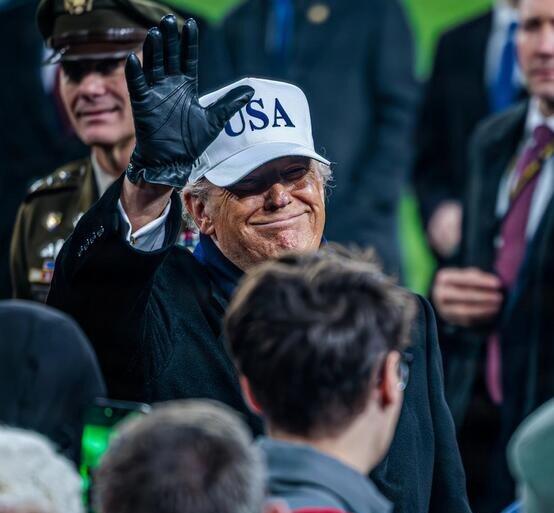

Comments made by President Donald Trump on Thursday disparaging NATO coalition soldiers in the war in Afghanistan have drawn the ire of British veterans and politicians.
During an interview with Fox News, Trump claimed allies weren’t involved in front-line operations.
“They’ll say they sent some troops to Afghanistan … and they did, they stayed a little back, a little off the front lines,” Trump said.
It’s unclear what Trump meant by “front lines” since the decades-long conflict in Afghanistan wasn’t fought along traditional front lines, such as in World War II.
Military.com reached out to the White House for comment on Friday.
According to Help for Heroes, a veteran charity organization, more than 1,100 non-U.S. soldiers were killed in the war in Afghanistan, most of them from NATO coalition forces, while over 2,300 American troops died in the 20-year conflict.
Both the UK and the U.S. have been tight NATO allies since the organization’s founding in 1949. The two nations helped form an alliance, along with several other Western countries, for security against threats from the Soviet Union. Thirty-two nations are currently in NATO.
Trump, however, questioned the alliance’s loyalty on Thursday, saying he wasn’t confident fellow countries would “be there if we ever needed them.”
Offensive and Not Accurate
Trump’s comments have no doubt rankled many in the UK.
Lord Mark Sedwill, who once served as British ambassador to Afghanistan, said that Trump’s statement was “offensive and simply wrong.” In an interview with Times Radio, Sedwill said it’s deeply offensive to Afghanistan veterans and families who lost loved ones fighting in the war.
“The Americans took the burden but the UK and Denmark, for example, had a higher rate of casualties than the Americans,” Sedwill said. “I was in Afghanistan, that was certainly the case there, and [they] were engaged in some of the most vicious fighting in some of the most dangerous areas. And so, he is completely wrong to be dismissive.”
The Times in London, England, interviewed families who lost soldiers in Afghanistan, saying battles in Helmand Province, for instance, had no front line, due to the Taliban’s use of improvised explosive devices and guerilla warfare tactics.
Statements ‘Sad to See’
Ian Wright lost his son, Gary Wright, only 22, in a suicide bombing. Wright, a Scottish member of the Royal Marines, died in 2006 when a man detonated a bomb in Lashkar Gar in the Helmand Province.
“There was no such thing as a front line in Afghanistan,” Ian Wright said. “The Taliban were not in any form of unit and not identifiable. They relied on IEDs and mixing with the public.”
Wright questioned why more people weren’t calling out Trump’s inaccurate comments.
“Normally, people would be shocked at the lack of diplomacy and factual accuracy shown by a president of the USA,” Wright said. “Sadly, this is not the case in respect of the current incumbent.”
Some critics are also pointing to Trump’s lack of military service, having received five deferments from serving during the Vietnam War.
“Trump avoided military service five times. How dare he question their sacrifice?” said Sir Ed Davey, a Liberal Democrat in the British government.
Even conservatives in the UK are calling out the president. Ben Obese-Jecty, an Afghanistan War veteran and former captain of the Royal Yorkshire Regiment, said, “It was sad to see our nation’s sacrifice, and that of our NATO partners, held so cheaply by the president of the United States.”
“Normally, people would be shocked at the lack of diplomacy and factual accuracy shown by a president of the USA,” Wright said. “Sadly, this is not the case in respect of the current incumbent.”
Obese-Jecty witnessed the perils of war up close.
“I saw firsthand the sacrifices made by British soldiers I served alongside in Sangin, where we suffered horrific casualties, as did the U.S. Marines the following year,” he said. “I don’t believe U.S. military personnel share the view of President Trump; his words do them a disservice as our closest military allies.”
Past Comments Resurface
This isn’t the first time Trump has made disparaging comments about veterans.
In 2015, while at a campaign event in Ames, Iowa, Trump told an audience that John McCain, the late Arizona Senator and Navy veteran, was a “loser.” McCain’s plane was shot down in Vietnam, and he survived nearly six years in a prisoner of war camp.
The event’s moderator, Republican pollster Frank Luntz, said, “But he’s a war hero!”
Not skipping a beat, Trump responded, “He’s not a war hero. He’s a war hero because he was captured. I like people that weren’t captured.”
During his first term, in 2018, prior to a planned trip to visit a cemetery in France, Trump allegedly called the American World War I veterans buried there “losers.” The story in The Atlantic also quoted sources close to Trump calling soldiers “suckers” and didn’t like the idea of having wounded veterans in military parades.
Despite his remarks, the president did accomplish several milestones within the Department of Veterans Affairs in his first term, including improving care, patient choice, and the removal of thousands of VA employees who he claimed weren’t provided adequate care. He also expanded telehealth programs and funding for mental health services, along with signing the Veterans Appeals and Modernization Act, to improve VA efficiency and speed up claims processes.
Trump also signed legislation to provide more educational opportunities through the GI Bill and allow student loan forgiveness for completely and permanently disabled veterans.
While it’s too early to assess Trump’s efforts for veterans in his second term, the president has pushed hard to reform the VA, threatening to slash more than 80,000 jobs at the nation’s largest healthcare system, only to ease back and eliminate about 30,000 positions. The VA announced in December that another 35,000 positions would be cut, but that most of them would be jobs that have gone unfilled for a long period of time.
Read the full article here
