



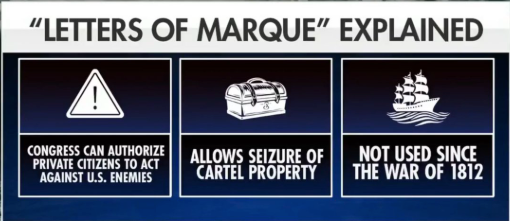

Sen. Mike Lee’s proposed Cartel Marque and Reprisal Authorization Act has generated predictable excitement in some circles. On its face, the idea sounds bold and decisive: authorize the President to commission private citizens to pursue cartels and other foreign actors deemed responsible for acts of aggression against the United States. These commissioned individuals would be bonded, armed, and permitted to seize property—and people—for profit.
That concept may sound novel. It is not. It’s a modern revival of letters of marque and reprisal, a centuries-old naval practice that allowed private vessels to act as state-sanctioned predators. What is new—and deeply concerning—is the bill’s expansion of that authority beyond the sea and into sovereign nations on land.
Under this proposal, private armed citizens would be authorized to cross international borders, conduct armed operations, and seize assets wherever the U.S. government determines “aggression” has occurred. The bill’s language is broad by design, allowing “all means reasonably necessary” to carry out these missions. Once that precedent is set, the implications extend far beyond cartels.
If the United States can redefine aggression to justify commissioning private enforcers abroad, other nations will do the same—using their own standards, grievances, and political priorities.
Environmental damage? Pacific island nations could declare U.S. plastic pollution an existential act of aggression and commission private forces to seize assets from American chemical or energy companies. Gun trafficking? Mexico already claims the majority of firearms recovered at cartel crime scenes originate in the United States. Under this framework, Mexican authorities could define American firearms manufacturing as an act of aggression against their citizens and authorize armed seizures of U.S.-based gun companies.
Climate policy? Fossil fuel extraction could be labeled aggression against national survival. Water usage? Corporate access to aquifers could be framed as violence against public health. Each country becomes judge, jury, and executioner—outsourcing enforcement to profit-motivated armed actors.
The mechanism is deceptively simple: define aggression broadly, issue commissions, require a bond, and let private actors operate without meaningful oversight. No international courts. No diplomatic constraints. No accountability when missions go sideways, innocents are harmed, or political enemies are targeted.
This isn’t a hypothetical slippery slope—it’s the logical end state of the authority being proposed.
Advocates of the Second Amendment should be especially cautious here. Normalizing the use of armed civilians as instruments of foreign policy does not strengthen liberty; it undermines it. It blurs the line between lawful self-defense and state-sanctioned violence. It hands future administrations—of any political persuasion—a tool that can be redefined, expanded, and abused with alarming ease.
If passed, this legislation wouldn’t just reshape how the United States confronts cartels. It would legitimize a global free-for-all in which armed contractors operate across borders under whatever justification a government finds convenient that day.
Our Take
At The Truth About Guns, we support aggressive, lawful action against criminal cartels. We also support constitutional limits, national sovereignty, and the principle that armed citizens are not tools of the state to be deployed for political expediency.
Reviving letters of marque may sound tough, but exporting privatized violence is not a serious or sustainable solution—and it invites consequences that will land squarely on American citizens, American businesses, and ultimately American gun owners.
Once governments normalize commissioning armed civilians for profit-driven enforcement abroad, the Second Amendment becomes a liability instead of a liberty. That’s a trade we should refuse—no matter how tempting the rhetoric sounds.
Read the full article here
