



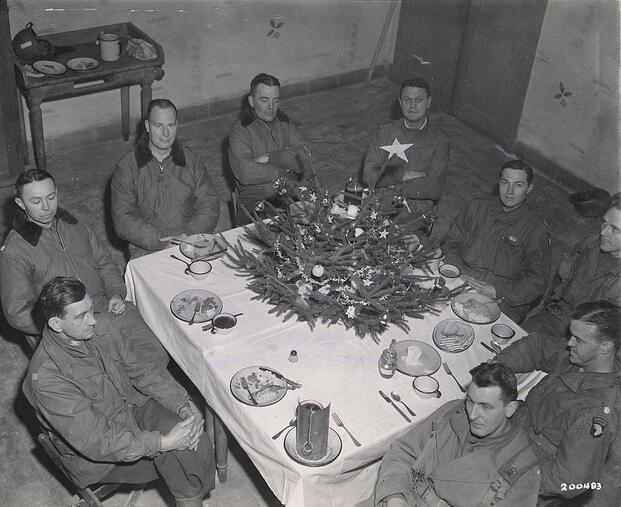

Elisabeth Vincken had listened to artillery fire for eight straight days before someone knocked on her cottage door on Christmas Eve in 1944. She opened it to find three lost American soldiers, one with a gunshot wound. Hours later, four German Wehrmacht soldiers showed up as well. The German woman forced both groups to surrender their weapons and sit down together for Christmas dinner. The next morning, the enemies shook hands and returned to the war.
The brief moment of peace occurred in a hunting cabin in the middle of the Hurtgen Forest during the Battle of the Bulge.
The Battle of the Bulge
On Dec. 16, 1944, Adolf Hitler launched Operation Wacht am Rhein, the last major German offensive on the Western Front during the war. Approximately 200,000 German troops and 1,000 tanks smashed into American positions across an 80-mile stretch of the Ardennes Forest.
Hitler aimed to split Allied forces and recapture Antwerp. The surprise attack created a bulge extending up to 50 miles into Allied lines as American forces were stunned and overrun in the initial assault.
The battle lasted until Jan. 25, 1945. American casualties would reach approximately 81,000, including 19,000 killed. German losses reached between 80,000 and 100,000. The offensive failed.
It was the largest battle ever fought by the U.S. Army and the deadliest battle American troops faced during WWII. In the chaos, three American soldiers became lost behind enemy lines.
The Vincken Hunting Cabin
The Vinckens had fled the German city of Aachen after Allied bombings had destroyed their home. Hubert Vincken sent his wife Elisabeth and son Fritz, 12, to his hunting cottage in the Hurtgen Forest. The German offensive on Dec. 16 trapped them there.
On Christmas Eve, Elisabeth was in the middle of preparing a dinner of chicken soup and potatoes. The three lost American soldiers knocked on the door. She learned their names, Jim, Robin, and Harry. Harry had a bullet through his leg. They had been separated from their battalion for three days.
Harboring enemy soldiers in the middle of a battle could lead to execution. Despite this, Elisabeth invited them inside, warmed them, offered them dinner and bandaged Harry’s wound.
An hour later, there was another knock on the door. Elisabeth opened it to find four German Wehrmacht soldiers. They too had become separated from their regiment and were starving and freezing. They asked to stay there for the night.
Elisabeth agreed, but warned them she had some guests that they may not take too kindly to. The Germans asked if they were American.
When she said yes, the Germans became agitated.
“Listen. You could be my sons, and so could they in there. A boy with a gunshot wound, fighting for his life, and his two friends, lost like you and just as hungry and exhausted as you are,” she told them. “This one night, this Christmas night, let us forget about killing.”
The German corporal nodded. They propped their rifles against the woodpile. Elisabeth collected the American weapons too and invited the Germans inside.

Christmas Dinner Between Enemies
Tension filled the room until the German corporal finally spoke up. He had studied medicine before being drafted. He cleaned and properly bandaged Harry’s leg wound, saying the American would survive as long as infection didn’t set in.
Elisabeth and Fritz served dinner to the men. Chicken soup, roasted potatoes, and bread. One of the Germans provided a bottle of red wine. Elisabeth gave half of it to the wounded American.
The soldiers sat around the table, Germans and Americans mixed together. They communicated through hand gestures and broken phrases. Two of the Germans, Heinz and Willi, were just 16. Two of the Americans were barely older than that.
Fritz later claimed he saw tears form in the soldiers’ eyes as his mother said Grace and they all ate the hot meal, likely the first decent food they had eaten in weeks. They were exhausted, scared young men far from home.
After dinner, Elisabeth asked everyone to step outside. They stood together in the snow and looked at the Star of Bethlehem, except Harry who continued resting. No one spoke for several minutes.
Fritz later spoke of the moment, “for all of us during the moment of silence, looking at the brightest star in the heavens, the war was a distant, almost-forgotten thing.”
On Christmas morning, the soldiers woke up and built a makeshift stretcher for Harry. The German corporal pulled out his compass and map, showing the Americans the route to their lines. The Germans would head the opposite direction.
The seven soldiers shook hands. The German corporal gifted his compass to the Americans to help them get home. Both groups walked off into the forest. Within hours, they would be enemies again. Fritz never learned the fate of the Germans.

The Reunion
Elisabeth and Fritz reunited with Hubert at the end of the war. Fritz later immigrated to the United States in 1959 and opened a bakery in Hawaii. He published his account of the story in Reader’s Digest in 1973. President Reagan mentioned it in a 1985 speech, but Fritz couldn’t find any of the soldiers he spent Christmas Eve in 1944 with.
In 1995, “Unsolved Mysteries” aired the story. A nursing home chaplain in Frederick, Maryland, recognized the story, one of the residents at the home had been telling the same story for decades.
On Jan. 19, 1996, Fritz flew to Maryland and met with Ralph, who had survived the war after fighting with the 121st Infantry Regiment, 8th Infantry Division. Ralph still had the German compass that the enemy corporal had gifted him.
“Your mother saved my life,” Ralph told him. Fritz called the meeting the highlight of his life.
Ralph died in 1999 at the age of 79. Fritz died in 2001 at the age 69.
The story of the 1944 Christmas Truce was retold in the 2002 TV movie “Silent Night.”
In a 1997 interview, Fritz said, “The inner strength of a single woman, who prevented potential bloodshed, taught me the practical meaning of ‘good will toward mankind.’ I remember mother and those seven young soldiers, who met as enemies and parted as friends, right in the middle of the Battle of the Bulge.”
Story Continues
Read the full article here
