





*Images by the author
The M14 rifle was, and is, a great battle weapon. Weighing a little over nine pounds and chambered in 7.62×51, it feeds from a 20-round detachable box magazine. A selective-fire switch allows it to fire either fully automatically or in semi-automatic mode.
OK… that’s the M14. But we have an M1A. They sure look a lot alike… what’s the difference? The main difference is that the M1A doesn’t have what some have called a “giggle switch” – no selective-auto capability. Other than that, they are pretty close. Speaking of differences, I did a quick Google search, and it returned these:
Feature M14 / M1A
- Type Military, select-fire (semi- and full-auto) / Civilian, semi-automatic only
- Receiver forged, military-grade / Typically cast, commercial-grade
- Manufacturer U.S. Government Springfield Armory / Commercial Springfield Armory, Inc.
- Fire Selector Yes / No
- Bayonet Lug Included on original models. / Removed after the 1994 ban, though it can be added back with a pre-ban flash suppressor
- Manufacturing Built to a strict military technical data package (TDP). / May not be made to the same TDP as the M14
So you see that they are pretty close. I have no experience with an M14, but I know many of you out there will have. I can only go on my impressions with the M1A, and I am impressed.
Let’s take a quick look at its specifications and features.
- Caliber .308 WIN (7.62x51mm NATO)
- Barrel 22″ 6-Groove Carbon Steel, 1:11
- Front Sight National Match .062″ Blade
- Rear Sight Military .0690 Aperture, MOA Adj. for Windage & Elevation
- Stock Walnut
- Trigger 2-Stage
- Muzzle Device Flash Suppressor
- Magazines (1) 10-Round
- Weight 9 lbs 3 oz
- Length 44.33″
- MSRP $1,914
It features a very nice walnut stock, a two-stage competition trigger, a classic flash suppressor, and an easily-adjusted rear aperture sight coupled with a National Match front post.
A Quick Bit Of History
Let’s look at the M14 for a moment, since our M1A is based on that venerable weapon.
The M14 came about as a replacement for the M1 Garand (and hopefully a few others… see below). It was officially adopted in 1957 but didn’t fully deploy for a few more years. It was eventually used by the Army and Marine Corps from about the mid-60s through the early 1970s. It was replaced by the M16 and its variants.
The M14 was originally designed to replace four existing weapons. They were the M1 Garand rifle, the M1 carbine, the M3 submachine gun, and the M1918 BAR. That’s quite an ambitious undertaking, one that was not going to work from the get-go (you can’t use a .308 in a submachine gun, it’s too big for a carbine, and it was considered to be underpowered for use in a BAR-style weapon). But the Garand was around for a good while, and it’s interesting to note that late WWII development of the Garand had it, among other things, firing in selective mode and using a 20-round box magazine… features the M14 shared. So the development of the M14 was not a total shock.
I won’t talk about the lengthy M14 adoption process; suffice it to say it was up against an FAL design. Why was it adopted over the FAL design? The reasons that the M14 was adopted include:
- Its design incorporated fewer parts
- It was lighter
- It had a self-compensating gas system
- Supposedly, it could be manufactured on the same machinery in place that had made the M1 Garand. They later found out that this was not the case, but they went ahead with the M14, anyway.
The M1A
Springfield Armory (SA) started producing the M1A in 1971. Early rifles used surplus government parts until SA began producing them in-house. This speaks to the faithfulness of the new semi-auto version… it really is like the original in many ways. We’ve already hit on the differences between the M14 and the M1A, so we will move on.
As for the M1A, SA offers several versions. Those include:
- The fancy $2499 50th Anniversary model with its custom wooden display case and bayonet lug;
- Four models of the $2087-$2540 SOCOM rifles (which include the Tanker model) with synthetic stocks (except the Tanker, which is walnut);
- Seven Standard Issue models (what we have here) that range from $1808 to $1914;
- Five models of the $1980 – $2129 Scout models that are shorter. You can check them all out here. Most variations concern the stock material (synthetic or wood) and CA compliance. The one we have here is the MA9102 Standard Issue, at $1914.
An Interesting Note
I was interrupted while I was writing this review by a text from a boyhood friend who now lives in SC. We grew up together in Indiana, and I spent a lot of time at his house. His dad was a collector and had all kinds of rifles, handguns, helmets, and other memorabilia hanging on the walls of his basement. I used to love going down there and just looking at all the stuff. Anyway, my friend heard I was getting this rifle in to review and expressed interest, as he owns an M1 Garand and an M1 carbine. Long story short, he contacted SA, and his M1A just shipped.
The “interesting” part comes in now… I’m done with my past history. The rifle I got does not have a bayonet lug or a 20-round magazine like the M14 had. He ordered both items from SA to make his as M14-like as possible (minus the giggle switch, of course). I think it’s good that you can order those things. The bayonet lug was discontinued after the 1994 gun control legislation hit, but you can get a pre-ban flash hider with a lug, as he found out.
Photos
Let’s look at some frosty photos I took…
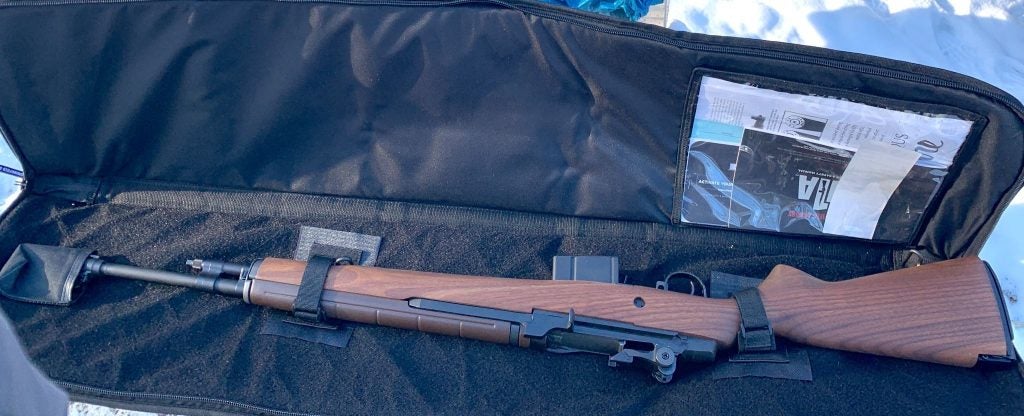
You get a nice zippered soft case with the rifle…
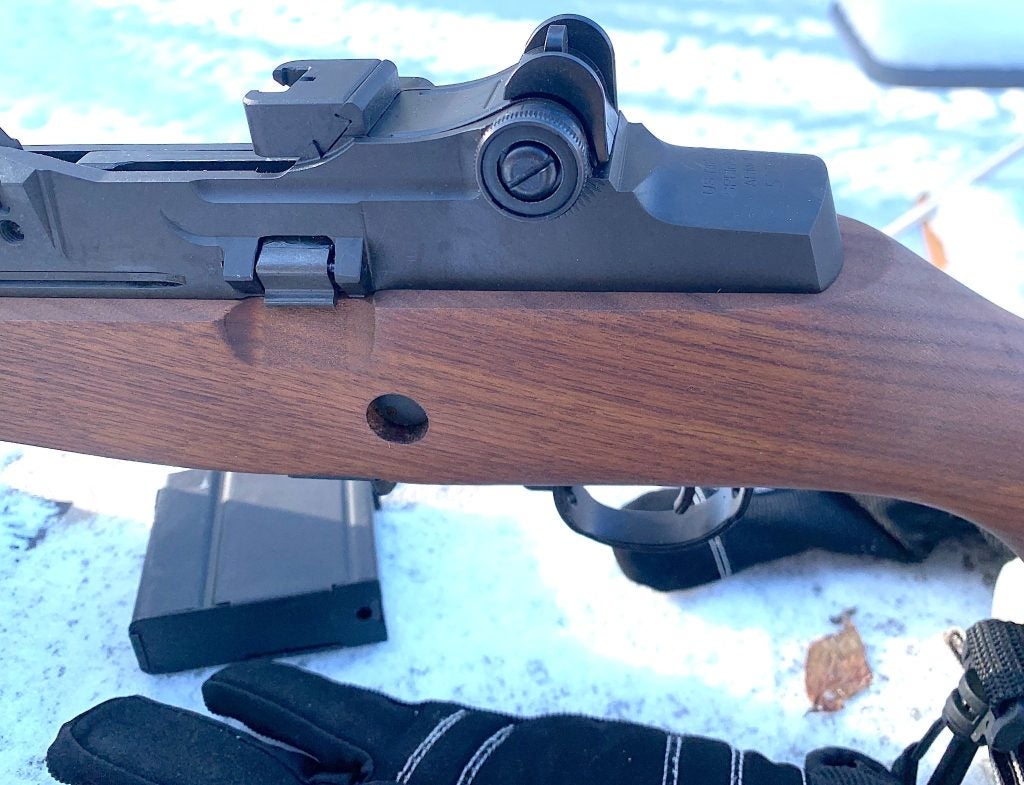
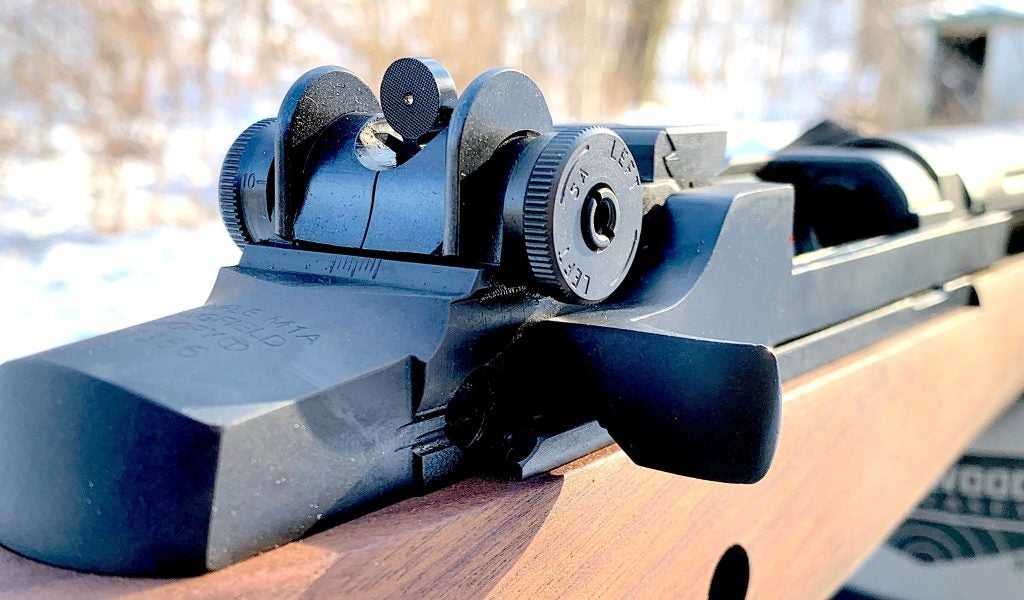
A couple of views of the rear receiver and sight
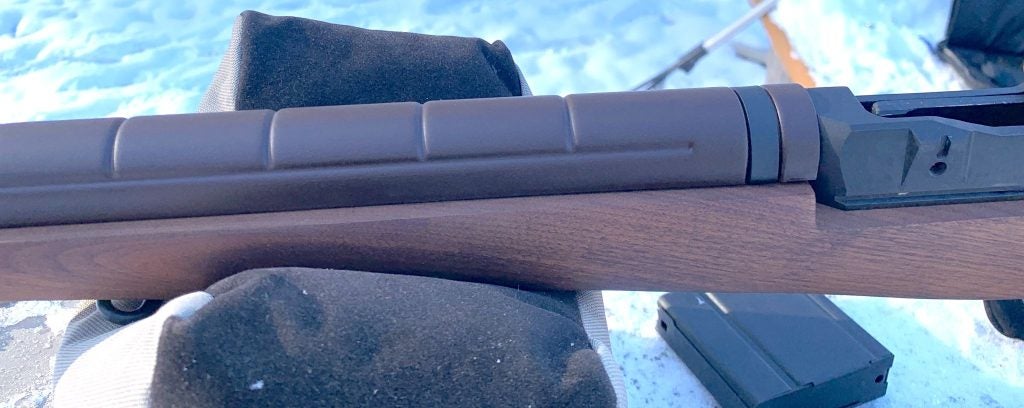
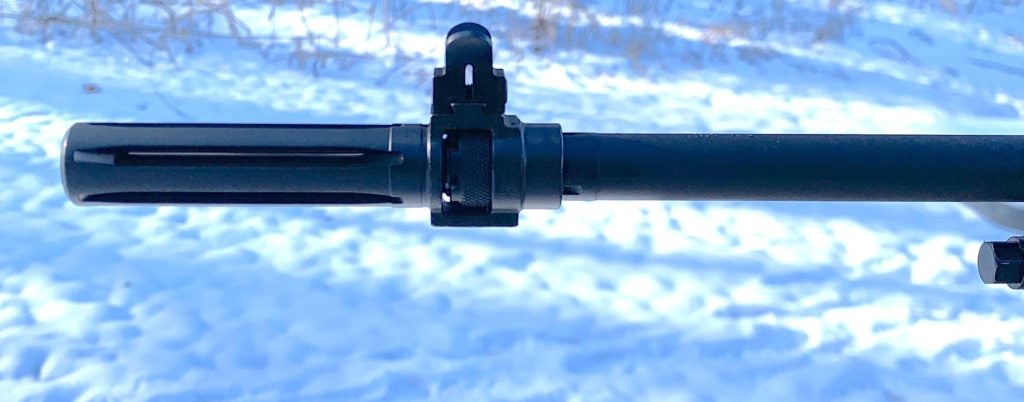
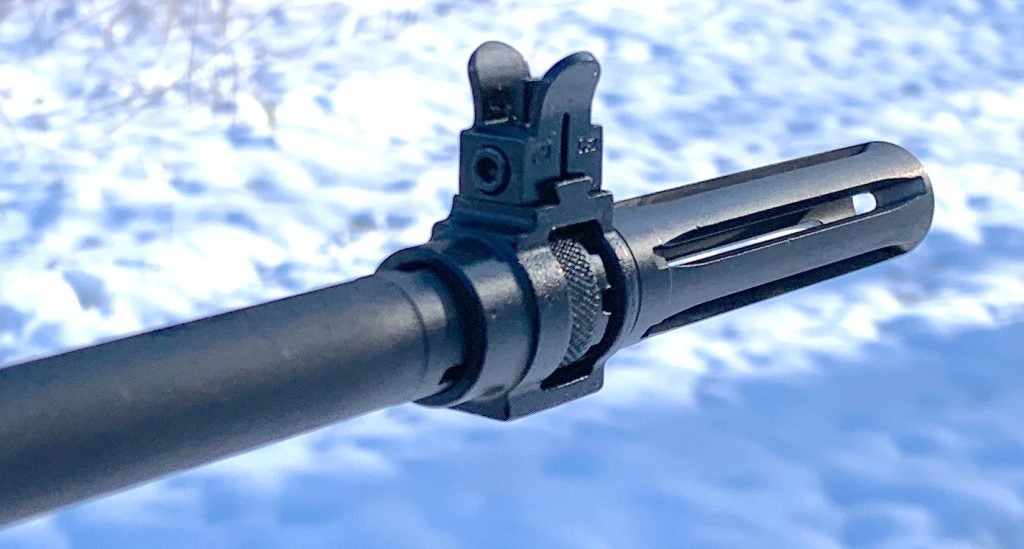
The handguard (above), front sight, and flash suppressor
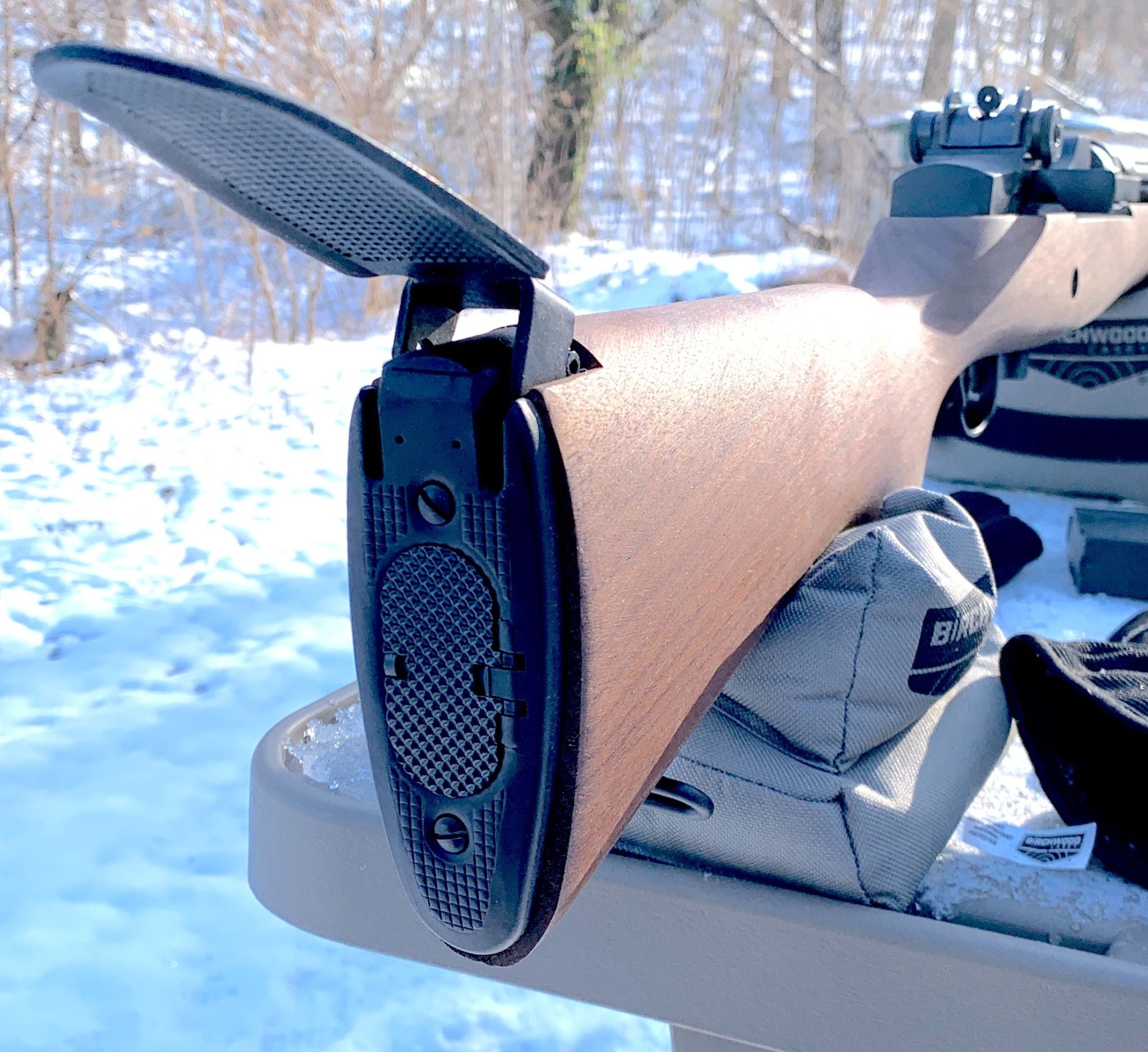
True to the original, there’s a compartment in the stock
Shooting The M1A
I pulled three loads from my Black Hills Gold .308 stash… all were Match loads and included:
- 150-grain Hornady SST
- 158-gr. ELD
- 175-grain Tipped MatchKing
We set targets as far out as we could in my snowy backyard, about 85 yards. I know it’s not 100, but conditions didn’t allow it, and we have no reason to believe this rifle wouldn’t be accurate WAY past 100 yards. As a matter of fact, I don’t really even need to include target pics, but where’s the fun in NOT shooting this rifle, I ask you? So, warts and all, here is a representative target. My son did the shooting, as I couldn’t feel my fingers… it was pretty cold!
By way of one excuse, he kept having condensation form in the aperture ring, so he couldn’t get a really sharp front sight image. As I said, this rifle will cut the mustard… he and I just don’t do so well in Indiana winter conditions!
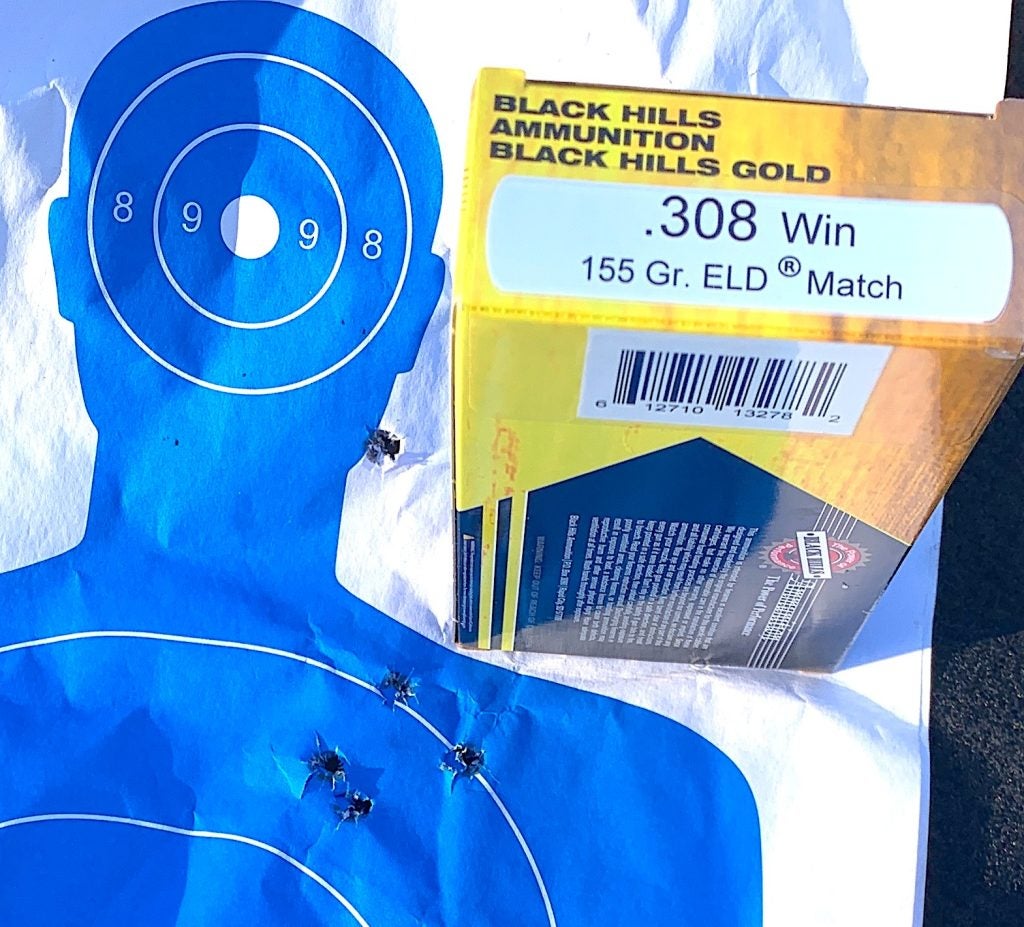
All three loads shot to about 2.0 MOA on average, discounting a few fliers (above). As with any rifle, you could experiment to see what load your rifle likes best. I recommend handloading, as you can custom-tailor your load’s components. Look for an article soon on loading for the .308 and the .277 SIG Fury.
Summing Up
For shooters who like military-style weapons, the M1A is worth considering. And, for those shooters who simply want a top-line semi-auto .308 rifle to tote around the homestead or to head to the deer woods with, the M1A is, again, something to consider. I guess what I’m saying is that this rifle is a versatile, useful tool in the hands of a good shooter.
Whether you want a shorter-barreled version (the Tanker), a synthetic-stocked SOCOM model, or one like what we have here, you are covered.
It is built to a proven standard that has withstood some very trying conditions, and is battle-proven (well, its military cousin is, at least). From the nice two-stage trigger to the MOA-adjustable sights to its beautiful walnut stock with a hidden compartment inside, you have a top-quality rifle that shoots one of the most versatile and abundant rifle cartridges around. If you have experience with the M14, this rifle is a decent civilian substitute. The M1A is a hum-dinger. If you haven’t shot one, you might want to track one down… it’ll be worth the effort!
Read the full article here
