



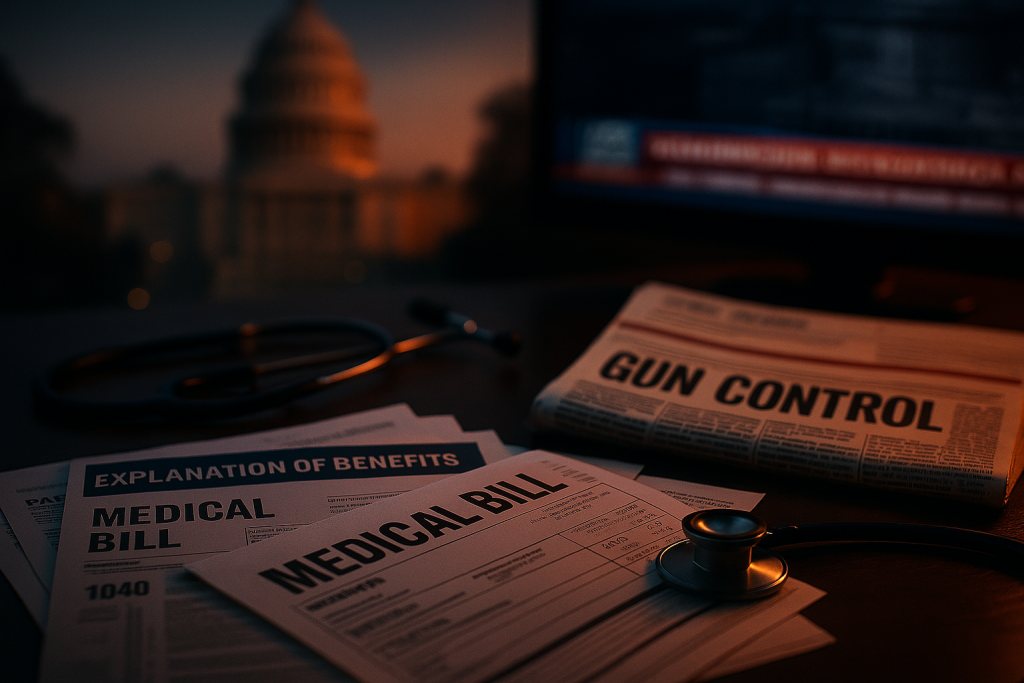

You can’t get an MRI without a six-week wait, your insurer denies the medication your doctor prescribed, and the bill for your “free annual checkup” shows up three weeks later for $487.63 — but sure, let’s talk about banning rifles again.
That’s modern politics in America: when the system’s bleeding out, the government argues about the bandages. Gun control is the perfect distraction — cheap, emotional, and endlessly reusable. It costs nothing to propose, polarizes the public on cue, and lets politicians look like they’re “doing something” while the healthcare system quietly collapses under the weight of its own insanity.
Somewhere between the rise of $900 ER co-pays and $2,200 “bronze tier” plans that cover basically nothing, America quietly accepted that healthcare would be the most confusing, non-transparent, financially punishing system in modern life.
Health insurance today isn’t a safety net — it’s a second mortgage with paperwork. Families are paying premiums that rival rent, vehicles now cost what houses used to, utilities have doubled, and somehow the one industry meant to keep people alive keeps inventing new ways to send them into debt.
Transparency vs. Reality in Healthcare Pricing
In theory, patients should be able to see exactly what their care will cost before they walk into a clinic or hospital. In practice, those numbers remain buried in complexity, technical files, and fine print that make true price comparison nearly impossible.
What the current rules aim to do
- Require hospitals to post consumer-friendly prices for 300+ “shoppable” services and provide a machine-readable file of all negotiated rates.
- Require health plans to publish negotiated rates, out-of-network payments, and provide tools showing estimated out-of-pocket costs before care.
- Push, through the Feb 25, 2025 order, toward actual prices (not estimates), standardized formats, and stronger enforcement.
Why many offices still can’t “just tell you” the cost
- Independent practices aren’t the primary target of federal transparency enforcement; hospitals and insurers are.
- Front desks rely on insurer portals showing deductibles, copays, and coinsurance—often only as estimates.
- Final amounts change after insurer adjudication, so many offices won’t guarantee prices in advance.
Price Transparency EO (Feb 25, 2025): Good Policy — Poorly Enforced
The White House Executive Order on Healthcare Price Transparency directs agencies to require real, usable prices, standardize formats, and tighten enforcement.
- Mandates disclosure of actual prices instead of vague “estimates.”
- Pushes for standardized, comparable data across hospitals and plans.
- Calls for stronger compliance and consistent enforcement.
The problem: Implementation lags, enforcement is inconsistent, and many posted files remain technically compliant but practically useless—opaque “machine-readable” data dumps instead of clear, human-readable prices patients can actually use. In short: great policy, weak follow-through.
Bottom line
Patients technically have a right to transparent pricing, but until compliance and enforcement catch up, most offices can still provide only best-effort estimates—not guarantees—before a visit.
Source: White House, Executive Order on Healthcare Price Transparency (Feb 25, 2025) .
No one in government has solved it. Hell, most of them don’t even understand it. Legislators who can’t define “deductible” are busy holding press conferences about “gun violence epidemics,” because that’s easier to sell than explaining how billing codes and private-equity hospital mergers gutted American medicine.
Meanwhile, the average citizen — rich, poor, or somewhere gasping in the middle — has adapted to it. Frustration has become the default setting. You call your insurer, sit on hold for 47 minutes, get transferred four times, and end up thanking the rep for waiving one of the mystery fees you never agreed to in the first place. Then you hang up and shrug: “That’s just how it is.”
That’s the part nobody wants to admit: the system doesn’t even need to improve; it just needs you numb enough to stop fighting. And it worked. Americans who would never tolerate government censorship will calmly pay $1,800 a month for the privilege of still getting denied coverage for a prescription their doctor ordered.
Because that’s what the machine counts on — exhaustion. A population that’s too tired to fight will accept anything, even failure disguised as compassion. And while you’re trying to figure out why your health plan costs more than your house, Congress is out front performing another round of televised virtue-signaling about “gun safety.”
It’s easier to chase headlines than to untangle a healthcare system designed like a booby trap. Easier to push the anti-gun narrative than to explain why the average person’s medical deductible has a deductible.
Gun control is emotional theater; healthcare is unscripted horror. And deep down, everyone knows it — the only difference is that one gets applause, and the other gets automated billing.
The Great Political Bait-and-Switch
Politicians know something most psychologists learned decades ago: when people feel powerless in one area, they’ll latch onto outrage in another. It’s textbook distraction — redirecting collective anxiety toward a simpler, more dramatic villain.
Healthcare is complex, messy, and humiliating. It’s endless paperwork, confusing jargon, and surprise bills that feel like financial jump scares. You can’t fit that chaos into a 15-second press clip. But “gun violence”? That’s a headline. It’s visual, emotional, and guaranteed to divide the public neatly into teams.
It’s not that gun control is their solution — it’s their substitute. When they can’t fix what actually affects everyone, they turn to what’s loud, visual, and politically useful. That’s how distraction works: it trades complexity for clarity, and it works every time because people crave something simple to blame.
Think about it: every American — conservative, liberal, or blissfully apolitical — has felt the same helplessness dealing with the healthcare system. Everyone’s had that moment on the phone with insurance, eyes glazed over, repeating, “Can I just talk to a human?” But instead of facing that universal dysfunction, politicians reframe the conversation into a moral showdown about guns, race, or identity — anything but accountability.
It’s the same psychological mechanism that magicians use: misdirection. You never see what the other hand’s doing because you’re too busy watching the shiny object. The press conference. The slogan. The photo op. The “emergency legislation.”
While everyone’s arguing over AR-15s, the medical-industrial complex quietly absorbs another $400 billion in administrative overhead. While senators grandstand about “saving lives,” pharmaceutical mergers keep inflating drug prices by another 20%. And while social media users scream at each other about “gun deaths,” half the country is skipping basic healthcare visits because they can’t afford the deductible.
The gun debate is the pressure valve — it releases frustration without ever addressing its source. It’s cathartic outrage. You get to feel morally superior for a few minutes, but nothing actually changes. And that’s the genius of it: politicians have turned distraction into governance.
They don’t need to fix the healthcare crisis. They just need to make you forget it long enough to re-elect them.
The Psychology of Learned Helplessness
The healthcare system isn’t just broken — it’s conditioning you. It’s designed to grind you down until compliance feels like relief. Every phone tree, every “please hold for the next available representative,” every delayed referral — it all trains you to lower your expectations until frustration becomes normal.
Trying to get medical care in America feels like a behavioral experiment gone off the rails. You start out hopeful, thinking, “Okay, I just need to find a provider in-network.” Twenty minutes later, you’re three websites deep, the plan directory is outdated, and half the listed doctors retired in 2019. You finally find one still breathing, make an appointment, and get told the earliest available slot is six weeks out.
Then the real fun begins. You show up on time, fill out a clipboard thick enough to qualify as a college thesis, and wait in a corral with 12 other miserable people staring at posters about “preventative wellness” they can’t afford. You finally see the doctor — for nine minutes. They half-listen, order tests, and you’re back to the front desk paying a “specialist co-pay” you didn’t even know applied.
Two weeks later, a bill arrives for something called “Level 4 Established Patient Visit – Extended Complexity.” You don’t know what that means. The Explanation of Benefits looks like it was written by a team of defense contractors. You call your insurer, sit on hold for 47 minutes, get transferred to three different people — and somehow, you end up apologizing for being frustrated.
That’s not inefficiency. That’s conditioning. It’s how you teach a population to stop fighting back.
Psychologists call it learned helplessness — when repeated failure convinces people that resistance is pointless. You stop expecting competence, stop demanding reform, and eventually start defending the very system that’s abusing you. You joke about it. You meme it. You tell your friends, “Yeah, it’s awful, but that’s just how it is.”
And once that mindset sets in, everything else becomes easy for the state to sell. Gun restrictions? Sure, if it “keeps us safe.” Digital currency? Okay, if it’s “more convenient.” Centralized medical databases? Why not — it’s “efficient.”
That’s the psychology of control: wear people down until obedience feels like the only logical response.
The healthcare system didn’t just fail Americans — it trained them. It’s a masterclass in bureaucratic conditioning, turning citizens into patients, patients into data, and outrage into apathy.
We stopped demanding results. We started grading on effort. And politicians figured out they don’t have to fix anything — they just have to look busy while the nation waits on hold.
If Mechanics Billed Like Hospitals
Most people would be furious if a tire shop couldn’t tell them the price of new tires, the cost of the initial inspection, or the total out-the-door estimate before any work starts. Yet that’s exactly how healthcare often operates: “estimates,” hidden fees, and totals you only discover weeks later.
What we expect from auto shops
- Upfront quote: tires, parts, labor, taxes, disposal fees.
- Clear options by brand/price; you choose.
- Written estimate; approval before work.
What we get from healthcare too often
- “Estimate only”—no guaranteed out-of-pocket.
- Surprise facility fees and post-visit coding changes.
- Final price revealed after insurer adjudication.
Bottom line: If citizens and officials wouldn’t tolerate mystery pricing for new tires, they shouldn’t accept it for medical care. Price transparency isn’t a perk—it’s the baseline.
Distraction as Governance: How the System Thrives on Chaos
If you’ve ever wondered why nothing ever gets fixed — healthcare, infrastructure, the border, pick your poison — it’s because dysfunction isn’t political failure anymore. It’s political fuel.
Distraction is the operating system of modern government. Every crisis buys time for the last one to fade from memory. Every headline drowns the last scandal in noise. Every promise of “reform” resets the outrage clock just long enough for voters to move on.
Gun control debates are the perfect example. They’re emotionally explosive, endlessly renewable, and completely unsolvable — which makes them priceless to politicians. You can run on them, fundraise on them, posture about them, and never actually resolve them. Meanwhile, the real crises — the ones that require boring, unglamorous problem-solving — stay conveniently out of sight.
Healthcare is the opposite: too complicated to summarize, too depressing to fix, and too universal to spin. It affects everyone, rich or poor, red or blue. That makes it politically radioactive. So instead of solving it, politicians do what they do best — outsource the blame.
They tell you it’s the insurance companies. Or Big Pharma. Or capitalism. Or socialism. Anyone but the people writing the laws that keep the system this way.
It’s a game of strategic chaos — the bureaucracy wins by keeping you overwhelmed. Your attention span becomes their currency. You’ll rage about guns on Twitter while your insurance premium quietly goes up another $300 a month. You’ll vote for the candidate who “cares about working families” while they cash checks from hospital lobbyists and union-backed healthcare conglomerates.
It’s not incompetence; it’s symbiosis. The illusion of division keeps the public fighting over symptoms instead of the disease. And that’s how modern governance survives — not through solutions, but through exhaustion. The art isn’t fixing chaos; it’s managing it.
And it’s not limited to healthcare. The same playbook runs everywhere: inflation, energy, housing, education. Keep the public anxious, then sell the anxiety back to them as policy. It’s governance by exhaustion — the art of making people too tired to resist.
Once the population hits that threshold — that dull, worn-out acceptance where people stop expecting improvement — everything else becomes easy. You can regulate speech, track transactions, ration medication, and the public will just sigh and call it “the new normal.”
That’s not democracy. That’s behavioral management. The most effective governments on earth don’t conquer people; they confuse them — one distraction, one headline, one illusion of control at a time.
The Real Epidemic: Bureaucratic Dependence
The real sickness in America isn’t guns, division, or even greed — it’s dependence. Not the kind you treat with rehab or therapy, but the slow, creeping addiction to bureaucracy.
We’ve been conditioned to believe the system will save us — even as it traps us in cycles of dependence disguised as convenience. We curse it, mock it, meme it, and then line back up for our next renewal, refill, or rebate. The IRS, the insurance portal, the federal benefits site — all of it runs on the same emotional algorithm: frustration followed by relief, followed by compliance.
It’s the same cycle every addict lives through: abuse, withdrawal, relapse. The government breaks something, promises to fix it, then creates a new agency to manage the damage. And every time, we fall for it — because the alternative, self-reliance, is harder.
Modern society doesn’t reward independence; it penalizes it. Try paying cash at a hospital. Try building your own home without a stack of permits. Try defending your own property without a lawyer, an app, and a court date. Everything about the modern system teaches you to surrender authority for “efficiency.”
And like any dependency, it grows. You don’t notice the loss of freedom because it’s rationed slowly — one digital ID, one “safety” measure, one executive order at a time. You don’t even call it control anymore. You call it “policy.”
The result? A society of people who can’t imagine life without being managed. A population that confuses freedom with stability and competence with convenience.
Meanwhile, the same government that can’t manage potholes pretends it can manage your health, your speech, your defense, your kids’ education, and your digital privacy — all while running a trillion-dollar deficit and a customer service line that hasn’t worked since dial-up.
That’s the real epidemic: a nation so used to failure that it starts to feel safe inside it.
Freedom isn’t lost through revolutions anymore. It’s lost through paperwork, portals, and polite compliance. You don’t have to ban liberty — you just have to convince people it’s impractical.
That’s how bureaucracies win. Not through force, but through fatigue. Not by outlawing rebellion, but by making rebellion feel like bad manners.
Dependence isn’t just economic — it’s emotional. The longer people tolerate dysfunction, the more they mistake endurance for strength.
The Cure Isn’t Political — It’s Psychological
You can’t vote your way out of a mindset. That’s the part America keeps missing. The problem isn’t just Washington — it’s the psychological conditioning that keeps us showing up to a broken system with the enthusiasm of a hostage who’s developed Stockholm Syndrome.
Politicians thrive on that cycle. They don’t fear rebellion; they fear awareness — the kind that can’t be spun into a campaign ad. Because once people realize they’ve been trained to obey rather than think, the whole structure starts to wobble.
The cure isn’t a new party or another movement promising “real change.” It’s the rediscovery of personal agency — that ancient, endangered belief that you are responsible for your own well-being, your own safety, and your own damn sanity.
That means not waiting for some bureaucrat to fix healthcare when the same people can’t even fix the phone system.
The government passed the Truth in Caller ID Act of 2009 (signed December 22, 2010) to outlaw caller-ID spoofing used for fraud. More than fifteen years later, Americans still receive billions of robocalls each month, many impersonating agencies like the “IRS” or “Medicare.” In April 2025, industry tracking indexes recorded nearly 5 billion robocalls — about 18.9 billion in the first four months of the year, an ≈11.9% jump over 2024. According to the FTC, consumers lost over $12.5 billion to fraud in 2024 — a record high. Despite the FCC issuing hundreds of millions in fines (including $208 million since 2015), actual collections have totaled only a few thousand dollars. It’s the perfect symbol of bureaucratic futility — a law written for headlines, enforced for appearances, and quietly forgotten once the cameras turn off. The same government that couldn’t stop spoofed calls wants you to trust it with your healthcare.
It means questioning every “update,” “reform,” and “safety measure” that promises comfort in exchange for control. It means remembering that the moment government becomes your caretaker, it quietly becomes your owner.
The first step in curing dependency is psychological: stop romanticizing the abuser. Stop pretending the same government that can’t even build a functional, well-designed, and easy-to-navigate website will somehow deliver utopia through regulation.
Freedom isn’t a program. It’s a reflex — and right now, that reflex is on life support. Bureaucracy doesn’t confiscate liberty overnight; it dulls it, one “policy improvement” at a time.
But the human brain — and the American spirit — have an incredible feature called neuroplasticity. It means we can rewire ourselves. We can reject learned helplessness. We can remember how to say no.
That’s the rebellion the system actually fears — not armed, but awake. Not angry, but alert. Not waiting on hold, but hanging up the damn phone.
Final Thought
Politicians never feared citizens with guns; they feared citizens who pay attention. Guns aren’t the problem — they’re the diversion.
Every headline, every “emergency” debate, keeps the public fixated on symbols of control while the real crises — healthcare, debt, corruption, and incompetence — quietly drain the country dry. The second people look past the outrage and see the pattern, the whole production unravels.
Max Tactical Firearms, LLC is a licensed FFL and SOT dealer offering a broad range of products for beginners to expert firearms enthusiasts. With an extensive online store featuring over 40,000+ products from more than 500+ brands, you’ll find everything from firearms and archery to hunting, camping, survival gear, optics, and more. Max Tactical Firearms, LLC also specializes in NFA items, including suppressors, SBRs, and other Class III firearms, and they ship regulated orders to FFLs nationwide while also accepting transfers. Additionally, they offer custom heirloom-grade display cases and handcrafted leather goods built to last.
Read the full article here
